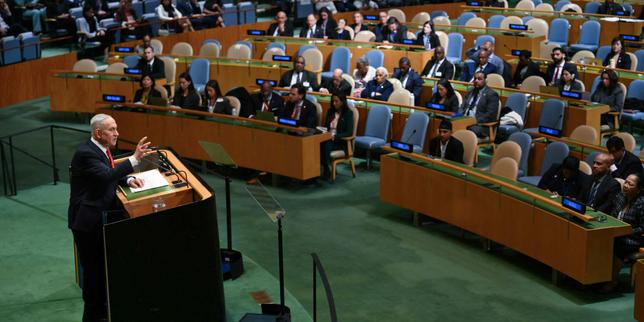
When Israeli Prime Minister Benjamin Netanyahu stepped up to the podium at the United Nations General Assembly, the assembly hall emptied in a wave of orchestrated diplomatic walkouts. Those who stayed heard an address built on absolute defiance. He looked out at the chamber and delivered a line designed to anchor international headlines for weeks: accusing Israel of genocide in Gaza is the biggest lie of the century. It was a rhetorical strike meant to reframe an entire global conversation, shifting the focus from the catastrophic urban destruction of the enclave to an existential narrative of national survival.
To understand the weight of this moment, one must look past the theatricality of the UN floor and examine the mechanics of modern international law and information warfare. For months, legal teams at the International Court of Justice and human rights organizations worldwide have documented the staggering civilian death toll, the collapse of medical infrastructure, and the widespread displacement inside the Gaza Strip. Legal frameworks defining genocide require proving specific intent to destroy a national, ethnic, racial, or religious group. Critics of Israeli military strategy argue that the sheer scale of devastation and deprivation fulfills that burden of proof.
Netanyahu’s counter-offensive at the UN relied on inverting that very legal standard. By asserting that Israel did not commit genocide, but rather prevented it, he leaned heavily on the memory of the October 7, 2023 attacks, framing the subsequent military campaign as an unavoidable shield against an adversary explicitly sworn to Israel's destruction. He pointed to logistical efforts regarding aid distribution and vaccination campaigns, arguing that a state bent on systematic extermination would not facilitate humanitarian entry points, however contested their efficacy might be. This argument serves a dual purpose: it aims to neutralize formal legal indictments in international courts while shoring up domestic political survival by casting foreign condemnation as a manifestation of historical persecution.
The diplomatic fallout was immediate and predictable. Western allies find themselves caught in an increasingly untenable middle ground, trying to balance traditional strategic alliances with domestic populations and international bodies demanding accountability for civilian casualties. Meanwhile, regional adversaries view the speech not as a defense, but as an escalation of denial, hardening positions across multiple active fronts from Lebanon to Iran.
As the rhetoric intensifies on both sides, the core humanitarian catastrophe risks getting buried beneath dueling definitions of international law. The battle is no longer fought solely with artillery and air strikes, but through the bitter struggle to define historical truth for future generations.
Netanyahu Calls Gaza Genocide Accusations 'Biggest Lie of the Century' at UN
This video captures the moment Israeli Prime Minister Benjamin Netanyahu addressed the United Nations General Assembly and dismissed allegations of genocide in Gaza.