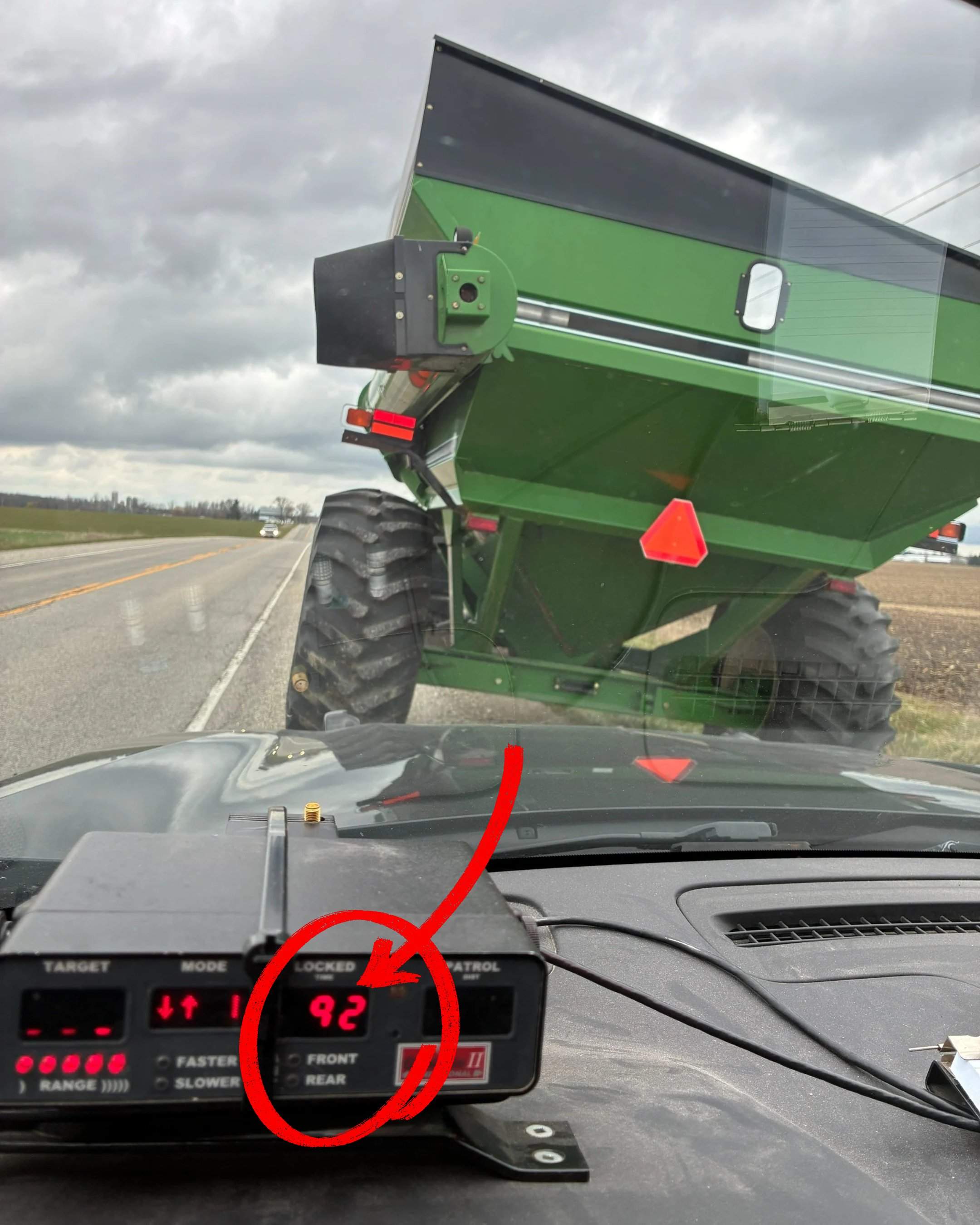
When Ontario Provincial Police clocked a farm truck traveling at 92 km/h in a posted 40 km/h zone, the incident looked on the surface like a routine traffic violation. It was not. Operating a heavy agricultural vehicle at more than double the legal speed limit in a low-speed zone exposes a dangerous collision between rural economic pressures, aging roadway infrastructure, and misunderstood traffic laws. Under Ontario's Highway Traffic Act, exceeding the speed limit by 50 km/h or more triggers an immediate stunt driving charge, resulting in a 30-day license suspension, a 14-day vehicle impoundment, and severe financial penalties regardless of whether the vehicle carries commercial or farm plates.
Most local news reports treat high-speed farm vehicle infractions as isolated anomalies. They publish the police press release, note the fine, and move on to the next fender bender. That shallow coverage misses the systemic forces pushing agricultural operators to treat country roads and small-town main streets like open highways. If you enjoyed this piece, you should look at: this related article.
The Physics of Heavy Machinery on Low-Speed Roads
Speed limits in 40 km/h zones exist for a specific reason. These corridors almost always run through school zones, dense residential stretches, or rural village centers where pedestrian traffic intersects with narrow shoulders and blind driveways.
Physics does not care about agricultural exemptions. A standard passenger sedan weighs roughly 1,500 kilograms. A fully loaded farm truck—whether a heavy-duty pickup hauling a gooseneck livestock trailer or a tandem-axle grain truck—routinely tips the scales between 5,000 and 20,000 kilograms. Kinetic energy increases with the square of velocity. Doubling a vehicle's speed quadruples the energy required to bring it to a halt. For another perspective on this event, refer to the recent update from The New York Times.
When a heavy farm truck moves at 92 km/h through a 40 km/h zone, its stopping distance expands exponentially. Air brakes or heavy-duty hydraulic systems require measurable fractions of a second just to engage, and tire traction on rural asphalt—often degraded by frost heaves, gravel runoff, and heavy seasonal wear—cannot arrest that momentum in time to avoid an unexpected obstacle. A child stepping off a curb or a tractor pulling out of a concession road leaves zero margin for error.
Why Agricultural Drivers Push the Limit
To understand why an operator would risk a livelihood by driving 52 km/h over the limit, you have to look at the clock governing modern agriculture. Farming is an industry dictated by narrow weather windows and tight supply chain schedules. When rain threatens a harvest or a livestock delivery window is closing at a processing facility, every minute on the asphalt feels like lost revenue.
Rural geography compounds this impatience. Drivers spend miles cruising along open concession roads posted at 80 km/h, where long straightaways and sparse traffic dull a driver's perception of speed. As those rural highways funnel directly into small towns, the speed limit drops abruptly from 80 km/h to 50 km/h, and then down to 40 km/h near schools or community centers.
In psychology, this phenomenon is known as speed adaptation. After sustained travel at high speeds, slowing down to 40 km/h feels like crawling. Without conscious discipline, an operator maintains highway momentum right past the transition signs, turning a rural thoroughfare into a high-velocity hazard before they even register the change in scenery.
The Myth of the Farm Plate Exemption
A persistent misconception in rural Ontario is that agricultural vehicles operate under a looser set of traffic enforcement rules. They do not. While Ontario's Highway Traffic Act provides specific allowances for slow-moving farm tractors, combines, and wagons—such as exemptions from certain commercial vehicle inspection requirements or allowances for oversized widths during daylight hours—those provisions apply to equipment moving below normal traffic speeds.
Farm-plated trucks, denoted by the distinct "FARM" lettering on their license plates, enjoy reduced registration fees to support agricultural commerce. That discount does not buy immunity from speed enforcement or stunt driving legislation.
When the Ontario Provincial Police pull over a farm truck at 92 km/h in a 40 km/h zone, the officer applies the exact same statutory threshold used for a sports car on the Queen Elizabeth Way. Under Section 172 of the Highway Traffic Act, driving at 50 km/h or more over the posted limit—or 40 km/h or more over in zones posted under 80 km/h—constitutes stunt driving. Notably, because the zone was 40 km/h, the threshold for stunt driving actually kicked in at just 80 km/h. At 92 km/h, the driver was well past the legal line.
The Real Cost of Stunt Driving in Agriculture
For a typical commuter, a 14-day vehicle impoundment and a 30-day administrative driver's license suspension are painful inconveniences. For a farm operation, those immediate roadside penalties can cripple an entire season.
Consider a hypothetical scenario during peak autumn harvest. If a primary grain truck is impounded at the roadside for two weeks, the farm loses vital hauling capacity precisely when crops must move from the field to the elevator. Towing and storage fees for heavy commercial or agricultural vehicles run significantly higher than standard passenger car rates, easily climbing into thousands of dollars before the truck even leaves the impound lot.
Then comes the court date. Upon conviction, stunt driving carries a minimum fine of $2,000 and a maximum of $10,000, alongside six demerit points, a mandatory driver improvement course, and a further license suspension of one to three years for a first offense.
The sharpest financial blow arrives when the farm's commercial auto insurance policy comes up for renewal. Insurers treat stunt driving convictions on par with impaired driving. An agricultural operation with a high-risk driver on its roster faces astronomical premium spikes or outright policy cancellation, forcing the business into the facility insurance market where coverage costs can triple overnight.
Infrastructure Design vs. Enforcement
Law enforcement patrols can catch individual offenders, but enforcement alone cannot fix a structural design flaw. Across Ontario, hundreds of rural highways act as the main arteries for small communities. Transportation planners historically prioritized regional vehicle throughput over local pedestrian safety, resulting in wide, flat asphalt lanes that visually encourage highway speeds right through town centers.
Drivers read the road, not just the signs. If a 40 km/h zone looks identical in width and sightlines to an 80 km/h rural highway, drivers will naturally gravitate toward the higher speed.
Some municipalities have begun fighting back with physical traffic-calming measures. Curb extensions, radar feedback signs, raised crosswalks, and chicanes force heavy vehicles to physically decelerate before entering sensitive zones. Yet these upgrades face fierce resistance in agricultural regions. Farm organizations rightly point out that poorly designed roundabouts or overly narrow chicanes can obstruct wide combines and multi-axle trailers, creating new bottlenecks and property damage risks.
Balancing the logistical needs of oversized farm equipment with the safety of small-town residents requires smarter engineering. Graduated speed reductions—stepping traffic down from 80 km/h to 60 km/h before hitting a 40 km/h zone—give heavy trucks adequate distance to shed momentum without burning out brake pads. High-visibility overhead flashing beacons tied to school hours alert distracted drivers far more effectively than a standard metal sign obscured by overgrown roadside brush.
The Cultural Blind Spot in Rural Road Safety
There is an uncomfortable truth that rural communities rarely confront openly. Road safety campaigns in Ontario overwhelmingly target urban commuters, distracted teenagers, and highway speeders. Rural drivers often view themselves as more experienced and capable behind the wheel due to the sheer volume of miles they log in harsh weather and on unpaved roads.
That confidence can curdle into complacency. Familiar roads breed dangerous habits. When you have driven the same ten-kilometer stretch between the home farm and the feed mill five hundred times without incident, vigilance drops. You stop scanning driveways. You push the throttle a little harder to beat the sunset.
Provincial collision statistics consistently demonstrate that rural roads carry a disproportionately high fatality rate compared to urban streets. Higher average speeds, undivided two-lane highways, roadside ditches, and longer emergency response times turn minor lapses in judgment into catastrophic crashes. When heavy agricultural trucks enter that equation at highway speeds inside a 40 km/h zone, the margin for human error vanishes completely.
Accountability Behind the Wheel
The OPP's decision to publicize a farm truck caught doing 92 km/h in a 40 km/h zone serves as a deliberate warning shot to the agricultural sector. Police detachments across rural Ontario are increasingly deploying automated license plate readers and targeted speed enforcement in village corridors where residents have complained about heavy truck traffic.
Farm owners and fleet managers must treat road safety with the same rigor they apply to grain bin safety or pesticide handling. Setting strict internal policies against speeding, utilizing GPS telematics to monitor fleet speeds, and building realistic transit buffers into daily schedules are not bureaucratic hurdles. They are basic risk management practices that protect workers, neighbors, and the financial survival of the farm itself.
No harvest deadline, livestock delivery, or equipment transfer is worth a human life or a destroyed livelihood. Slowing down when the speed limit drops is not an inconvenience—it is the fundamental price of sharing public roads.