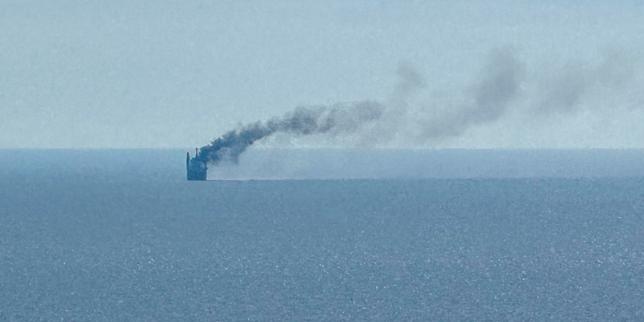
The war in Ukraine has expanded into the Sea of Azov, where a relentless Ukrainian drone campaign has choked Russian commercial shipping and grain logistics, creating a volatile new maritime front. This sudden escalation occurs alongside bruising Russian aerial bombardments targeting Kyiv's defense factories and grinding attritional fighting in the east. While public attention remains fixed on static trench lines, the true mechanics of the conflict have shifted toward systematic economic sabotage and autonomous interdiction. The strategic friction points of mid-2026 are no longer just about holding ground, but about destroying the adversary's capability to fund and sustain the fight.
For the past several years, the Sea of Azov operated as a secure inland lake for the Russian Federation. It served as a vital sanctuary for moving nearly a quarter of the country's agricultural exports, entirely insulated from the conventional naval threats that forced the Russian Black Sea Fleet to abandon its historic berths in occupied Crimea. That insulation dissolved entirely over the second week of July.
Ukrainian drone forces deployed massed swarms of uncrewed surface vessels and long-range aerial strike platforms directly into the shipping lanes. In a concentrated nine-day offensive, Ukrainian forces struck 116 Russian vessels, including five massive oil tankers, five dry cargo carriers, and a crucial fleet tugboat. The immediate tactical reality is stark. Commercial vessels are trapped. Moving grain out of the Don River or through the Kerch Strait has become an exercise in extreme vulnerability, forcing global markets to price in a permanent state of maritime insecurity in eastern Europe.
The Suffocation of Russia's Maritime Grain Corridor
The mechanics of this naval blockade are distinctly asymmetrical. Ukraine possesses no major surface warships in the region, yet it has managed to impose a functional denial zone across hundreds of square miles of water. According to industry operators speaking under conditions of anonymity, multiple grain ships caught fire following strikes on July 13 and July 14. Ships are anchored in exposed clusters, waiting for security clearances that never materialize, transforming them into stationary targets for low-cost, explosive-laden drones.
The diplomatic fallout was instantaneous. Russian Foreign Minister Sergei Lavrov publicly categorized the campaign as an act of maritime terrorism that goes beyond traditional piracy, arguing that the strikes serve no direct military purpose other than naked economic intimidation. Moscow's rhetorical shift underscores a deeper anxiety. The Kremlin relies heavily on agricultural revenues to stabilize its domestic economy amid biting international sanctions. If the Azov-Don channel remains restricted, the Russian Ministry of Agriculture will be forced to execute an expensive, logistically complex rerouting of grain flows toward deep-water terminals in the Black Sea or distant ports in the Baltic Sea.
Kyiv defends the campaign through a doctrine of total economic interdiction. Military spokesmen maintain that every vessel targeted directly contributes to the Kremlin’s broader logistics network, whether by moving dual-use fuel supplies or generating hard currency used to finance weapons procurement. The targeting of infrastructure is a reciprocal reality. As Ukrainian drones paralyze the Sea of Azov, Russian forces have systematically pounded the port infrastructure of Odesa, threatening to slice Ukraine's own Black Sea grain capacity by an estimated one-third. The resulting picture is a double-sided blockade, an economic strangulation strategy where civilian trade assets are fully integrated into the front line.
The Carnage of Attrition by the Numbers
Away from the coast, the land campaign has yielded a staggering human toll that challenges historical precedents of modern warfare. Independent defense intelligence assessments indicate that Russian military forces have sustained roughly 1.4 million total battlefield casualties since the invasion began in February 2022, a figure that includes an estimated 450,000 fatalities. To put these numbers in perspective, the Kremlin has lost more soldiers in Ukraine than the Soviet Union did in all its post-World War II interventions combined.
The first half of 2026 witnessed an intensification of this human deficit. The casualty ratio shifted heavily against Russian forces, reaching an estimated eight-to-one imbalance in specific sectors of the eastern front. This spike is directly tied to the proliferation of autonomous reconnaissance and strike systems. Ukrainian forces have deployed high-density drone nets across active combat zones, executing automated artillery correction and precision air interdiction against exposed Russian infantry formations.
Estimated Russian Combat Losses (Cumulative to July 2026)
+-----------------------------------+--------------------+
| Asset Category                    | Approximate Losses |
+-----------------------------------+--------------------+
| Personnel (Casualties / Deaths)   | 1,421,800+         |
| Main Battle Tanks                 | 12,130+            |
| Armored Fighting Vehicles         | 24,930+            |
| Artillery Systems                 | 45,900+            |
| Operational-Tactical UAVs         | 407,200+           |
+-----------------------------------+--------------------+
This math has produced tangible shifts on the map. During the spring of 2026, the Russian military suffered a net loss of approximately 400 square kilometers of territory, marking the first sustained contraction of their occupied footprint since late 2024. The loss of territorial initiative forced significant political concessions inside Russia. The scaled-back nature of the annual military parades in May highlighted deep security concerns regarding Ukraine's expanded strike range, which now routinely reaches targets thousands of kilometers beyond the border.
Factories Under Fire in Kyiv and Odessa
The response from the Russian General Staff has been a fierce, vertical escalation. Unable to secure decisive breakthroughs on the ground, Russian forces have unleashed a massive wave of precision ballistic and cruise missile strikes against Ukraine’s domestic military-industrial complex. On the morning of July 14, coordinated salvos targeted Kyiv and Odessa, filling the capital's skyline with plumes of dense industrial smoke.
The targets were selected to disrupt Ukraine's long-range weapon manufacturing pipelines. Among the primary installations hit was the Radioizmeritel plant in Kyiv, a major facility dedicated to producing the guidance components and advanced electronic assemblies used in Ukraine's home-grown Neptune-MD and Grom-2 missile systems. Simultaneously, Russian missiles struck the Armo Tech factory, a sprawling industrial site responsible for assembling explosive warheads and processing high-grade military propellants.
These strikes reveal a calculated effort to decapitate Ukraine's defense independence. By targeting the production lines of the very weapons that are currently terrorizing Russian logistics hubs, the Kremlin hopes to exhaust Ukraine's limited stock of Western-supplied air defense interceptors, such as the Patriot PAC-3 system. If Ukraine is forced to choose between protecting its front-line units or shielding its domestic factories, its strategic depth will inevitably erode.
The Friction in Western Training Camps
While Ukraine constructs its defense strategy around automated systems and asymmetric strikes, the preparation of its conventional ground forces remains dependent on foreign partnerships. This arrangement is under severe strain. Deep in the pine forests of western Poland, at Camp Jomsborg, an international coalition of instructors from Australia, New Zealand, the United States, and Baltic nations is working to train the next generation of Ukrainian platoon leaders.
The training is grueling. Instructors subject war-weary Ukrainian veterans to intense, eighteen-hour days designed to simulate the chaotic, drone-saturated environments of the eastern front. Yet, the instructors themselves are voicing growing frustration over a critical bottleneck: equipment shortages.
Members of the Australian Defence Force deployed to the camp have pointed out a baffling systemic failure. While frontline trainers are forced to ration basic equipment and vehicles during high-intensity simulated exercises, vast quantities of retired, excess, and older-generation military stock remain sitting in storage depots back in their home countries. The administrative inertia of donor governments prevents these vital materials from reaching the hands of the soldiers who need them most. Veterans are returning to the battlefield with world-class tactical knowledge but insufficient hardware to implement it, exposing a persistent gap between Western political rhetoric and concrete logistics.
The Dawn of Autonomous Interdiction
The current state of the conflict proves that the traditional concepts of battlefield victory have been thoroughly rewritten. The integration of semi-autonomous drones has transformed the airspace over Ukraine and the waters of the Sea of Azov into a highly lethal, transparent environment where large-scale troop movements are easily spotted and instantly targeted. This technological evolution has outpaced the doctrine of both NATO and the Russian military, turning the war into a test of industrial endurance and software adaptation.
Ukraine’s ability to sustain its maritime interdiction campaign will ultimately determine whether it can force Russia to negotiate from a position of weakness. However, this strategy relies on an uninterrupted supply of raw materials, microchips, and propellant components, all of which are currently under threat from Russia's renewed missile campaign against domestic factories. The battle is no longer a simple contest of territorial control, but a highly complex, interconnected struggle where a drone strike in the Sea of Azov, a manufacturing delay in a Kyiv electronics plant, and an administrative bottleneck in an Australian supply depot are all tied to the same strategic outcome.