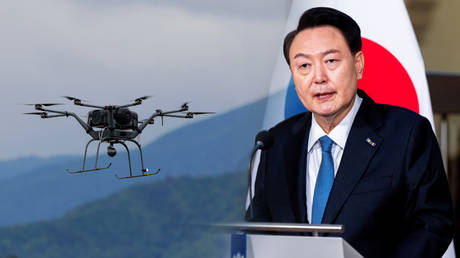
The Seoul Central District Court delivered a staggering 30-year prison sentence to former South Korean President Yoon Suk Yeol on Friday. The judicial system ruled that Yoon orchestrated a highly classified, illegal military drone operation over Pyongyang in October 2024. The objective was not national defense. Instead, the court found that Yoon deliberately tried to incite an armed provocation from North Korea to engineer a security panic, manufacturing the exact political crisis he needed to justify his disastrous declaration of martial law on December 3, 2024.
This latest sentence lands as a crushing blow to the jailed former leader, who was already handed a life sentence in February for leading an insurrection. The specialized judicial probe proved that the state apparatus was weaponized for political survival rather than territorial preservation. For decades, the division along the 38th parallel has been handled with calculated deterrence. Yoon broke that convention, treating the most volatile border in the world as a personal chess piece.
The Anatomy of an Engineered Crisis
The judicial ruling systematically dismantled the official narrative that the drone incursions were a standard tactical response to North Korea's provocative trash-balloon campaigns. Special prosecutors uncovered a paper trail and operational logs showing a deliberate psychological warfare scheme designed to force Kim Jong Un’s regime into a kinetic military reaction.
Yoon did not act alone. The court handed down an equally severe 30-year sentence to former Defense Minister Kim Yong-hyun, while Yeo In-hyung, the former chief of the Defense Counterintelligence Command, received 15 years. These men chose to use state military assets to fabricate wartime conditions.
When military drones slipped across the border toward Pyongyang in late 2024 to drop propaganda leaflets, the public believed it was an escalation originating entirely from the North or from rogue activist groups. Behind closed doors, the Drone Operations Command—whose former chief, Kim Yong-dae, received a suspended three-year sentence on Friday—was acting under direct presidential orders. The court noted that by flying these assets deep into hostile territory, the administration exposed highly classified South Korean military capabilities, ultimately compromising state security when a drone crashed near the North Korean capital.
The Mechanic of the Pretext
To understand why a sitting democratic president would risk a hot war, one must examine the domestic political corner Yoon had been backed into by late 2024. Facing structural legislative gridlock, a hostile parliament, and mounting corruption investigations involving his wife, the administration was rapidly running out of political capital.
Under the South Korean constitution, a president can declare martial law during times of war or an equivalent national security crisis. Yoon required a spark. The drone operations were designed to generate a localized border skirmish or an immediate artillery retaliation from Pyongyang. Had North Korea launched a kinetic strike in response to the drones, the declaration of martial law on December 3 would have carried the veneer of necessity.
Instead, the plan hit a major snag. Pyongyang chose a path of public fury and rhetorical escalation rather than immediate military retaliation, leaving Yoon to trigger the martial law decree without the massive border clash he had anticipated. The resulting decree lasted only a few hours before the National Assembly defied troops and barricades to vote down the measure, setting off a chain reaction that led to Yoon's impeachment, removal from power, and subsequent arrest.
Structural Fallout and the Blue House Curse
The conviction shines a harsh light on a recurring flaw within South Korea's hyper-presidential system. The concentration of executive control over the military and intelligence services frequently allows a desperate leader to bypass traditional legislative oversight.
Yoon’s defense team continues to maintain that the operations were legitimate counter-measures to North Korean aggression, warning that criminalizing executive military decisions establishes a dangerous precedent for national defense. The judiciary rejected this defense entirely, asserting that the deployment served a purely personal political agenda.
The verdict continues a historic, brutal cycle for South Korea's executive branch, where the path from the presidential palace to a prison cell remains remarkably short. Four of Yoon’s predecessors have faced imprisonment post-tenure. This current ruling, however, sets a far more dangerous historical precedent. Previous leaders were jailed for bribery, extortion, or political crackdowns. Yoon is the first in the democratic era convicted of actively trying to provoke a foreign adversary into a potential war simply to consolidate power at home.
The current administration under liberal President Lee Jae Myung faces the delicate task of repairing the damage. Earlier this year, Lee expressed formal regret over separate government drone operations discovered in January, signaling a desperate attempt to de-escalate cross-border frictions. While Pyongyang initially acknowledged the gesture, hopes for structural diplomatic stabilization remain bleak. By demonstrating that South Korea's military operations could be manufactured for domestic political games, the scandal has given North Korea a permanent rhetorical justification to maintain its maximum-readiness posture along the DMZ.


