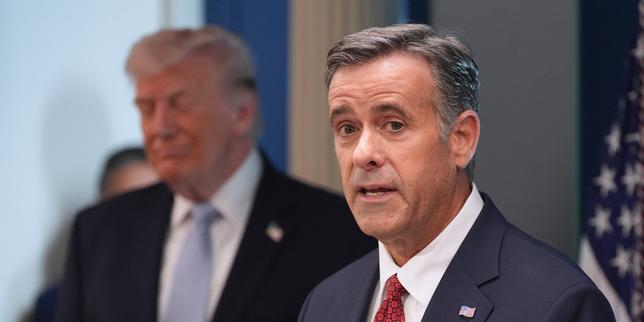
The arrival of a United States Air Force C-17 Globemaster at Moscow’s Vnukovo International Airport broke four years of visible silence between American spycraft and the Kremlin. When Central Intelligence Agency Director John Ratcliffe touched down for undisclosed meetings with Russian intelligence counterparts, the White House rushed to defuse the geopolitical panic. President Donald Trump dismissed the historic journey as "semi-routine," claiming it involved none of the pressing threat escalations or NATO boundary checks whispered about in Western intelligence corridors.
Yet history tells a sharper story. The last time a sitting CIA director made this specific pilgrimage to Moscow was November 2021, when William Burns flew into the Russian capital carrying urgent warnings days before the invasion of Ukraine. When intelligence chiefs bypass diplomatic channels and fly directly into enemy territory under the cover of military transport and temporary drone stand-downs, routine is the absolute last thing happening. Also making waves in related news: The Shadow on the Doorstep.
The Anatomy of a Backchannel Emergency
Diplomacy is loud, messy, and public. Intelligence backchannels are quiet, pragmatic, and designed to manage existential friction before it crosses into unmanageable catastrophe. Behind the administrative insistence that Ratcliffe's mission was ordinary administrative business lies a convergence of military exhaustion and economic pressure points.
Washington needed direct communication lines with Moscow not because relations are stabilizing, but because they are dangerously brittle. Over the summer, Ukrainian long-range drone campaigns reached deeper into Russian core territory than at any previous point in the conflict, crippling critical infrastructure, fuel refineries, and major logistics centers. This wave of strikes triggered the most severe internal domestic fuel crunch inside Russia since the collapse of the Soviet Union. More insights on this are explored by The New York Times.
Before Ratcliffe’s plane touched down, the White House quietly requested that Kyiv pause its strikes on Moscow, Saint Petersburg, and northern Russian regions for a three-day window. Kyiv complied, suspending operations while a high-level American delegation moved through the Russian capital. That level of operational synchronization points directly to a high-stakes negotiation framework, one where Washington is attempting to force a diplomatic breakthrough on a conflict that has defined its foreign policy failures.
The Real Leverage Points
To understand why the CIA director had to deliver messages in person rather than through secure communication lines or standard diplomatic envoys, look at the nature of modern intelligence tradecraft. Secure digital infrastructure is subject to constant monitoring, cryptographic paranoia, and intentional leaks designed for domestic political posturing. A physical meeting between spy chiefs strips away the theater.
Sergei Naryshkin, head of Russia's foreign intelligence service, hosted the American delegation for direct talks that ultimately yielded an agreement to maintain regular agency-level contacts. This decision to institutionalize backchannel communication exposes the limitations of traditional State Department mediation. When official peace talks stall completely, intelligence services are deployed as shock absorbers to test bottom lines, define red lines, and determine whether leadership on both sides is genuinely prepared to halt hostilities.
The public dismissal of the trip as mundane theater misses the structural reality of how great powers manage terminal deadlocks. Trump’s assertion that both Washington and Moscow want an end to the war highlights an urgent domestic imperative to find an off-ramp. Years of sanctions, billions in military aid, and shifting battlefield advantages have left both sides searching for mechanisms to de-escalate without appearing weak.
Beyond the Official Spin
The friction between public minimization and covert reality reveals a deeper truth about contemporary statecraft. Governments caught between domestic political promises and intractable foreign wars rely on intelligence channels to do the dirty work of reality-checking. Ratcliffe did not travel to Moscow to exchange pleasantries or discuss minor administrative protocols. He went because satellite data, economic indicators, and military assessments signaled that the trajectory of the war was approaching a dangerous inflection point.
As the smoke clears from the temporary regional pauses and the diplomatic posturing settles, the consequences of this rare intelligence summit will ripple through the architecture of European security. The resumption of direct spy-to-spy contact does not signal peace, but it ensures that when the next escalation threshold approaches, the bridge between Washington and Moscow remains open.