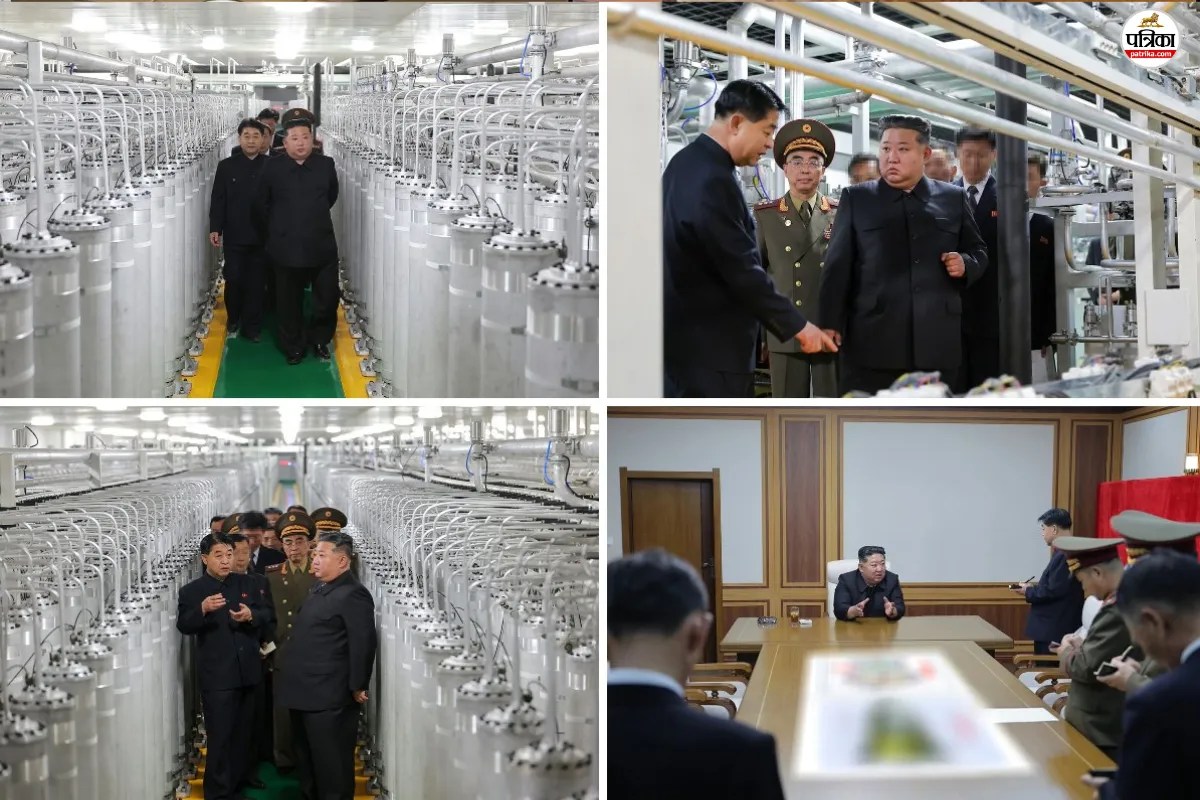
North Korea has pulled back the curtain on its highly classified uranium enrichment capabilities, revealing state-of-the-art centrifuges used to produce weapon-grade nuclear material. During an unprecedented site visit, leader Kim Jong Un demanded a rapid expansion of the facility to exponentially increase the regime's nuclear arsenal. This development confirms that despite years of international sanctions, isolation, and diplomatic pressure, Pyongyang has successfully scaled up its domestic nuclear fuel cycle infrastructure, presenting a heightened strategic challenge to regional security and global non-proliferation efforts.
The Reality Behind the Cascades
The state-sponsored imagery showing rows of shimmering, high-speed centrifuges represents more than a choreographed propaganda victory. It offers structural proof of a sophisticated, operational nuclear supply chain. For years, intelligence agencies tracked the Kangson and Yongbyon complexes through satellite photography, estimating capacity based on roof dimensions and thermal signatures. The recent disclosures validate the grimmest of those assessments.
Centrifuges require precise engineering. They must spin at supersonic speeds to separate uranium-235 from uranium-238 isotopes. To achieve this, North Korea needed high-strength maraging steel or specific carbon fiber filaments, materials strictly banned under United Nations sanctions. The sheer volume of visible machinery indicates a highly successful procurement network or, more alarmingly, a fully realized domestic manufacturing capability that can replicate these components without foreign imports.
[Natural Uranium] -> [UF6 Gas Conversion] -> [Centrifuge Cascades] -> [Highly Enriched Uranium]
This infrastructure does not exist in a vacuum. The expansion of these facilities indicates that the regime has secured a steady supply of uranium concentrate, known as yellowcake, from its domestic mines in Pyongsan. The entire production line, from raw ore extraction to chemical conversion into uranium hexafluoride gas, is functioning at a higher velocity than previously estimated.
The Strategic Multiplication of Nuclear Fuel
Focusing solely on the physical centrifuges misses the broader geopolitical calculus. Pyongyang is shifting its doctrine from maintaining a minimal deterrent to building a highly adaptable, tactical nuclear force. Producing highly enriched uranium is central to this objective.
While plutonium production requires a nuclear reactor and a distinct reprocessing facility, uranium enrichment offers a different set of advantages for a sanctioned state.
- Lower Thermal Footprint: Enrichment facilities emit very little heat, making them difficult to detect via infrared satellite sensors.
- Modular Expansion: A state can hide centrifuge cascades inside ordinary-looking industrial buildings.
- Higher Yield Potential: Uranium can be used to create highly flexible, compact warheads suitable for tactical systems, including cruise missiles and short-range ballistic delivery platforms.
The stated goal of doubling output underscores a desire to saturate regional missile defense systems. If an adversary faces five incoming missiles, interception is highly probable. If that number jumps to fifty, the defensive umbrella risks total failure. By expanding the fuel plant, the regime ensures it has the raw material required to supply an assembly line of diverse warheads.
Exploding the Sanctions Myth
The expansion of this nuclear site exposes a uncomfortable truth for international policymakers. The economic blockade designed to starve the weapons program has failed to stop its technological progression.
Sanctions operate on the premise that a country can be isolated from the global marketplace until the financial pain forces a strategic retreat. This logic falls apart when dealing with a state that prioritizes military advancement over civilian economic welfare. Over decades, the regime constructed a shadow financial network, utilizing illicit ship-to-ship transfers of coal and oil, state-sponsored cyber operations targeting global cryptocurrency exchanges, and loose enforcement along its northern border to fund its military industrial complex.
The technical proficiency displayed in the enrichment facility suggests that intellectual property and specialized machinery have bypassed border controls for years. The international community must reckon with the fact that defensive trade barriers can delay, but cannot entirely prevent, a determined state from achieving advanced industrial capabilities.
The Verification Void and the Future of Deterrence
Traditional diplomatic playbooks offer no viable path forward in light of these disclosures. Previous negotiation frameworks relied on the verified disabling of known facilities like Yongbyon. The confirmation of highly advanced, potentially duplicated enrichment sites makes the historical baseline for verification completely obsolete.
Inspectors cannot verify the dismantlement of a program when they do not know the location of every covert facility. Because centrifuge production can be decentralized across subterranean networks, any future arms control agreement based on voluntary declarations is functionally dead.
This leaves regional actors with few choices. Deterrence must evolve beyond the threat of punitive sanctions. The focus shifts toward advanced missile defense deployment, hardening critical infrastructure against cyber threats, and increasing electronic warfare capabilities to disrupt command and control systems. The expansion of the fuel plant shows that the regime is not preparing for a diplomatic breakthrough. It is preparing for a protracted era of nuclear permanence.