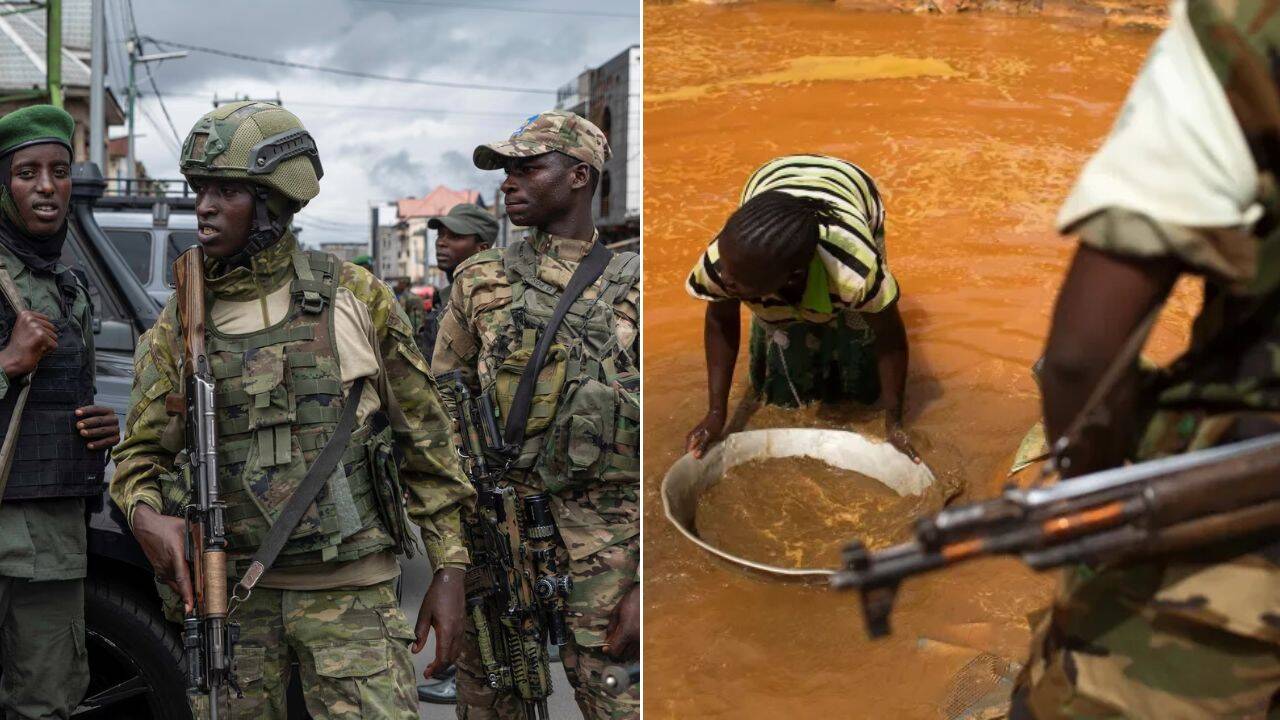
When people talk about the conflict in the eastern Democratic Republic of Congo, they usually focus on big names and sweeping political movements. They talk about the M23 insurgency, Rwandan backing, and Kinshasa’s struggling military. But zooming out to look only at high-level politics misses the real engine of the violence. On the ground, the war survives on a sprawling, decentralized shadow economy powered by three things: guns, artisanal gold, and relentless roadside extortion.
If you want to understand why peace in eastern Congo remains elusive, you have to look at how local militias, guerrilla factions, and even state-allied forces turn ordinary commerce into a steady profit stream. This isn't just a political crisis anymore. It's a self-sustaining business model. For a different perspective, check out: this related article.
The Roadblock Economy and the Business of Circulation
Control over territory in North Kivu, South Kivu, and Tanganyika isn't just about flying a flag over a town. It's about who controls the trade routes. Research into what experts call "roadblock heterarquía" reveals a fragmented landscape where checkpoints act as toll booths for every single item moving through the region.
Think about how a supply chain works normally. Goods move from farms and factories to markets. In eastern Congo, that transit is heavily taxed at gunpoint by whoever holds the road. Further insight on this trend has been provided by USA Today.
- The M23 and major rebel factions squeeze massive revenue out of everyday consumer goods, right down to commercial staples like beer and food supplies, earning millions in illicit duties.
- Wazalendo and local militias embed themselves within local community structures, using taxation to fund their operations while claiming to protect populations.
- Government security forces often set up their own dense networks of checkpoints to sustain their deployments locally through informal levies.
These checkpoints turn basic survival into a taxable event. Farmers bringing produce to market, traders hauling manufactured goods, and truck drivers crossing provincial lines all pay a heavy toll. Without these cash flows, the armed groups couldn't buy ammunition, pay recruits, or sustain operations.
Gold Pits and the Machinery of Pillage
Beyond the roadways, mineral wealth remains the ultimate prize. Artisanal gold mines scattered across remote provinces like Tanganyika and South Kivu are hotbeds of exploitation.
In places like Mwala, young men carrying assault rifles stand guard over makeshift mining camps. While these groups often frame their presence in patriotic terms—defending local communities against rival factions—the reality on the ground looks entirely different. Miners extract gold under brutal conditions, and much of the mineralized sand, known locally as robotas, is smuggled across borders into neighboring countries like Rwanda through illicit boat networks operating under cover of darkness.
International watchdogs and human rights organizations have repeatedly flagged these supply chains. Gold and coltan extracted through forced labor and severe abuse end up filtering into global electronics and precious metal markets. For the militias holding the shafts, these minerals provide instant liquidity. You dig the gold, you sell it to cross-border traders, and you buy more weapons. The loop closes, and the war continues.
Why Military Victories Won't Stop the Cycle
Kinshasa and its international partners frequently treat the conflict as a purely military problem. The strategy usually centers on defeating insurgent groups on the battlefield or pushing them back through force. But military strategy alone fails to address the underlying economic incentives.
Local militias that step up to fight the M23 often receive official recognition or integration as army auxiliaries, but many retain their independent command structures and local economic rackets. Civil society representatives in the region point out a harsh truth: even if a formal peace accord were signed tomorrow, collecting the vast proliferation of weapons currently in circulation is virtually impossible.
The weapons have become status symbols, protection tools, and business assets. When young fighters realize that holding a ridge or a gold mine offers better financial prospects than farming or legitimate trade, disarmament programs struggle to gain traction. Trust in state institutions has eroded to the point where local populations view armed actors—regardless of which side they claim to represent—primarily as a source of extortion and pressure.
Shifting the Policy Focus
Tackling the crisis requires a complete pivot in how regional and international actors approach the region. Focusing solely on upstream production sites misses the broader economic picture.
Policymakers need to target the fiscal governance of trade corridors, disrupt illicit cross-border smuggling networks, and dismantle the localized checkpoint systems that make conflict profitable. Until the financial incentives underpinning this shadow economy are dismantled, guns, gold, and tolls will continue to fuel the instability in eastern Congo.


