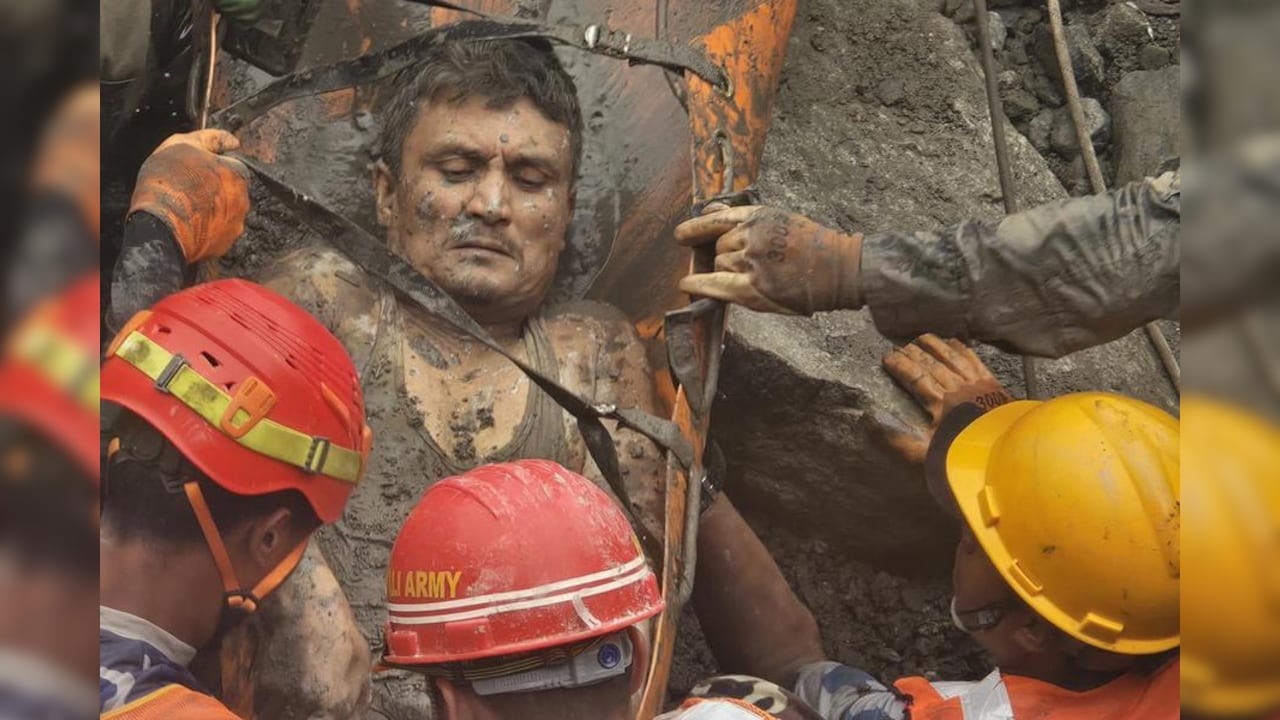
When a catastrophic glacier collapse sent a massive wall of rock, ice, and slurry tearing through the Himalayas, it triggered an emergency response unlike anything seen before in South Asia. Weeks into a disaster that left thousands missing, international engineers and the Nepal Army achieved what many deemed physically impossible: pulling two living workers out of a buried hydropower tunnel.
The operation at the Trishuli-3A project site stripped away standard disaster protocol, forcing rescue coordinators to invent new extraction methodologies in real-time. Understanding how crews reached Sanjay Shah and Kabir Maharjan after nine days in total darkness requires looking past the comforting word "miracle" and examining the brutal engineering reality of subterranean rescue. Don't forget to check out our previous coverage on this related article.
Locating the Invisible Entrance
The first obstacle facing emergency services was remarkably simple and terrifyingly complex: the tunnel entrance had vanished.
Flash floods do not merely deposit water; they displace entire geography. Tons of debris had completely buried the mouth of the Trishuli-3A tunnel, shifting the hillside's topography beyond recognition. Standard GPS coordinates were useless because the surface infrastructure used for spatial orientation had been swept into the river basin. If you want more about the history of this, The Guardian provides an excellent summary.
Rescue coordinators had to rely on a patchwork of historical topographic maps, low-resolution satellite imagery, shaky helicopter footage, and visible surface markers such as surviving power poles to estimate where the portal should be located under dozens of feet of mud. Only after mapping these coordinates could heavy machinery begin the slow, dangerous work of surface excavation without knowing if they were digging toward the tunnel mouth or empty space that could trigger a secondary collapse.
The Mechanics of Subterranean Draining
Once the entrance was exposed, crews confronted a completely blocked, flooded bore. Water filled sections of the passage, while the rest was choked with dense mud and boulders the size of automobiles.
Pumping water out of a horizontal shaft located deep inside an unstable mountain slope presents unique hydraulic problems. Rescuers could not simply drop standard pumps into the void; they had to engineer a series of drainage trenches connecting the interior of the tunnel directly to the nearby river to gravity-feed the standing water out.
Even after draining the primary pools, the debris presented a structural hazard. Moving massive boulders inside a confined, compromised underground space usually demands heavy equipment, but the machinery could not fit inside the narrow conduit. The engineering team made a high-stakes decision: they brought in controlled explosives.
Using explosives inside a collapsed mountain tunnel is an extreme measure. A single miscalculation in charge weight can destabilize the surrounding rock mass, crushing both the trapped survivors and the rescue crew. The Nepal Army executed the blasts with millimetric precision, fracturing the massive rock jams just enough to clear pathways for manual shoveling while maintaining the structural integrity of the mountain overhead.
The Psychology and Physiology of Deep Confinement
Inside the mountain, Shah and Maharjan endured more than 200 hours in pitch-black conditions, surviving on air pockets trapped within the upper levels of the facility.
Human physiology under such extreme sensory deprivation undergoes rapid deterioration. Without light, circadian rhythms collapse, electrolyte balances fail, and psychological panic routinely induces hyperventilation, which rapidly depletes the precious oxygen available in a sealed pocket. That both men survived for over a week points to a rare combination of structural happenstance and psychological resilience.
When rescuers finally advanced roughly 60 meters into the bore and heard a faint response to their shouts, they were operating on the edge of statistical probability. The extraction itself required manual hauling through narrow, mud-slicked clearances where any sudden shift in the overhead debris could have re-sealed the exit.
The Broader Infrastructure Reckoning
While the recovery of Shah and Maharjan provided a profound psychological boost, it highlights a grim systemic vulnerability across the Himalayan region. Dozens of hydropower projects and infrastructure developments sit in narrow, steep river valleys acutely vulnerable to glacial lake outburst floods.
When a mountain river is suddenly hit by millions of cubic meters of displaced ice and mud, underground facilities transform into subterranean traps. The conventional emergency response frameworks used in urban settings or flatland industrial accidents fall short in high-altitude gorges where heavy airlift capacity is constantly threatened by unpredictable weather, fog, and thin air.
The extraordinary nature of the Trishuli-3A extraction lies not just in the miraculous survival of two men, but in the improvisation required to execute it. As changing climate conditions increase the frequency of glacial instabilities across high-altitude mountain chains, the methods forged in the mud of Rasuwa will serve as the baseline manual for every sub-surface disaster response that follows.


