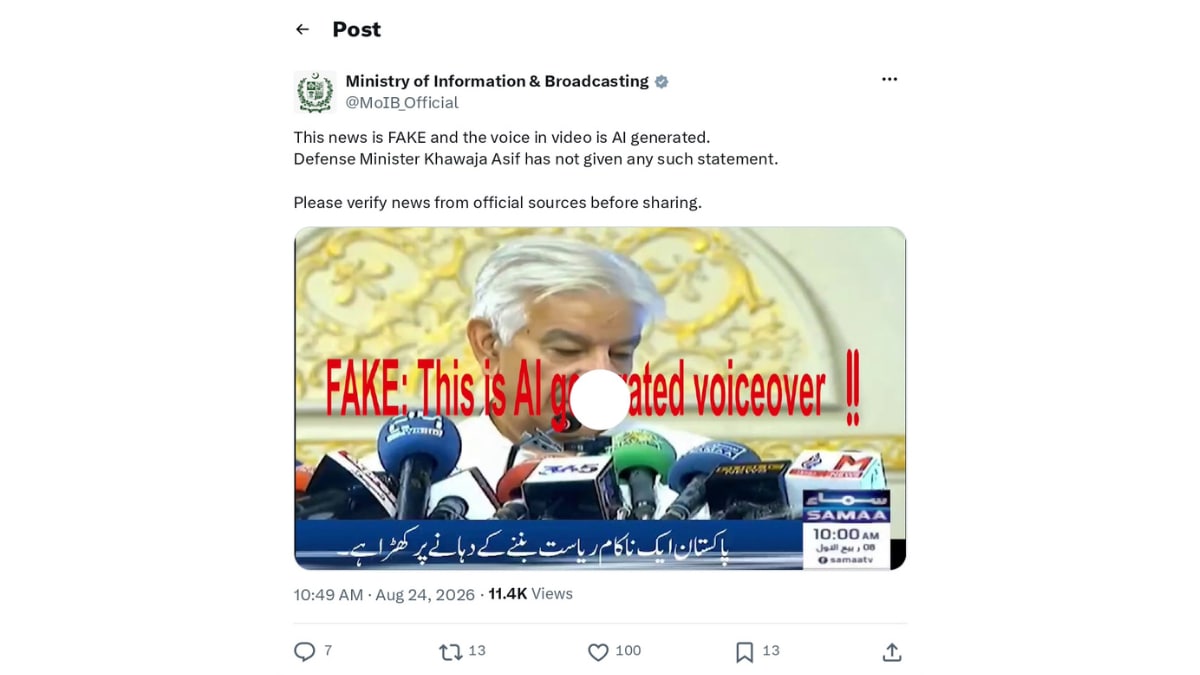
Deepfake technology has officially transcended the realm of absurd internet memes and graduated to the dangerous theater of international statecraft. When a fabricated video surfaced featuring Pakistan's Defence Minister Khawaja Asif seemingly delivering an unsparing critique of his own nation while praising India's economic and technological trajectory, the digital ecosystem convulsed. Islamabad moved swiftly to squash the clip, attributing the smooth audio-visual mimicry to artificial intelligence.
The primary query surrounding this digital forgery is straightforward: how did a synthetic media file manage to bypass initial skepticism and force a formal government refutation? The answer lies in the terrifyingly low barrier to entry for high-fidelity voice cloning and video mapping. Automated generative tools can now clone regional accents, mimic cadence, and replicate specific vocal anomalies with chilling precision. By manipulating public perception through hyper-realistic fabrications, bad actors can manufacture diplomatic crises out of thin air.
This specific incident is not an isolated glitch in the matrix of modern media. It represents an escalation in cognitive warfare where institutional credibility is systematically targeted. When state ministers can be digitally simulated calling out their own governance failures while lauding a historical rival, the objective is rarely humor. The goal is to exacerbate internal fractures, ignite nationalist outrage across borders, and poison the well of cross-border diplomacy.
Consider a hypothetical scenario in a tense geopolitical corridor. A synthetic clip shows a high-ranking military official ordering unauthorized troop movements. Before forensic analysts can verify the file's metadata, automated social media amplification networks push the asset to millions. Stock markets react, emergency committees convene, and military readiness levels shift based entirely on nonexistent data. The speed of digital fabrication has completely outpaced the institutional velocity of fact-checking.
Pakistan's Ministry of Information and Broadcasting faced a monumental challenge in debunking the Asif video because modern audiences are primed to believe the worst about public officials. When a politician is known for polarizing rhetoric, synthetic extensions of their voice sound entirely plausible to the untrained ear. This psychological vulnerability is the true weapon. Creators of these deepfakes do not need to invent entirely new personas; they simply hijack existing credibility and stretch it until the seams snap.
The international media apparatus often acts as an unwitting accomplice in this cycle. Driven by round-the-clock news cycles and algorithmic rewards for speed over verification, regional outlets frequently pick up unverified digital artifacts. By the time an official clarification or forensic audio analysis clears the air, the narrative has already traveled halfway around the globe. Retractions rarely achieve the viral velocity of the initial fabrication, leaving a permanent stain on public discourse.
Combating this wave of synthetic subversion requires a radical overhaul of how digital platforms authenticate media assets. Cryptographic watermarking and blockchain-based provenance tracking are frequently proposed as technical safeguards, yet these solutions face severe implementation hurdles across decentralized networks. Until verification protocols match the speed of generation, truth will remain permanently outpaced by illusion.
As generative models grow more sophisticated, the line separating verified reality from calculated fiction dissolves further into ambiguity.
Pakistan Defence Minister Khawaja Asif Latest News
This video provides an analytical overview of Pakistan Defence Minister Khawaja Asif dealing with public controversies and fact-checking scrutiny regarding regional security claims.
http://googleusercontent.com/youtube_content/1