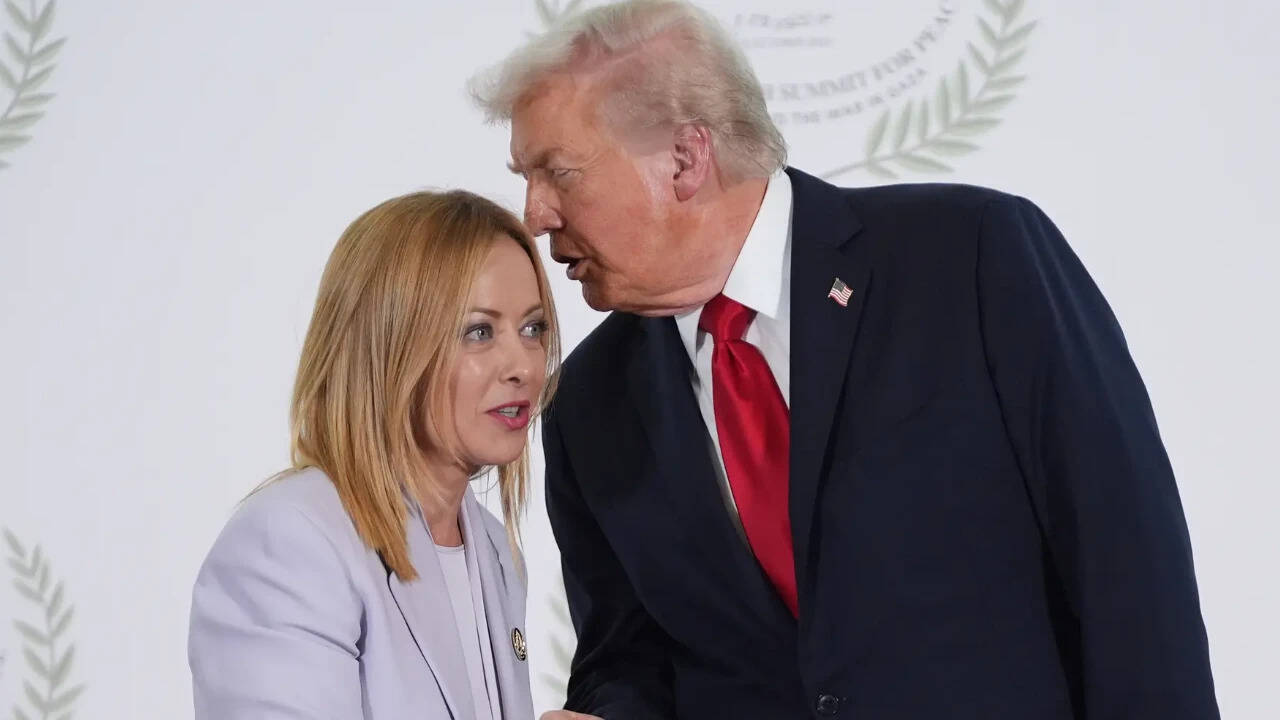
The public spat looked like a classic piece of reality television masquerading as high diplomacy. Donald Trump claimed during an interview with the Italian television network La7 that Italian Prime Minister Giorgia Meloni had practically begged him for a photograph at the Group of Seven summit in Evian-les-Bains. Meloni responded hours later with a sharply produced social media video shot in Rome, stating flatly that neither she nor Italy ever begs. The immediate fallout seemed significant, with Foreign Minister Antonio Tajani abruptly canceling a high-profile diplomatic excursion to the United States in protest of what he labeled offensive remarks.
Yet the theatrical focus on a disputed photo-op obscures a far deeper and more dangerous structural breakdown between Rome and Washington. This is not a mere clash of egos or a temporary misunderstanding between two conservative leaders who once praised each other in glowing terms. It is a fundamental conflict over military sovereignty, Middle Eastern warfare, and the shifting boundaries of European alignment. While Italian cabinet ministers scramble to put out the fire by insisting that individual leaders come and go while permanent alliances endure, the operational mechanics of the U.S.-Italy relationship are facing their most severe strain in decades. You might also find this similar story useful: The Global Crackdown Panic Over Chinas New Law is a Dangerous Distraction.
The Battle for Italian Airspace and the Ghost of Sigonella
The true flashpoint of this diplomatic breakdown has nothing to do with cameras or summit seating arrangements. It is anchored firmly in the concrete runways of Sicily. In March, the Italian government quietly but firmly turned down an American request to utilize Italian airbases, specifically the strategic hub at Sigonella, for offensive bomber operations directed toward the Middle East amid the expanding war with Iran. Meloni insisted that any such deployment required explicit parliamentary approval, a process that would have triggered a massive political crisis within her own coalition and sparked widespread public protests across a deeply anti-war Italian electorate.
Trump did not take the refusal lightly. He spent part of a weekend at Camp David airing his grievances on social media, explicitly complaining that Italy had denied the United States the use of its landing strips and runways despite relying on American security guarantees. To Trump, this was a clear betrayal by a junior partner. For Italy, it was an assertion of constitutional reality and national self-interest. As extensively documented in latest articles by Reuters, the implications are widespread.
This confrontation directly echoes the famous Sigonella crisis of 1985. During that Cold War incident, Italian Prime Minister Bettino Craxi deployed military police to surround American special forces at the Sicilian base, asserting Italian legal jurisdiction over hijacked terrorists against the direct wishes of President Ronald Reagan. Meloni’s current refusal to grant automatic clearance for American bombers demonstrates that Rome still regards its territory as a sovereign domain rather than an open launching pad for unilateral American military campaigns. The war in Iran has transformed this long-standing legal boundary into an active geopolitical friction point.
Cabinet Damage Control and the Transatlantic Myth
In the wake of Trump’s public broadsides, Italy’s senior ministers have been forced into an agonizing balancing act. Defense Minister Guido Crosetto and Foreign Minister Antonio Tajani have both issued public statements calculated to minimize the long-term fallout. Crosetto noted that his primary objective was maintaining ties with a key global ally, suggesting that administrative relationships outlast the politicians who occasionally disrupt them. Tajani adopted an identical posture, claiming that transatlantic bonds are far too deep to be unraveled by individual rhetorical outbursts.
This damage control reveals a profound anxiety within the Italian political establishment. Italy relies heavily on the United States for intelligence sharing, maritime security in the Mediterranean, and industrial defense cooperation. The professional diplomatic corps knows that Italy cannot afford a prolonged freeze in relations with Washington. Consequently, ministers are attempting to decouple Meloni’s personal political brand from the state’s institutional obligations.
However, this strategy of compartmentalization ignores the reality that modern populist diplomacy is intensely personalized. Trump views foreign policy through the lens of personal loyalty and transactional deference. When Meloni broke ranks to criticize his attacks on Pope Leo XIV’s anti-war declarations, Trump viewed it as an act of political defiance. The institutional safety nets that managed transatlantic friction during the Cold War have eroded, leaving state-to-state relations highly vulnerable to the volatile interactions of individual leaders.
Domestic Theatre and the Right Wing Rebalance
Meloni’s unusually fierce counter-attack against Trump’s claims cannot be understood solely as an act of wounded pride. It is a highly calculated domestic political maneuver. For the past year, Italy's opposition parties have consistently targeted Meloni for her historical alignment with American conservative movements, attempting to portray her as a subordinate figure waiting for instructions from Washington. By publicly drawing a line and declaring that Italy does not beg, Meloni effectively neutralized that left-wing narrative in a single stroke.
Furthermore, the public break serves an essential purpose within her own right-wing coalition. Her coalition partners, including Transport Minister Matteo Salvini, have frequently flirted with more radically nationalist and anti-Washington rhetoric to appeal to Euroskeptic voters. Meloni’s firm stance allows her to dominate the nationalist narrative, positioning her administration as a defender of Italian dignity without succumbing to the outright anti-Americanism found on the fringes of the political spectrum.
Summary of Friction Points between Rome and Washington
+-----------------------+----------------------------------+----------------------------------+
| Issue                 | Washington Posture               | Rome Posture                     |
+-----------------------+----------------------------------+----------------------------------+
| Iranian Conflict      | Demands use of Italian airbases  | Denies access without parliament |
| Ukrainian Aid         | Demands sustained European funds | Backs Kyiv but fears escalation  |
| Papal Diplomacy       | Dismisses Pope's peace appeals   | Defends Papal anti-war authority |
+-----------------------+----------------------------------+----------------------------------+
The underlying friction is also visible in Meloni's declining domestic numbers, a vulnerability that Trump openly mocked on his social media platform. Trump claimed her sliding popularity was a direct result of her refusal to back the United States against Iran. Meloni countered sharply, pointing out that being associated with Trump's erratic foreign policy had done little to help her standing at home. This public trading of barbs shows that the temporary alliance of convenience that peaked during her visit to Mar-a-Lago has been entirely replaced by competitive domestic messaging.
The Fractured Front Heading into the Alliance Summit
The long-term danger for Western intelligence networks and defense planning is that this public division is occurring right as the alliance prepares for a crucial NATO summit in Turkey. The transatlantic alliance is trying to project an image of absolute solidarity to its adversaries in Moscow and Beijing. Instead, the two leaders will arrive in Turkey trailing a highly public trail of mutual resentment and unresolved operational disputes.
The systemic divergence between Washington’s demands for total compliance and Europe’s internal legal constraints is growing wider. Italy is simply the first major European state to hit the limit of what its domestic political structure can tolerate regarding Middle Eastern military escalation. While professional diplomats will continue to repeat the mantra that institutional relationships survive the individuals who temporarily manage them, the tactical reality on the ground tells a very different story. The dispute over the G7 photo was merely a symptom of a much deeper debate over who controls European bases, who dictates Western military strategy, and where the boundaries of sovereign independence actually lie. The era of uncritical European deference to Washington's global military mandates has met a firm barrier in the parliament of Rome.
For a broader look at the immediate political fallout and the perspectives from both sides of the Atlantic, the Italian PM Meloni Fires Back At Trump's Latest Criticism provides essential video coverage of the public exchanges that initiated this diplomatic crisis.