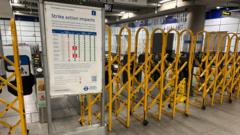
London commuters are waking up to a fractured capital this morning as last-minute talks between Transport for London and the Rail, Maritime and Transport union have collapsed, locking in a series of highly disruptive 24-hour strikes. The industrial action, beginning at midday on Tuesday, May 19, and repeating on Thursday, May 21, will trigger widespread suspensions across the London Underground network. While headlines focus on the immediate gridlock and the shutdown of entire arteries like the Piccadilly and Circle lines, the mainstream narrative is missing the real story. This is not a standard dispute over pay or job cuts. It is a civil war over the future of work, exposing a bitter rift between London’s two major transport unions and raising serious questions about employee fatigue in a post-pandemic transit system.
At the surface level, the conflict appears bizarre. Transport for London is offering a compressed four-day working week. Under the proposal, drivers would see their 36-hour schedule spread across five days reduced to a 35-hour week spread over four days. For the first time, one meal break would be paid. Management insists the scheme is entirely voluntary. If a driver wants to stay on the traditional five-day schedule, they can.
To the outside observer, striking against a shorter working week seems counterintuitive. In fact, Aslef, the rival train drivers’ union that represents a significant portion of the workforce, looked at the exact same deal and signed it. An Aslef spokesperson noted that the agreement hands participating drivers an extra 35 days off each year in return for minor adjustments, calling the RMT's resistance the first strike in history designed to stop people having more time off.
Yet the RMT, led by general secretary Eddie Dempsey, sees a Trojan horse.
The union's resistance is grounded in the operational mechanics of how those 35 hours will be extracted. Compressing the working week means shifts will lengthen significantly. The RMT argues that extended driving stretches in deep-level, hot, and noisy Tube tunnels will accelerate operator fatigue, creating hidden safety risks for the millions of passengers moving through the subterranean network.
There is also a deep institutional mistrust regarding flexibility. Union officials claim that internal referendums showed a clear majority of drivers rejected the concept, fearing that "voluntary" frameworks quickly mutate into management tools. The RMT suspects that once the principle of compressed schedules is established on the trial line—the Bakerloo line—management will seek to extend maximum daily driving times, alter shift patterns with minimal notice, and push drivers to start earlier or finish later to cover roster gaps.
The collapse of these talks highlights a profound strategic split within the labor movement itself. By accepting the deal, Aslef wagered that a modern workforce values blocks of leisure time above all else. By striking, the RMT is drawing a hard line around workplace intensity and the physical toll of the job. It is a fundamental disagreement over what constitutes a high-quality working life.
The structural reality of London Underground’s staffing model means the disruption will be highly uneven but severe. Tube drivers are not generalists. A driver is specifically trained, licensed, and restricted to a single route. Management cannot simply move a surplus driver from the Northern line to cover a shortage on the Piccadilly line.
Because the RMT holds an overwhelming majority of drivers on specific routes, certain lines will simply cease to function. The Circle and Piccadilly lines are expected to suffer total suspensions from midday onwards during the strike days. The Piccadilly line closure deals a direct blow to London's international connectivity, severing the primary low-cost rail link to Heathrow Airport.
On other vital routes, TfL is attempting a triage strategy. On the Central and Metropolitan lines, available non-striking drivers are being concentrated on the highest-traffic central corridors. This means no service will run between White City and Liverpool Street on the Central line, and no trains will service the Baker Street to Aldgate section of the Metropolitan line.
Conversely, the Northern and Victoria lines are projected to run near-normal services with only minor delays, reflecting Aslef’s stronger foothold among the drivers stationed at those depots. This uneven landscape will create dangerous bottlenecks at major interchange hubs like King's Cross St Pancras, Victoria, and Waterloo as passengers pour off functional lines only to find their connecting routes barricaded.
The political backdrop has quietly shifted the leverage in favor of the unions. In February 2026, the Labour government repealed the controversial 40% support threshold for strike ballots in key public services—a restrictive measure originally introduced by the Conservative government under the Trade Union Act 2016.
Previously, a strike ballot in public transport required not just a simple majority of those who voted, but the approval of at least 40% of all eligible members, regardless of turnout. By erasing this statutory hurdle, the government lowered the legal barrier required to launch industrial action. The RMT’s current mandate is a direct beneficiary of this legislative pivot. With further walkouts already penciled in for mid-June, the union is utilizing its restored legal freedom to dig in for a protracted war of attrition.
For London’s broader economy, the timing is brutal. The capital’s hospitality, retail, and corporate sectors are already grappling with hybrid working patterns that leave Thursdays and Fridays vulnerable. Midday-to-midday walkouts are intentionally designed by union tacticians to maximize disruption across two business days rather than one, poisoning the morning commute on Wednesdays and Fridays as trains and crews struggle to get back into their correct geographical positions.
TfL's advice to the public is familiar: use the Elizabeth line, the London Overground, or local buses. But these systems lack the capacity to absorb millions of displaced Underground passengers. The Elizabeth line will remain operational because its staff belong to different negotiating frameworks, but its central stations are already braced for severe overcrowding and temporary closures to manage platform density.
The underlying crisis is that both sides have run out of room to negotiate. TfL is financially constrained, still dealing with the long-term structural deficit left by the pandemic and dependent on strict budgetary oversight. Offering more money is off the table; offering a compressed week was management's attempt to grant a benefit that theoretically cost nothing extra in basic wages.
The RMT has countered by demanding a 32-hour, four-day week without a loss of pay—a position TfL views as an absolute financial impossibility. With management accusing the union of walking away from a voluntary benefit, and the union accusing management of executing a bad-faith U-turn to impose changes against the will of the workforce, the distance between the two parties is unbridgeable.
London is not just facing four days of travel chaos this week. It is witnessing a structural breakdown in transport labor relations that will dictate the terms of public service employment for the rest of the decade.