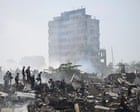
The double-strike of magnitude 7.2 and 7.5 earthquakes that shattered north-central Venezuela on June 24, 2026, has left a confirmed 235 dead and over 4,300 injured. International search and rescue teams from Chile, Colombia, the US, and Spain are arriving on the ground, navigating severed transit lines and a crippled aviation hub to pull survivors from pulverized high-rises. While official reports focus heavily on the unfolding rescue logistics, the true crisis lies in the intersection of a rare geological event and a decade of unchecked systemic vulnerability.
The catastrophe was not a single tremor, but an exceedingly rare back-to-back "doublet". The San Sebastián and Boconó fault systems ruptured just 39 seconds apart. Because the main 7.5 shock occurred at a shallow depth of only ten kilometers, its lateral energy directly targeted structural weaknesses in the nation's most densely populated urban centers.
The Anatomy of Structural Failure
For decades, structural engineers have warned that northern Venezuela’s rapid urban expansion ignored basic seismic zoning. The devastation in Chacao, Altamira, and Los Palos Grandes is proof of that neglect. Residential high-rises built during various economic booms were structured to handle vertical loads, but lacked the lateral force resistance required to survive a major strike-slip rupture.
At the Petunia Residences in Los Palos Grandes, 14 floors collapsed into a dense sandwich of concrete, leaving only six floors standing. In Altamira, a 22-story tower flattened entirely. This was not a failure of raw materials, but a failure of modern engineering oversight.
When a building undergoes horizontal ground acceleration during a doublet event, the first shock fractures the brittle masonry infill walls. The second, more powerful shock then shears the unreinforced concrete columns, triggering a progressive "pancake" collapse. The structural integrity of these towers was compromised decades before the ground ever moved.
The La Guaira Logistical Chokehold
While public attention remains fixed on the capital, the coastal state of La Guaira has become an isolated disaster zone. Over 250 residential buildings have collapsed along the narrow strip between the mountains and the Caribbean Sea. Landslides triggered by the violent ground shaking have effectively buried key roads connecting the coast to the interior.
The geopolitical and logistical reality of the rescue operation is highly complicated.
- Simón Bolívar International Airport is offline. Falling debris and structural cracks in the terminal building forced authorities to cancel all flights. This prevents heavy transport aircraft carrying international urban search and rescue teams from landing directly near the worst-hit zones.
- Alternative maritime routes are compromised. Massive clouds of pulverized concrete and dust rolled off the coastal mountains, blinding port operations and complicating early naval reconnaissance.
- The terrain acts as a barrier. Aid must now be routed through secondary airfields or over unstable mountain passes, delaying the arrival of specialized listening devices, search dogs, and heavy hydraulic extrication gear.
Pre-Existing Vulnerabilities as a Force Multiplier
Disasters do not happen in a vacuum. The humanitarian fallout from these earthquakes is magnified by years of institutional decay. Hospitals in Caracas and Miranda, already plagued by intermittent electricity and water shortages, were instantly overwhelmed by the influx of thousands of casualties.
A rescue operation requires water, fuel, and stable communications. Right now, all three are scarce. Emergency crews are forced to ration fuel for heavy machinery, choosing between operating excavators at a high-priority collapse site or distributing water to displaced families. The United States Geological Survey's PAGER system issued a red alert, projecting a high probability that the economic losses will reach into tens of billions of dollars—a massive blow to a fragile economy.
International Aid Faces Reality
The arrival of foreign teams from the Americas and Europe provides vital specialized support, yet their effectiveness remains tied to local infrastructure. A highly trained search crew cannot operate efficiently if it spends twelve hours clearing a single landslide just to reach a collapse site.
The focus will inevitably shift from saving lives to identifying the missing, who now number in the thousands. Local civil defense forces and volunteer networks are currently doing the heavy lifting, digging through rubble with bare hands and car jacks in states like Yaracuy and Carabobo.
The underlying problem remains: rebuilding cannot simply mean replacing what fell. If the same structural shortcuts and regulatory blind spots are repeated during the reconstruction phase, the next inevitable rupture along the Caribbean plate boundary will yield the exact same result.