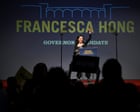
The political geography of the American Midwest is undergoing a profound stress test, and the epicenter sits squarely in Wisconsin. As the state prepares for its gubernatorial showdown, the traditional machinery of the Democratic Party is facing an unprecedented challenge from within. State Representative Francesca Hong, a democratic socialist, former professional chef, and small business owner, has shifted from a long-shot legislative voice to a commanding force in the primary. This campaign is not merely about who succeeds outgoing Governor Tony Evers. It is a referendum on whether a working-class populist platform can conquer a crucial swing state that has long preferred cautious centrism.
Understanding how Hong reached the frontrunner status requires examining the changing demographics and economic anxieties of the state. Madison and Milwaukee remain reliable anchors for progressive policy, but the path to executive power requires building a coalition across manufacturing hubs and rural counties that narrowly favored Donald Trump in past presidential cycles. Traditional party strategists argued for a candidate who could quietly thread the needle between suburban moderates and union loyalists. Hong took a different path. Her platform rejects corporate political action committee donations and centers on an aggressive expansion of public services, funded by higher taxes on corporations and high earners.
The policy architecture of her campaign rests on what her team terms an infrastructure of care. This includes universal childcare, fully funded public education, and systemic labor protections. For decades, establishment politicians treated these goals as secondary objectives, achievable only after bipartisan compromises that often diluted their impact. Hong frames them as baseline prerequisites for economic survival. Her background in the service industry heavily influences this messaging. Having spent years working in restaurant kitchens and managing payroll before entering the State Assembly in 2021, she speaks directly to service workers and small business owners who feel abandoned by economic growth that benefits only corporate portfolios.
Skeptics point to the math behind her tax proposals as a major vulnerability. Opponents and conservative analysts argue that hiking taxes on top earners and large corporate profits will trigger capital flight, driving high-income residents and businesses across the border to neighboring states. During primary debates, these economic counter-arguments took center stage, with critics pressing her on how the state would maintain its revenue base if millionaires chose to relocate. Hong counters that public investments in education, healthcare, and childcare create a stable workforce that ultimately attracts long-term stability, arguing that decades of trickle-down tax cuts have failed to deliver shared prosperity.
The intra-party friction extends beyond taxation and touches the very identity of modern liberalism. Governor Tony Evers built a brand on steady, low-drama governance, acting as a functional administrative firewall against a deeply conservative state legislature. Hong represents a sharp ideological break from that style. Her activism includes organizing mutual aid networks, participating in labor strikes, and maintaining open ties with the Democratic Socialists of America. This approach energizes younger voters and urban volunteers who want systemic disruption rather than institutional management. At the same time, it alarms older, more conservative-leaning Democrats in the WOW counties—Waukesha, Ozaukee, and Washington—who view democratic socialism as a bridge too far in a general election.
The mechanics of winning a statewide primary in a purple state demand a delicate balance between base mobilization and broad appeal. While national media profiles focus heavily on the historic nature of her candidacy—she is the first Asian American legislator in state history—her campaign relies heavily on traditional, shoe-leather organizing. Canvassers knock on doors in rural towns where progressive messaging is usually dismissed out of hand, tying her platform directly to the survival of local public schools and healthcare access. By focusing local conversations on tangible public goods rather than abstract ideological labels, her team attempts to bypass the automatic resistance that partisan branding often triggers.
Opponents within the primary field have tried to capitalize on her unconventional political history, highlighting past social media posts and activist alignments to paint her as too extreme for a general electorate. Yet these attacks have often backfired by reinforcing her anti-establishment credentials among primary voters who are deeply skeptical of conventional political polish. In an era where authenticity is valued above careful message testing, Hong's refusal to moderate her tone or sanitize her background resonates deeply with a faction of the electorate that feels alienated by institutional politics.
The outcome of this primary will send shockwaves through the national Democratic Party. If a democratic socialist can capture the nomination for governor in a state that frequently decides presidential outcomes, it shatters the long-held assumption that progressive candidates are viable only in deeply blue urban enclaves. It proves that economic populism, when paired with a genuine working-class biography, can cut through the noise of modern media and force a complete reimagining of what a competitive statewide platform looks like in the heart of the Rust Belt.