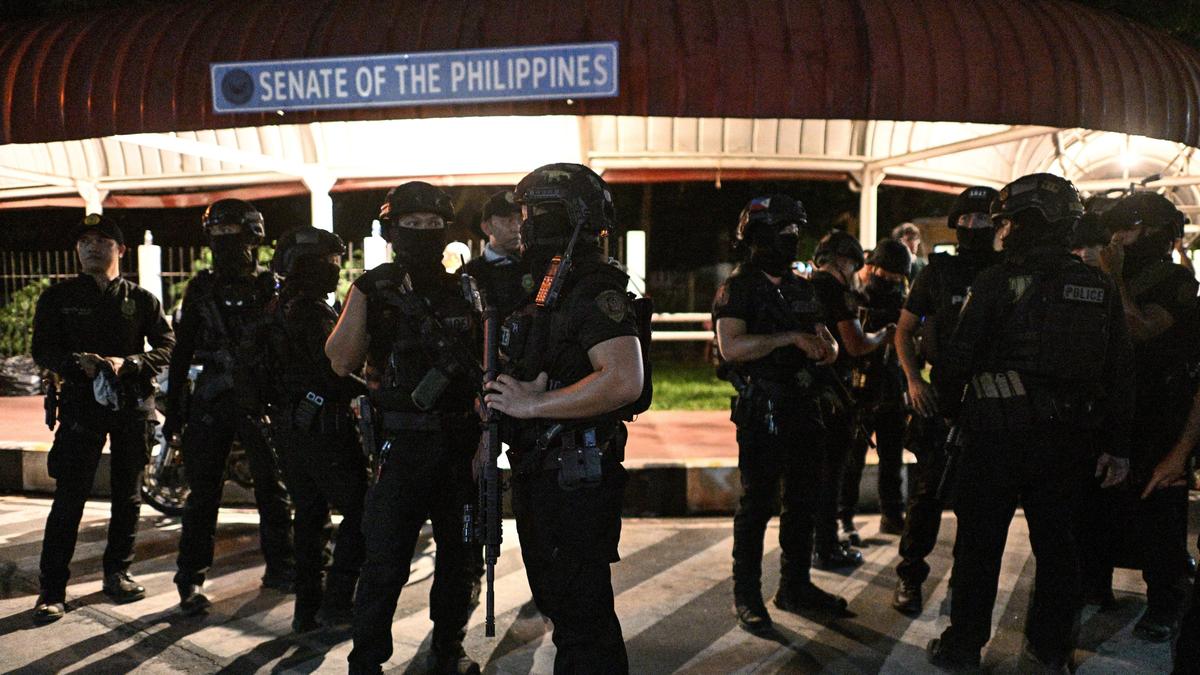
The occurrence of kinetic violence within the Philippine Senate represents a critical failure in the state's monopoly on legitimate force and an immediate threat to the country’s sovereign risk profile. When President Ferdinand Marcos Jr. convenes an emergency meeting following a shooting in a legislative chamber, the objective is not merely tactical coordination; it is the restoration of institutional signaling. In high-stakes governance, the physical security of a Senate floor is the primary proxy for the stability of the entire administrative apparatus.
The breakdown of order within the Philippine legislature functions as a stress test for three specific national systems: the internal security architecture of the legislative branch, the executive’s crisis management protocol, and the continuity of the legislative agenda under duress.
The Triad of Institutional Destabilization
To quantify the impact of this crisis, we must look beyond the immediate casualties or the identity of the shooter. The event triggers three distinct vectors of institutional decay.
1. The Perceptual Risk Vector
Investors and international observers treat legislative stability as a baseline requirement for capital allocation. A shooting within the Senate introduces a "volatility premium" to Philippine markets. This isn't about the physical damage to the building; it is the realization that the deliberative center of the state is porous. If the state cannot secure its own lawmakers, its ability to enforce contracts or protect infrastructure is brought into question.
2. The Command and Control Bottleneck
President Marcos’s call for an emergency meeting highlights a centralization of crisis response. While necessary for optics, this reflects a lack of autonomous, pre-programmed security protocols. The need for executive intervention to manage a localized breach indicates that existing security frameworks—the Senate Sergeant-at-Arms and the Philippine National Police (PNP) coordination—failed to contain the event before it reached the level of a national emergency.
3. The Legislative Inertia Function
Political chaos serves as a hard brake on policy velocity. Every hour spent on emergency meetings, forensic investigations, and security audits is an hour subtracted from the deliberation of the national budget, tax reforms, and regional defense strategies. The opportunity cost of this shooting is measured in the stalled momentum of the "Bagong Pilipinas" (New Philippines) developmental roadmap.
Structural Failures in Perimeter Integrity
A shooting in a high-security zone is never an isolated lapse; it is the culmination of a "Swiss Cheese" model of failure, where multiple layers of defense align their holes simultaneously. Analyzing the breach requires deconstructing the layers of the Senate's security stack.
- Intelligence and Vetting (Layer 1): The failure to identify the threat before it entered the vicinity. This suggests a gap in human intelligence or a failure in the background check systems for staff, visitors, or security personnel.
- Physical Access Control (Layer 2): The breakdown of the "Hardened Perimeter." Modern legislative buildings utilize multi-stage screening involving X-ray, metal detection, and ballistic barriers. A firearm reaching the Senate floor implies a failure in technical sensors or, more likely, a bypass facilitated by human error or social engineering.
- Rapid Response and Neutralization (Layer 3): The transition from "Chaos" to "Meeting." The time delta between the first shot and the containment of the scene determines the severity of the institutional trauma. If the shooter was able to create "chaos" (as reported), the immediate suppression protocols were insufficient.
The Executive Response as a Strategic Variable
President Marcos’s reaction follows a specific logic of political consolidation. By taking immediate personal charge of the situation, the executive branch absorbs the authority that the legislative branch temporarily lost during the breach. This creates a shift in the balance of power.
The Logic of the Emergency Meeting
The meeting serves two hidden functions:
- Alignment of the Security Apparati: Forcing the heads of the PNP, the Armed Forces of the Philippines (AFP), and the National Intelligence Coordinating Agency (NICA) into a single room to establish a unified narrative and prevent inter-agency finger-pointing.
- Mitigation of Panic: In the information age, a vacuum of authority is filled by speculation. By announcing an emergency meeting, the President signals that the "state" is still functional, even if the "building" is compromised.
The risk of this strategy is the "Normalization of Crisis." If the President must intervene in every security breach, the perceived competence of lower-level institutions diminishes. This creates a dependency where the state cannot function without direct executive oversight, a hallmark of fragile democracies.
Analyzing the Shooting Through the Lens of Political Polarization
While the motive of the shooter remains a subject of investigation, the context of the Philippine Senate cannot be ignored. The chamber is currently the site of intense debates regarding constitutional change (Cha-cha), foreign policy pivots toward the West, and internal investigations into previous administrations.
The shooting acts as a "Force Multiplier" for existing tensions. If the shooter is linked to any political faction, the event ceases to be a criminal act and becomes an act of political warfare. This forces the Marcos administration to navigate a narrow corridor: they must prosecute the perpetrators aggressively to show strength, but they must do so without appearing to use the event as a pretext for a crackdown on legitimate opposition.
The Economic Consequences of Legislative Instability
We can model the impact of this shooting using the Political Risk Discount Factor.
$R_p = \frac{V_i + S_g}{C_a}$
Where:
- $R_p$ is the perceived risk.
- $V_i$ is the intensity of violence.
- $S_g$ is the systemic gap (the time it takes to restore order).
- $C_a$ is the perceived capability of the administration.
As $V_i$ increases due to the shooting, the denominator ($C_a$) must increase proportionally through decisive executive action to keep $R_p$ stable. If the emergency meeting does not result in concrete, visible changes to security and a transparent investigation, the risk factor climbs, leading to a potential softening of the Philippine Peso and a cautious stance from foreign direct investment (FDI).
The second-order effect is the impact on the "Build Better More" infrastructure program. Legislative instability often leads to a "flight to safety" by technocrats and bureaucrats who become hesitant to sign off on major projects during periods of physical danger or political upheaval.
Hardening the Philippine State: A Strategic Protocol
To move beyond the current chaos, the administration must transition from reactive crisis management to a proactive structural hardening. This involves more than just adding guards; it requires a redesign of the legislative security protocol.
- Bifurcation of Security Command: Establishing a civilian-led, militarily-trained Legislative Protection Service that operates independently of the PNP. This removes the Senate's reliance on an external police force that is also subject to executive influence.
- Digital and Physical Integration: Implementing real-time biometric tracking for all individuals within the GSIS building (where the Senate is housed). The current system of manual logs and badges is a 20th-century solution to 21st-century threats.
- Redline Definition: The President must clearly define the "Redlines" of political discourse. When political rhetoric edges into the territory of inciting physical violence, the legal system must act as a circuit breaker. The shooting is a symptom of a heated political environment where the "Cost of Aggression" has become too low.
The shooting at the Philippine Senate is a diagnostic tool. It has revealed the vulnerabilities in the state’s physical security and the fragility of its legislative process. The emergency meeting called by President Marcos is the first step in a necessary, albeit painful, recalibration of how the Philippine state protects its democratic core.
The immediate move must be a comprehensive audit of the Senate's internal security protocols by a third-party international firm to restore external confidence. Simultaneously, the administration must fast-track the pending National Security Act updates to provide a clearer legal framework for neutralizing domestic threats that target constitutional bodies. Failure to treat this as a systemic breach rather than a random act of violence will result in the permanent embedding of a volatility premium into the Philippine political economy.


:max_bytes(150000):strip_icc():focal(819x186:821x188)/Murdaugh-Family-e90854a716884d608fb6fd925e18d840.jpg)
