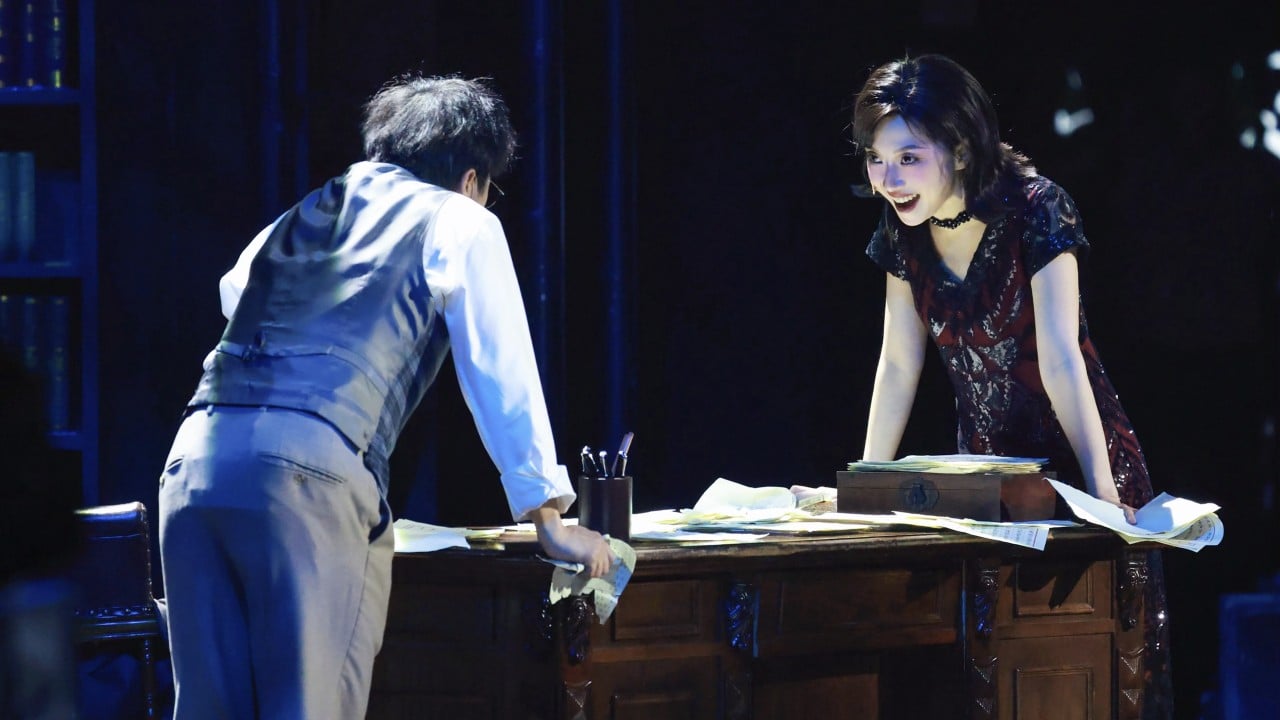
The air inside the cramped theater in Shanghai’s People’s Square smells of damp velvet and rain from the street outside. A young woman named Lin sits in row three, her knees practically brushing the edge of the stage. There is no orchestra pit here. No towering velvet curtains. Just two actors, a piano, and a spotlight so close she can see the beads of sweat forming on the lead actor's brow.
He sings not of grand revolutions or phantom-filled opera houses, but of the suffocating pressure of parental expectations, of loneliness in a city of twenty-four million people, and of a quiet, desperate hunger for art.
Lin watches, her breath hitched. She has spent hundreds of dollars in the past over grand Western touring productions. She sat in the nosebleed seats of massive auditoriums, watching tiny specks of actors belt out timeless English lyrics while she squinted at the subtitles flashing on screens beside the stage. It was spectacular. It was historic.
But it never made her cry like this.
A quiet revolution has taken over the commercial theater scene in China’s major cultural hubs. For decades, the industry assumed that the path to success lay in replicating the massive, roaring spectacles of Broadway and the West End. The assumption was simple: bigger is better. If you build a multi-million-dollar chandelier and drop it from the ceiling, they will come.
They did come, for a time. But look closer at the marquees today, and you will see something entirely different happening. Small-scale, intensely emotional musicals originating from Seoul have quietly pushed the traditional giants off the boards.
To understand why this happened, we have to look past the spreadsheets of theater executives and look instead at the architecture of human emotion.
Consider the physical reality of a Western mega-musical. When a production like Wicked or The Lion King tours internationally, it requires an arena. It demands thousands of seats to break even on its staggering weekly operating costs. The experience is inherently communal, but it is also distant. The audience is a collective mass, observing a polished, immovable monument of Western culture from afar.
Korean musicals, often referred to as K-musicals, grew out of a completely different ecosystem. In the early 2000s, the Daehangno district in Seoul became a breeding ground for intimate, small-theater productions. Directors and writers, working with limited budgets, realized they could not compete with the sheer visual noise of New York or London.
So, they turned inward.
They created shows that required only three or four actors. They stripped away the rotating stages and the massive ensemble casts. Instead, they focused heavily on psychological depth, intense interpersonal relationships, and melodies that borrowed heavily from the hyper-expressive playbook of K-pop and television dramas.
When Chinese production companies began licensing these shows—adapting them into Mandarin with local casts—they discovered an audience that was starved for exactly this kind of proximity.
Step into any of the converted studio spaces in Shanghai’s Jiushi Spaces or the grand theater's studio halls on a Tuesday night. The scale is intentionally small. A typical theater holds fewer than three hundred people.
This creates a completely different relationship between the performer and the observer. In a space that small, you cannot hide behind special effects. Every cracked note, every tear, and every micro-expression is entirely visible.
For a generation of young Chinese theatergoers—predominantly women in their twenties and early thirties—this intimacy is intoxicating. They are not just watching a story; they are sharing a room with it. The barrier between the art and the life of the viewer dissolves completely.
But the shift is driven by more than just physical closeness. The true power of these adapted pieces lies in a deep, unspoken cultural alignment.
Western musicals frequently rely on grand, universal tropes or specific historical contexts that can feel alien to a contemporary Asian audience. Les Misérables is a masterpiece, but its emotional core is tied tightly to the specific sociopolitical history of 19th-century France. The humor in The Book of Mormon relies on a specific cultural familiarity with American religious satire.
Now, look at the themes of the most successful small-scale Korean imports in China, such as Mia Famiglia, Vincent van Gogh, or Fanletter.
Fanletter, for instance, is set during a dark, literary era, focusing on writers seeking solace in art while dealing with intense psychological trauma, isolation, and unexpressed love. These narratives lean heavily into concepts that resonate deeply across East Asia: the crushing weight of societal conformity, the bittersweet nature of unrequited loyalty, and the internal agony of trying to define oneself against the wishes of a family or a rigid community.
There is a specific word in the Korean language, han, which denotes a collective feeling of sadness, oppression, and unresolved resentment mixed with hope. It is a complex emotional state born from a turbulent history. While China has its own distinct cultural legacy, the generational pressures felt by young urban professionals in Beijing or Shanghai today mirror this emotional weight with startling accuracy.
When a character on stage sings about the exhaustion of trying to live up to an impossible ideal, the audience isn't just understanding the lyrics. They are feeling their own lives reflected back at them in real time.
The business model of these productions also completely changes how people consume theater.
A ticket to a massive touring Broadway production is an event. It is something a casual fan might do once a year, or even once a lifetime, treating it like a luxury vacation. The prices are high, the runs are short, and the experience is rigid.
Small-scale K-musicals operate more like a local coffee shop. Because the production costs are lower, tickets are significantly more affordable. This has given rise to a culture of repeat attendance that Western producers can only dream of.
It is entirely common for a dedicated fan in Shanghai to see the exact same musical ten, fifteen, or even twenty times during a single run. They do not do this because they forgot the plot. They do it because the production companies rotate the casting constantly.
A three-person musical might have five different actors rotating through the lead role. Every single combination of actors creates a completely different emotional dynamic on stage. One pairing might play a relationship with a subtle, tragic undercurrent; another pairing might emphasize a frantic, chaotic energy.
Fans track these casting combinations like sports statistics. They discuss the varying chemistry on social media platforms like Xiaohongshu, debating the artistic choices of a specific Tuesday night performance versus a Saturday matinee. Theater is no longer a static piece of art to be viewed and filed away. It is a living, breathing ecosystem that the audience actively participates in.
This has fostered an intense fandom culture that looks remarkably similar to the idol industries of East Asia. Actors are not distant stars who disappear behind a stage door; they are accessible, celebrated figures who engage deeply with their community. The theater lobby transforms into a gallery of fan-contributed flower arrangements, custom-designed merchandise, and handwritten letters.
The traditional titans of theater are noticing. Broadway imports will always find a place in the massive, prestigious venues for the sheer spectacle of it all. There will always be a market for the grand tourist experience.
But the emotional territory of the city has been claimed by the smaller rooms.
As the house lights dim for the second act in that small Shanghai theater, Lin watches the pianist hit a low, rumbling chord. The actor on stage takes a long, ragged breath, his eyes glistening under the hot lights. He looks directly toward her section of the room, crying out a melody of grief and survival that requires no cultural translation whatsoever.
In the dark, two hundred people lean forward simultaneously, pulled by an invisible thread toward a stage that offers no distance, no escape, and absolute truth.