A standard ceramic coffee mug sits on your desk. It feels permanent. Solid. It likely traveled twelve thousand miles to get to you. For that mug to exist in your hand, it had to pass through a gap in the earth only eighteen miles wide.
If that gap closes, your world changes. Recently making news recently: Safety Culture Is Killing the People It Claims to Protect.
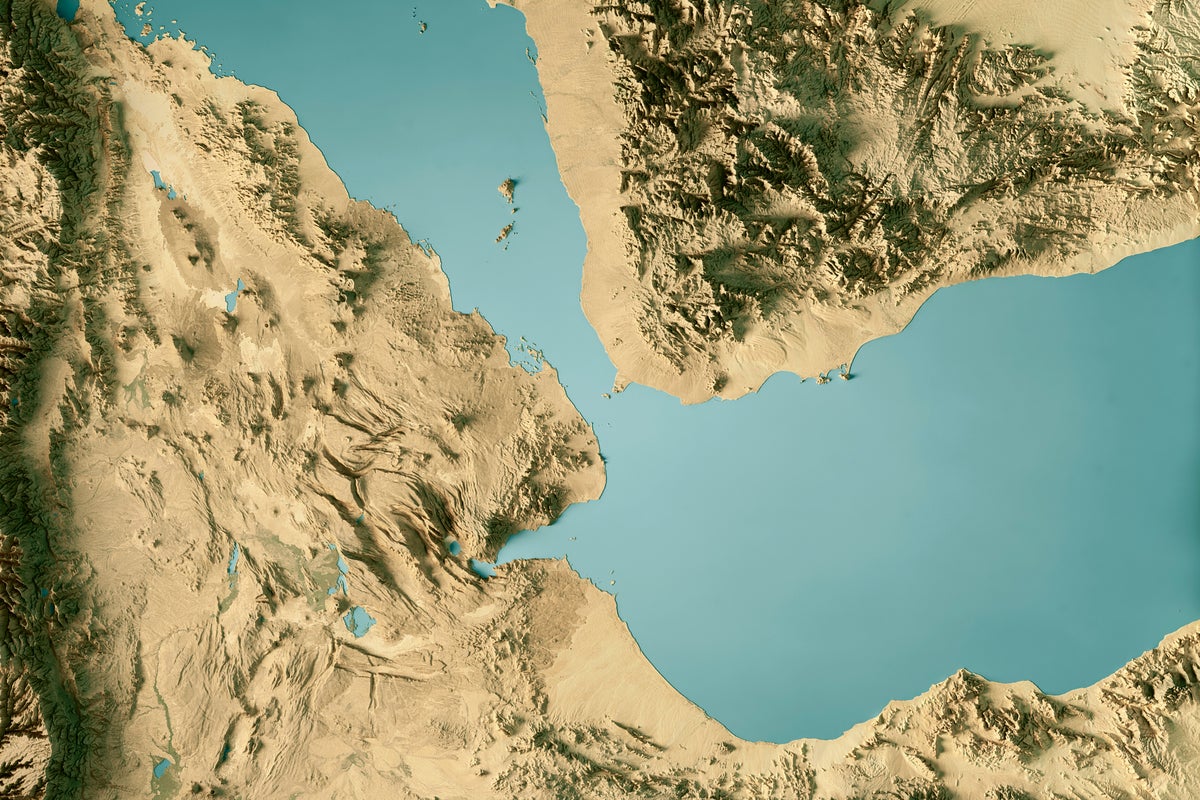
The Bab al-Mandab Strait is a jagged throat of water connecting the Red Sea to the Gulf of Aden. To the northeast lies Yemen; to the southwest, Djibouti and Eritrea. Ancient sailors, terrified by the volatile currents and the jagged reefs that wrecked wood-hulled dhows, gave it a name that stuck for centuries. They called it the Gate of Tears. Today, the name has stopped being a poetic relic and started being a prophecy.
The Ghost in the Supply Chain
Meet Elias. He is a hypothetical merchant mariner, but his reality is shared by over a million people currently at sea. He is standing on the bridge of a Triple E-class container ship. Below his boots are eighteen thousand steel boxes. Inside those boxes are lithium-ion batteries, Swedish flat-pack furniture, Egyptian cotton sheets, and the high-end semiconductors required to keep a modern hospital running. More details on this are explored by Bloomberg.
Elias isn't looking at the horizon for weather anymore. He is looking for skiffs.
When the Houthi movement in Yemen began launching drones and anti-ship ballistic missiles into this corridor, the math of global existence shifted overnight. For decades, we treated the oceans like magic. You click a button, a box appears on your porch. We forgot that the magic relies on a handful of geographic "chokepoints" that are terrifyingly fragile.
The Gate of Tears is the most vulnerable of them all.
About 12% of total global trade flows through this single needle-eye. More importantly, it is the primary artery for energy. Millions of barrels of oil and vast quantities of Liquified Natural Gas (LNG) transit these waters daily, heading toward European ports that are already reeling from energy instability. When a missile strikes a tanker here, the shockwave doesn't stay in the Red Sea. It travels through the wires of the New York Stock Exchange and ends up at your local gas pump.
The Long Way Around
Geography is a stubborn thing. If you cannot go through the Gate of Tears, you have exactly one alternative. You turn the ship around. You sail south, past the coast of Tanzania, past Mozambique, and around the Cape of Good Hope at the southern tip of Africa.
Then you turn north and head for the Atlantic.
This isn't just a detour. It is a fundamental rewiring of the global economy. Bypassing the Red Sea adds roughly 3,500 nautical miles to a journey from Asia to Europe. In human terms, that is ten to fourteen extra days at sea. In economic terms, it is a catastrophe of compound interest.
Consider the fuel. A large container vessel can burn 150 tons of heavy fuel oil per day. Adding two weeks to a round trip costs millions of dollars in extra propellant alone. Then there is the "blank sailing" effect. If every ship takes two weeks longer to finish its route, there are fewer ships available at the starting ports. Scarcity drives prices up. Suddenly, the shipping cost for that ceramic mug on your desk triples.
We saw this happen during the 2021 grounding of the Ever Given in the Suez Canal. The world held its breath for six days. But a physical blockage is a problem with an engineering solution. A kinetic conflict—where missiles are the barrier—is a problem with no clear expiration date.
The Djibouti Paradox
If you stood on the shores of Djibouti and looked out across the strait, you would see a surreal gathering of the world’s military might. Because the Gate of Tears is so vital, it has become the most militarized neighborhood on the planet.
Within a few miles of each other, you have American, Chinese, French, and Japanese military bases. They are all there for the same reason: to guard the throat. Yet, despite the billions of dollars in hardware, the vulnerability remains. A drone costing $2,000 can successfully threaten a destroyer costing $2 billion.
This is the new asymmetry of the Gate of Tears.
The Houthis, positioned on the jagged cliffs of Yemen, understand a fundamental truth about the modern world. You don’t need to win a war to win a disruption. You only need to make the risk high enough that the insurance companies say "no."
In the shipping world, the real gatekeepers aren't the admirals. They are the underwriters in London offices. When insurance premiums for Red Sea transits spike by 1,000% in a single month, the route effectively closes. The "Gate of Tears" becomes a wall.
The Ripple Effect on the Dinner Table
The stakes are often framed in terms of oil and tech, but the most visceral impact is felt in the gut. The Gate of Tears is a major route for grain.
Ukraine and Russia provide a massive portion of the world’s wheat. Much of that wheat, destined for the hungry markets of East Africa and South Asia, must pass through these waters. When the strait is contested, food security becomes a weapon of war.
It is a cruel irony. The people living on the shores of the Bab al-Mandab are often the ones most affected by the rising cost of the very food passing their coastline. A delay in shipping doesn't just mean a late iPhone in London; it means a bread riot in Cairo or Mombasa.
We are living through a period where the "just-in-time" delivery model—the backbone of 21st-century capitalism—is meeting the "just-in-case" reality of ancient geopolitical grudges. Companies are being forced to hoard inventory, driving up costs and slowing down innovation. The efficiency we spent forty years building is evaporating.
The Sound of a Closing Gate
The world feels smaller when things go right. We talk about the "global village" and the borderless internet. But the Gate of Tears reminds us that the world is still vast, physical, and dangerously narrow in places.
Think back to Elias on his bridge. He is looking at a screen that tracks hundreds of other vessels. In a normal year, that screen is a dense forest of icons. Today, it is thinning out. The icons are clustering elsewhere, hugging the African coast, seeking safety in the open, empty vastness of the Atlantic.
This shift is more than a logistical hiccup. It is a sign that the era of "safe seas" is flickering. For nearly eight decades, the assumption was that the great shipping lanes were neutral ground, protected by a global consensus. That consensus is fraying.
The Gate of Tears is a barometer for the health of our civilization. When it is open, we thrive. We exchange ideas, goods, and energy with a speed that would seem like sorcery to our ancestors. When it begins to close, we retreat into our silos. We pay more for less. We watch the horizon with suspicion.
The water in the strait remains a deep, deceptive blue. The sun still bakes the red rocks of the Yemeni coast. But the silence out on the water is getting louder. Every ship that decides to take the long way around is a vote of no confidence in the stability of our modern life.
We are rediscovering why the old sailors wept when they reached these coordinates. They knew that nature, and the men who guard its narrowest passages, have the final say in whether we move forward or stand still. The gate is swinging, and the sound it makes is a warning that the comforts of the shore are far more fragile than we ever dared to imagine.
The ceramic mug is still in your hand. For now.