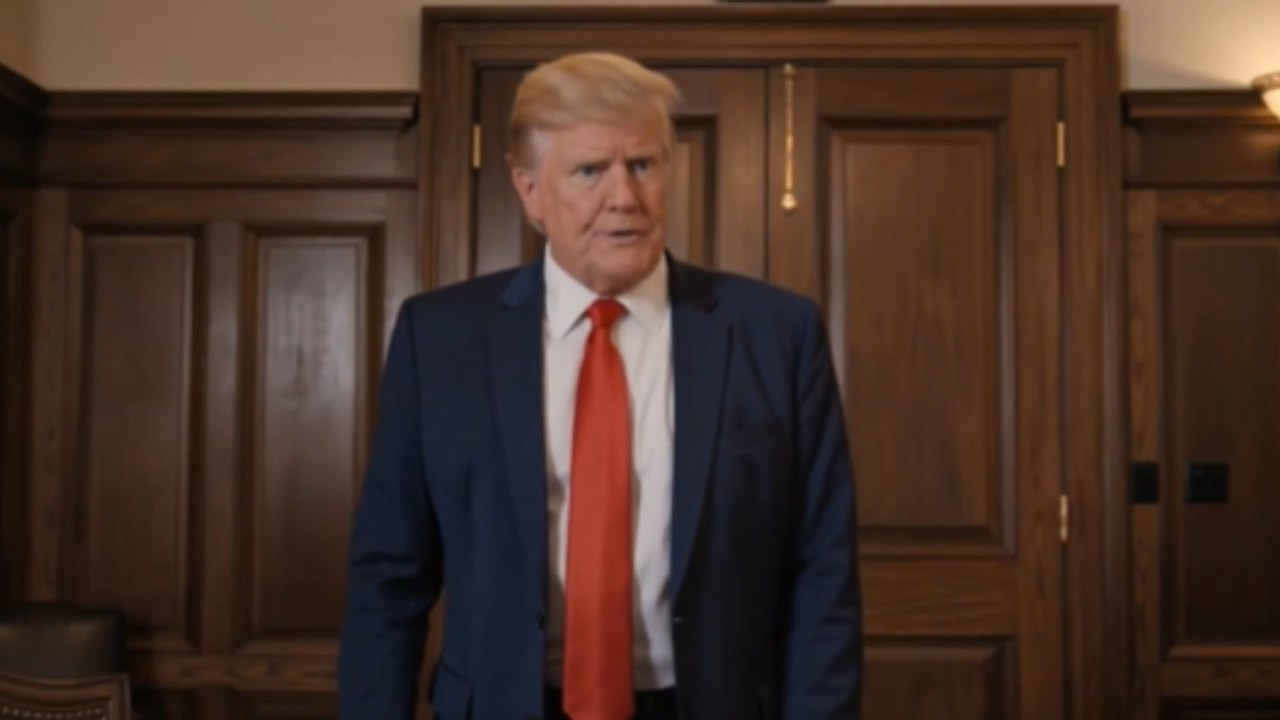
Tehran has moved beyond the era of grainy propaganda and clunky state-run broadcasts. In a sophisticated digital maneuver that caught Washington off guard, Iranian state-affiliated media channels recently deployed high-fidelity AI video to humiliate President Donald Trump. The footage, which shows an AI-generated Trump being silenced during a mock address, claims to respond to his commentary on a ceasefire brokered via Pakistan. This is not just a prank. It represents a fundamental shift in how middle powers use synthetic media to bypass traditional diplomatic channels and strike directly at the psyche of their adversaries.
The incident centers on a viral clip where a digital twin of Trump is told to "shut up" after he purportedly criticized the terms of a regional ceasefire extension. While the immediate trigger was a request involving Pakistan’s mediation, the underlying mechanics reveal a terrifyingly low barrier to entry for state-sponsored deepfakes. Iran is no longer just defending its borders; it is attacking the perceived authority of American leadership through a lens of technological mockery.
The Architecture of Digital Defiance
The production value of the video in question signals that the Iranian Revolutionary Guard Corps (IRGC) or its proxies have gained access to advanced generative modeling. This isn't the "uncanny valley" content of two years ago. The lip-syncing is precise. The cadence of the voice mimics the specific rhetorical flourishes of the former president. By choosing to target Trump specifically—a figure who looms large in the Iranian consciousness since the 2020 assassination of Qasem Soleimani—Tehran is settling a score through code.
They are using these tools to create a feedback loop of humiliation. When a Western leader makes a statement regarding Middle Eastern security, the Iranian response is now instantaneous and visual. They are skipping the formal press release from the Foreign Ministry. Instead, they are releasing 15-second clips designed for Telegram and X that make the most powerful men in the world look like bumbling caricatures. This tactic exploits the inherent speed of social media, where a debunking takes hours but a "burn" takes seconds to go viral.
Pakistan as the Proxy Pivot
The mention of Pakistan in this digital skirmish adds a layer of complexity that many Western analysts missed. Islamabad has long walked a tightrope between its "all-weather friendship" with China and its volatile security partnership with the United States. When Iran claims a ceasefire was extended at "Pakistan's request," they are intentionally framing the U.S. as an outsider to regional stability.
By using AI to portray Trump as an obstacle to this Pakistan-led peace, Iran is driving a wedge between Washington and its South Asian allies. It paints the U.S. as a disruptive force and the Islamic Republic as a rational actor willing to listen to its neighbors. This narrative inversion is the primary goal of the "Shut up Trump" campaign. It’s about more than just a funny video; it is about who gets to claim the title of "Peacemaker" in the eyes of the Global South.
The Cost of Cheap Fakes
We have entered a period where the cost of creating a geopolitical crisis has dropped to the price of a mid-tier GPU. In the past, state-level psychological operations (PSYOPs) required vast networks of agents, printing presses, or radio stations. Today, a small team in a windowless office in Tehran can generate a video that forces the State Department to issue a formal clarification.
Consider the technical requirements.
- Source Material: Thousands of hours of Trump footage are freely available on YouTube to train a voice model.
- Processing Power: High-end consumer hardware is sufficient to render a short, convincing deepfake.
- Distribution: Bot farms ensure the video reaches millions of English-speaking users before the platform moderators even wake up.
This democratization of deception means that the truth is no longer the baseline. The baseline is whatever visual evidence hits the screen first.
The Psychological Siege
The "Shut up Trump" video functions as a form of digital iconoclasm. In many cultures, the image of the leader is synonymous with the power of the state. By distorting that image—making it say things it never said or subjecting it to verbal abuse—Iran is practicing a modern form of ritual shaming. It targets the American obsession with "strength" and "optics."
When the Iranian media mocks a U.S. president with AI, they are sending a message to their own population and their regional proxies: Look, the Great Satan is just a collection of pixels we can manipulate at will. It is an effective tool for domestic morale. It makes the threat of U.S. sanctions or military action feel less imposing when you can turn the Commander-in-Chief into a punchline on your phone.
Regional Realignment and the AI Arms Race
This isn't happening in a vacuum. The Middle East is currently undergoing a massive technological overhaul. Saudi Arabia and the UAE are investing billions in AI research. Israel remains a global leader in cyber warfare. Iran, under heavy sanctions, has been forced to become resourceful, focusing on asymmetric capabilities like drone swarms and digital influence operations.
The use of AI video to interfere with the discourse surrounding a ceasefire suggests that future negotiations will not just happen behind closed doors. They will happen in a hall of mirrors. Imagine a scenario where a fake video of a negotiator "accepting" a deal is leaked an hour before the real meeting starts. The confusion alone could scuttle years of diplomacy. Tehran has just proven they are willing to pull that trigger.
Verifying the Unverifiable
The burden of proof has shifted. It used to be that the government had to prove a video was real. Now, they have to prove it is fake—and even then, the correction rarely reaches the same audience as the original. The "Shut up Trump" video was obviously a parody to many, but as the technology improves, the line between "obvious satire" and "believable misinformation" will vanish.
Western intelligence agencies are currently scrambling to develop detection algorithms that can keep pace. But these are defensive measures. Iran is playing offense. By the time a video is flagged as "manipulated media" by a social media platform, the narrative has already shifted. The "Pakistan request" story is now inextricably linked with the image of a silenced Trump in the minds of millions of viewers across the Middle East and South Asia.
The Strategy of the Mockery
Why mockery instead of a traditional threat? Because threats invite retaliation. Mockery, however, creates a dilemma for the target. If the U.S. responds too harshly to a digital video, it looks thin-skinned and desperate. If it ignores the video, it allows the humiliation to fester and the narrative to take root. Iran understands this "trap of the small insult" perfectly.
They are leveraging the viral nature of Western political polarization. They know that a significant portion of the U.S. population will share the video simply because they dislike the person being mocked, effectively doing the IRGC's distribution work for them. This is the ultimate synergy of foreign interference: getting your enemy's citizens to amplify your propaganda because it aligns with their internal domestic grievances.
Diplomatic Fallout and the Pakistan Factor
The ripple effects in Islamabad are equally significant. Pakistan’s military and intelligence services often operate in the shadows of major regional deals. By highlighting Pakistan’s role in the ceasefire through a high-profile digital stunt, Iran is forcing Islamabad into a spotlight it might not want. It places Pakistan in the middle of a tug-of-war between Tehran’s digital aggression and Washington’s diplomatic expectations.
If Pakistan is seen as the architect of a deal that "silences" American interests, it complicates their relationship with the Pentagon. Iran knows this. Every frame of that AI video was calculated to maximize friction between the U.S. and its partners. This is not "news" in the traditional sense; it is a weaponized event.
The Weaponization of Silence
The specific choice to make Trump "shut up" is a direct commentary on the perceived "loudness" of American foreign policy. For decades, the U.S. has dominated the global narrative through its media machines. Iran is now using the West’s own technology—generative AI developed in Silicon Valley—to tell the West to be quiet.
This is the new reality of the 2020s. Wars are fought in the electromagnetic spectrum and the cognitive realm long before a single shot is fired. The "Shut up Trump" video is a shot across the bow. It is a demonstration of capability. It says that Iran can reach into the heart of American culture, grab its most recognizable figures, and force them to play a role in a script written in Tehran.
The ceasefire in question might hold or it might break, but the digital precedent has been set. The next time a major international crisis erupts, don't look for the official statements first. Look for the AI-generated video that makes your side look like the villain of a comedy sketch. That is where the real war for influence is being won.
Governments that fail to adapt to this era of synthetic mockery will find themselves constantly reacting to ghosts. They will be chasing shadows in a digital landscape they no longer control. The Iranian regime has realized that you don't need to defeat a superpower on the battlefield if you can make the entire world laugh at its expense. The screen is the new frontline, and the pixels are the new bullets.
Western policymakers need to stop viewing these incidents as isolated pranks. They are iterative tests of a burgeoning doctrine of digital sovereignty. Iran is testing the limits of what the digital public will accept as "truth" or "reasonable satire." As the models improve and the voices become indistinguishable from reality, the ability to silence an opponent with a click of a button becomes the ultimate diplomatic leverage.
The era of the press release is dead. The era of the deepfake diplomat has arrived. If you want to understand the future of conflict, stop watching the tanks and start watching the timelines. The battle for the ceasefire was fought on the ground, but the battle for the meaning of that ceasefire was fought in a GPU-accelerated cloud, and in that theater, the "Shut up Trump" video was a masterful opening move.