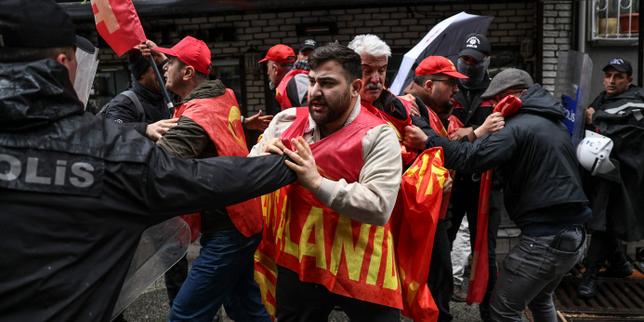
The headlines are predictable. They read like a script written in 2013 and dusted off every twelve months since. "Dozens arrested in Istanbul." "Police use tear gas to block Taksim Square." It paints a picture of a regime on the brink of a nervous breakdown and a protest movement fighting for the soul of the republic.
It is a comfortable narrative. It is also entirely wrong. If you found value in this piece, you might want to check out: this related article.
What we witnessed today in the streets of Beşiktaş and the barricades leading to Taksim wasn't a spontaneous eruption of democratic fervor, nor was it a desperate act of state survival. It was a highly choreographed ritual. This is the May Day Industrial Complex, a symbiotic performance where both the Turkish state and the fractured opposition trade blows to maintain their respective brand identities. If you are looking for the pulse of Turkish politics, stop looking at the police shields on the European side. You are watching a staged play while the real game is being played in the backrooms of Ankara and the boardrooms of the Anatolian Tigers.
The Taksim Fetish and the Death of Actual Labor Politics
Every year, the "progressive" media focuses on Taksim Square as if the cobblestones themselves possess magical democratic properties. The logic is flawed: if we can just stand in this specific square, the government will tremble. For another look on this story, check out the recent coverage from Associated Press.
Let’s be blunt. Taksim hasn't been a meaningful site of labor protest for decades. It is a symbol of secular-urban identity, not worker rights. By fixating on a banned geography, the organizers have effectively abandoned the actual workers they claim to represent. While 50 people were being hauled into white vans today, millions of Turkish laborers—suffering under 70% inflation—were either at home or working shifts in factories that the "revolutionaries" haven't visited in years.
The opposition has fallen into the trap of aesthetic resistance. They prefer the visual of a gas mask and a banner to the grueling, unglamorous work of unionizing the gig economy or the textile workshops of Zeytinburnu. When you prioritize the location of the protest over the substance of the grievance, you have already lost. The state knows this. They love the Taksim ban because it provides a predictable, contained theater of conflict that avoids deeper discussions about the crumbling purchasing power of the Turkish Lira.
The State’s Strategic Overreaction
Why does the Erdogan administration deploy thousands of riot police, shut down the Metrobus, and paralyze a city of 16 million just to stop a few hundred people from carrying carnations to a monument?
It isn't fear. It's a flex.
The Turkish state is a master of "calibrated escalation." By turning May 1 into a security crisis, the government successfully shifts the national conversation from "Why can’t I afford meat?" to "Who is threatening our public order?" It is a classic diversionary tactic that the media falls for every single time. Every arrest is a data point the government uses to signal to its core Anatolian base that the "chaos-loving elites" of Istanbul are trying to bring back the instability of the 1970s.
I have sat in rooms with political consultants who view these clashes not as failures of governance, but as successful PR campaigns. For the Ministry of Interior, 50 arrests is a quiet Tuesday. It’s a manageable number that demonstrates "firmness" without triggering a genuine international backlash. They aren't trying to stop a revolution; they are managing a brand of stability through visible force.
The Myth of the "Smashed" Protest
The competitor articles talk about the protests being "thwarted" or "smashed." This implies the protestors expected to win. They didn't.
In modern Turkish activism, the arrest is the goal. For many of the smaller, fringe leftist groups involved, an arrest record is a badge of authenticity. It is the only currency they have in a political market where they hold zero seats in parliament and zero influence in the workplace. We are seeing the "NGO-ization" of dissent, where the performance of being arrested replaces the actual achievement of policy change.
Consider the logistics. The police announce the bans weeks in advance. The protest groups announce their routes. Everyone knows exactly where the tear gas will be fired. It is the most transparent "clash" in the world. Real resistance is unpredictable. This is a scheduled appointment.
The High Cost of Symbolic Victories
While everyone argues about whether the CHP (Republican People's Party) leadership was "bold enough" to march to the barricades, the structural issues facing Turkish labor are ignored.
- The Informal Economy: Nearly a third of the Turkish workforce is unregistered. They don't care about Taksim. They care about social security and workplace safety.
- The Union Vacuum: Official unions are either state-aligned or paralyzed by bureaucracy.
- The Refugee Labor Trap: Millions of displaced workers are being used to drive down wages, a topic that neither the "pro-worker" protestors nor the government wants to touch because it complicates their tidy narratives.
If you want to disrupt the status quo, stop marching toward police lines in Beşiktaş. Start organizing in the industrial zones of Kocaeli. Start building digital networks for courier workers who are currently the most exploited class in the country. But that doesn't produce "cool" photos for Instagram or a punchy headline about "clashes in Istanbul."
The "People Also Ask" Delusion
You see the questions online: "Is it safe to travel to Istanbul on May 1?" "Why is Taksim Square closed?"
The answers given are usually sanitized travel advice. The real answer is: Istanbul is perfectly safe because the violence is localized, performative, and targeted. The closure of Taksim isn't about security; it's about the state's psychological ownership of the city's heart.
People ask if these protests will lead to another Gezi Park. The answer is a resounding no. Gezi was an anomaly because it was unchoreographed. Today's events are the opposite—they are the most rehearsed part of the Turkish political calendar.
The Superior Strategy: Abandon the Square
The most radical thing the Turkish opposition could do next year is ignore Taksim entirely.
Imagine a May Day where the unions and activists held thousands of small, localized meetings in working-class neighborhoods like Bağcılar or Sultanbeyli. Places where the police wouldn't dare use tear gas for fear of alienating the government's own voters. Places where the conversation would actually be about the price of bread and the collapse of the middle class.
But they won't do that. They are addicted to the Taksim narrative. They are trapped in a cycle of nostalgic resistance that serves the state's interests more than their own.
The arrests in Istanbul today aren't a sign of a regime in crisis. They are the heartbeat of a system that has figured out how to turn dissent into a manageable, annual spectacle. The "manifestants" got their photos, the police got their practice, and the government got its headline about "preserving the peace."
Everyone got what they wanted except the Turkish worker.
Stop reading the arrest counts. Start looking at the inflation numbers and the silence in the factories. That is where the real story is buried, and no amount of tear gas in Taksim will change that.
The spectacle is the distraction. The barricade is a stage. And the audience is being played.


