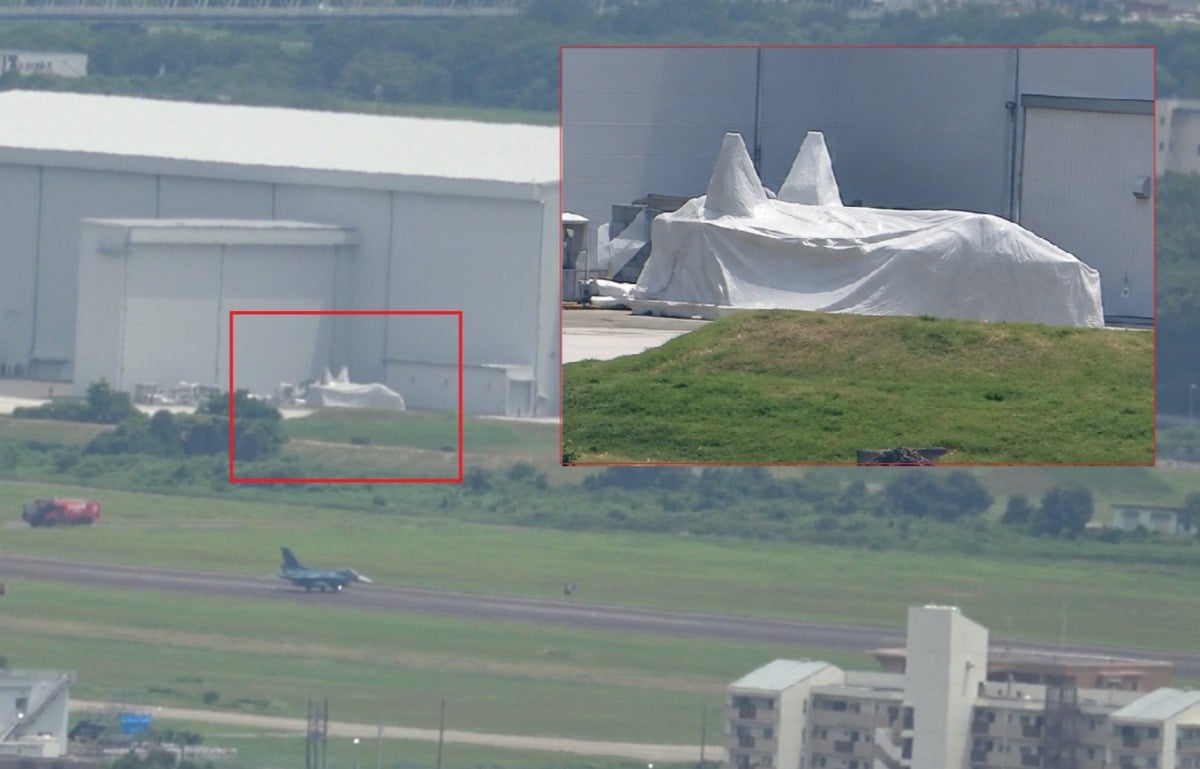
The defense blogosphere is losing its collective mind over a blurry satellite photo.
A "mystery shrouded fighter jet" was spotted at Gifu Air Base, the primary flight test center for the Japan Air Self-Defense Force (JASDF). The internet immediately did what it always does: spun a narrative of a secret, rule-breaking, hyper-advanced sixth-generation stealth platform developed in total isolation. Commentators are whispering about a sudden leap in low-observable design, a rogue offshoot of the Global Combat Air Programme (GCAP), or a resurrected Mitsubishi X-2 Shinshin. For another look, check out: this related article.
It is a beautiful story. It is also completely detached from the brutal realities of modern aerospace engineering and defense procurement.
The lazy consensus among military analysts is that every tarp-covered airframe at a test base represents a quantum leap in warfare. They want the drama of a stealth reveal. But if you have spent any time dealing with defense logistics, international supply chains, or the crushing weight of aerospace budgets, you know that this hype is a illusion. Related reporting on this matter has been provided by Ars Technica.
Japan is not building a secret, sovereign wunderwaffe in the shadows of Gifu. The reality is far more bureaucratic, far more complex, and infinitely more interesting than the sci-fi fantasy being pushed for clicks.
The Mirage of the Lone-Wolf Superfighter
Let us dismantle the core premise of the "mystery jet" panic: the idea that a nation-state can secretly design, prototype, and test an entirely new front-line combat aircraft without anyone noticing until a commercial satellite passes overhead.
This is not 1970. You cannot hide a skunkworks project in the modern digital and physical panopticon. More importantly, you cannot afford to.
Developing a next-generation flight platform requires an astronomical financial commitment. The development costs for true next-gen platforms run into the tens of billions of dollars before a single operational squadron takes flight. Japan’s defense budget, while expanding rapidly to hit the target of 2% of GDP, is already heavily committed to existing, transparent programs.
Look at the ledger. Tokyo is buying a massive fleet of F-35As and F-35Bs from Lockheed Martin. They are heavily invested in upgrading their existing F-15J Eagle fleet into the "Japanese Super Interceptor" configuration. Most importantly, Japan signed a binding, trilateral treaty with the United Kingdom and Italy to co-develop the Global Combat Air Programme.
To suggest that Japan is simultaneously running a completely separate, secret, clean-sheet fighter program is to misunderstand basic arithmetic. Aerospace engineering is not a field where you can quietly hide a multi-billion-dollar line item under "miscellaneous office supplies."
What Is Actually Under the Tarp?
If it is not a secret sixth-generation fighter, what did the satellites actually capture?
When you strip away the sensationalism, three highly plausible, logical options emerge. None of them require a conspiracy theory.
1. The X-2 Shinshin Testbed, Reconfigured
Remember the Mitsubishi X-2 Shinshin? It was Japan’s official technology demonstrator that flew between 2016 and 2018. It was never meant for mass production. Its sole purpose was to validate local stealth characteristics, radar cross-section reduction, and thrust-vectoring technologies.
After the flight test campaign ended, the X-2 did not vanish into a particle beam. It sat in a hangar at Gifu. Defense labs frequently pull retired demonstrators out of mothballs to test new components. If Japan is testing a new radar absorbent material (RAM), a fresh sensor aperture for the GCAP program, or a modified antenna array, they do not build a new jet. They bolt it onto an old airframe, cover it with a radar-reflective tarp to hide the specific geometric changes from foreign intelligence, and wheel it out onto the tarmac.
2. An Unmanned Loyal Wingman Prototype
The future of aerial combat is not a lone pilot in a trillion-dollar stealth jet. It is a manned fighter commanding a swarm of autonomous, attritable drones.
Japan’s Acquisition, Technology & Logistics Agency (ATLA) has been highly transparent about its desire to develop combat drones to fly alongside the F-35 and the future GCAP aircraft. These drones need to be high-performance, low-observable, and sized similarly to a small fighter. A modular, uncrewed combat aerial vehicle (UCAV) prototype fits the exact physical profile of the Gifu "mystery" airframe.
Calling this a "secret fighter jet" is a misnomer. It is an engine testbed or an aerodynamic shell for autonomous flight software.
3. A Maintenance and Subsystem Rig
Sometimes, a plane shape is just a plane shape. Aerospace companies regularly build full-scale fiberglass or metallic mockups for electromagnetic interference (EMI) testing, radar cross-section validation, or ground-crew training.
If you need to test how a new electronic warfare suite interacts with the physical structure of a jet, you do not risk a live, flying aircraft. You park a non-flying rig outside, subject it to intense radio frequencies, and cover it up when you are done to protect the sensor layouts from orbital reconnaissance.
The Flawed Premise of Sovereign Stealth
The public remains obsessed with the idea of national self-reliance in military aviation. The narrative that Japan will suddenly break away from international partnerships and launch a unilateral fighter is a fantasy driven by nostalgia for the era of the Zero or the Mitsubishi F-2.
That era is dead. The sheer complexity of modern combat systems makes total sovereignty an economic impossibility for almost every nation on Earth, save for perhaps the United States and China.
Consider the subsystem breakdown of a modern fighter:
- The Engines: Developing a high-thrust, low-bypass turbofan with advanced thermal management takes decades. While IHI Corporation has made incredible strides with the XF9-1 engine engine program, scaling that into a reliable, mass-produced power plant requires immense industrial infrastructure.
- The Software: A modern fighter is a flying supercomputer. The software architecture requires millions of lines of code to handle sensor fusion—merging data from radar, infrared search-and-track (IRST), and external data links into a single picture for the pilot. Writing, debugging, and certifying this software is the single biggest bottleneck in aviation history.
- The Mission Systems: Active Electronically Scanned Array (AESA) radars, electronic counter-countermeasures, and optical sensors require rare-earth elements, advanced semiconductor manufacturing, and specialized fabrication facilities that are globally distributed.
When you analyze these components, the idea of a "mystery jet" appearing out of nowhere falls apart. The global aerospace matrix is too interconnected.
The Dangerous Hype Cycle
Why does this matter? Why not just let the internet enjoy its mystery jet rumors?
Because this brand of sensationalism distorts the public understanding of defense reality. It creates an expectation that military power is defined by sudden, cinematic reveals of secret weapons.
It isn't. Military power is defined by industrial capacity, software stability, logistics, and production rates.
While defense blogs track a single tarp-covered shape at Gifu, the real story of Japanese air power is happening in boring, unglamorous conference rooms and software labs across Tokyo, London, and Rome. The success of Japan’s future air defense rests entirely on whether three distinct governments can agree on code-sharing protocols, industrial workshare percentages, and export controls for the GCAP program.
That is the unsexy truth. A treaty negotiation over intellectual property rights will determine the balance of power in the Indo-Pacific far more than whatever prototype is currently sitting on the Gifu tarmac.
Stop looking at the satellite photos for a secret savior. The mystery jet is not a revolution. It is just another incremental data point in a long, grinding, collaborative bureaucratic process. The hype machine wants you to believe in miracles. The ledger shows only engineering and economics. And economics always wins.