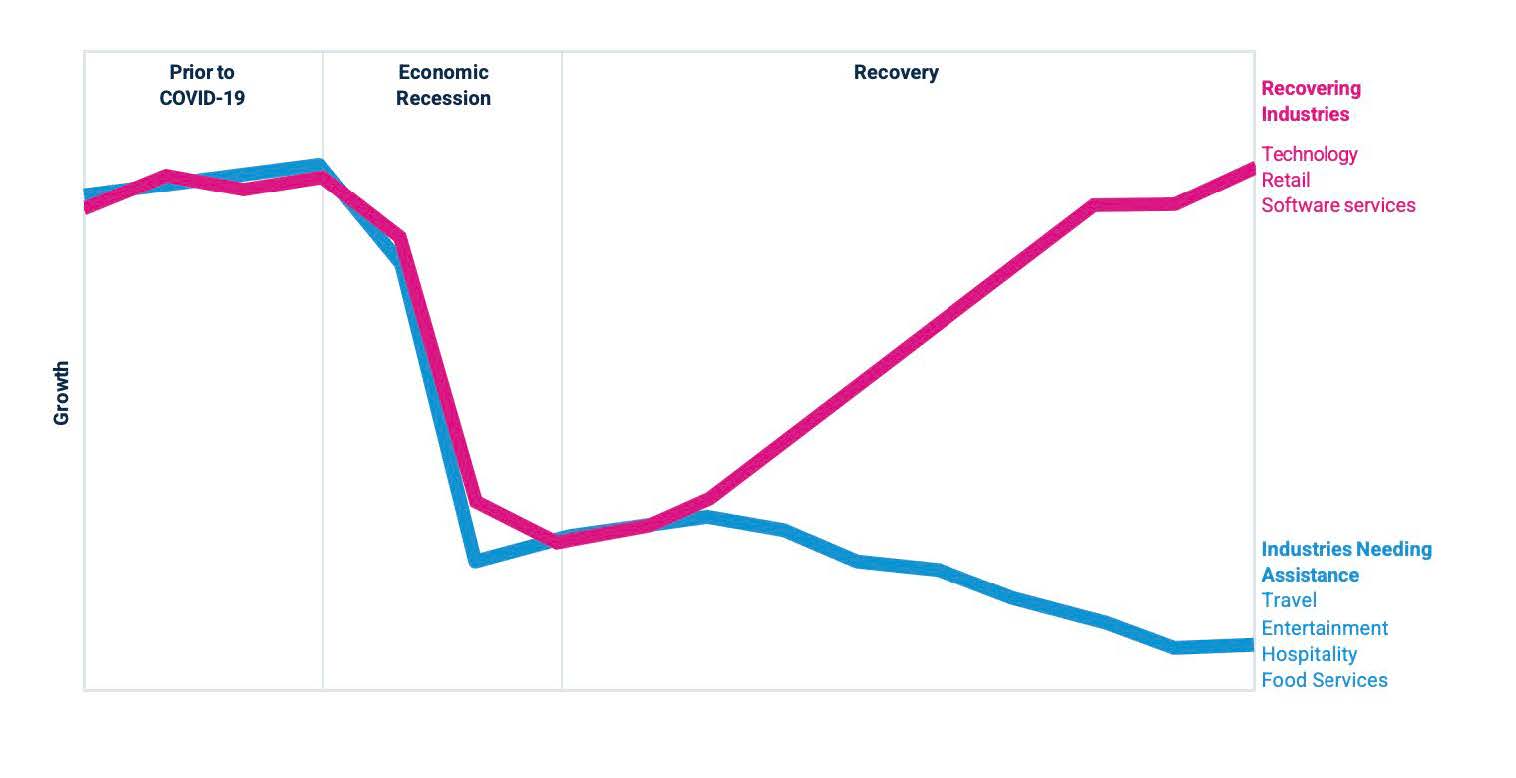
Economists love the letter K because it allows them to draw a simple picture for a complex reality. They tell you the story of two diverging paths: the wealthy climbing toward the stratosphere while the working class slides into a gutter. It is a neat, tidy narrative that fits perfectly into a 20-second news segment.
It is also largely a fabrication of lazy data interpretation. You might also find this connected story useful: The Price of a Steering Wheel.
The "K-shaped recovery" isn't a permanent structural shift in how money moves; it is a temporary byproduct of government interventionism and a massive misunderstanding of what "wealth" actually represents in a digital-first world. If you are sitting around waiting for the bottom leg of the K to "catch up" through policy shifts or wage hikes, you are missing the biggest transfer of economic utility in human history. The gap isn't widening because the poor are getting poorer. The gap is widening because we are measuring the wrong things using tools built for the 1970s.
The Wealth Illusion Of Asset Inflation
Most analysts look at the S&P 500 and the housing market, see them at record highs, and scream "Inequality!" They assume that because equity holders are "up" and renters are "down," the system is broken. As highlighted in latest articles by The Economist, the implications are widespread.
What they fail to account for is that these asset prices are not reflecting "growth" in the traditional sense. They are reflecting the devaluation of the currency. When the Federal Reserve pumps liquidity into the system, that money flows to the most efficient collateral: stocks and real estate. This isn't the top of the K "winning." It’s the top of the K desperately trying to park their purchasing power in anything that isn't melting away at 7% a year.
I’ve sat in rooms with fund managers who are terrified because their "wealth" is locked in overvalued tech stocks that haven't turned a profit in a decade. On paper, they are the top leg of the K. In reality, they are trapped in a high-stakes game of musical chairs. The "wealth gap" is often just a "valuation gap" driven by cheap debt.
Why The Bottom Leg Isn't Where You Think It Is
The standard narrative says the service worker is the victim of the K-shape. But look at the actual mobility data. We are seeing a massive "unbundling" of the traditional career path. A person who was a "bottom leg" retail worker five years ago is now a "top leg" independent contractor, content creator, or niche consultant.
The K-shape assumes people stay in their lanes. They don’t. The volatility of the modern economy means the legs of the K are constantly swapping members. If you look at longitudinal data—following the same people over ten years rather than looking at static income brackets—the "divergence" starts to look like a churn.
The Skill Arbitrage Nobody Talks About
The real divide in the economy isn't between the rich and the poor. It’s between the leveraged and the linear.
Linear workers trade time for money. If you work one hour, you get paid for one hour. This group is the one "sliding" down the K. But they aren't sliding because of corporate greed; they are sliding because time is the least valuable thing you can sell in an age of automation.
Leveraged workers use code, media, or capital to disconnect their income from their time. A developer writes a script once, and it creates value a million times. That is the upper leg of the K.
Instead of screaming about the unfairness of the shape, we should be admitting that the "linear" economy is dead. Any job that can be described in a manual is being priced to zero. That’s not a K-shaped recovery; that’s a total industrial evolution.
The Consumer Surplus Counter-Argument
Critics of the K-shape focus entirely on income and ignored utility.
Imagine a scenario where a billionaire in 1980 wanted to access the world's information, listen to any song instantly, and navigate any city with real-time traffic data. They couldn't do it. No amount of money could buy those things. Today, someone in the "bottom leg" of the K has those capabilities for $20 a month.
The cost of living for "survival" has increased (rent, healthcare, education), but the cost of "thriving" (access to knowledge, global markets, communication) has plummeted to near zero. We are experiencing massive deflation in the things that matter for upward mobility, and massive inflation in the things used for status signaling.
Stop Trying To Flatten The K
Policy wonks want to "fix" the K-shape by taxing the top and subsidizing the bottom. This is like trying to fix a leaky boat by moving water from the front to the back with a teaspoon.
The real solution is to recognize that the K-shape is a symptom of Centralization.
- Centralized Finance: Cheap money flows to the top first.
- Centralized Education: Degrees cost $200k but offer skills that expire in three years.
- Centralized Platforms: A few tech giants capture the lion's share of digital value.
If you want to disrupt the K-shape, you don't tax it. You decentralize the opportunity. We are seeing this already with the rise of the "Permissionless Economy." You don't need a gatekeeper to start a business, build an audience, or learn a high-value skill. The tools to jump from the bottom leg to the top leg have never been cheaper.
The Hidden Risk Of The Top Leg
Everyone looks at the top leg of the K with envy. They shouldn't. The top leg is currently the most fragile.
High-earning professionals—lawyers, mid-level managers, accountants—are the ones most threatened by the next wave of technological disruption. Their high salaries are built on "process knowledge" that is easily replicated. The person earning $200k a year for pushing spreadsheets is actually in a more precarious position than the plumber earning $80k. The plumber has a physical moat. The spreadsheet pusher is one software update away from the bottom leg.
The Brutal Reality Of The "Gap"
The gap isn't a glitch; it’s the design of a digital meritocracy.
In a physical world, the best baker in town can only sell so many loaves of bread. The gap between the best and the tenth-best is small. In a digital world, the best baker (or coder, or writer) can serve the entire planet. The "winner-take-most" dynamic creates the K-shape naturally.
Is it "fair"? No. But it is the reality of a world where geography no longer limits competition.
If you're asking "How do we stop the K-shaped economy?" you're asking the wrong question. You should be asking "How do I ensure my value is non-linear?"
The "K" isn't a trap unless you refuse to move. The data shows that the greatest threat to the working class isn't the wealth of the billionaires—it's the obsolescence of the skills we are still teaching in schools.
The Action Plan For The New Divergence
Forget the stimulus checks. Forget the minimum wage debates. Those are band-aids on a gunshot wound. To survive the K-shape, you need to abandon the middle.
- Own Assets, Not Income: If you only have a salary, you are a victim of the inflation that fuels the top leg. You must own a piece of the machine.
- Specialize in the "Human" Margin: AI and automation handle the logical. You handle the emotional, the creative, and the complex physical.
- Ignore the Macro, Master the Micro: The "economy" is an abstract concept that doesn't exist for you. Your personal economy is driven by your specific niche.
The K-shape isn't an omen of doom. It’s a map of the new world. You can complain about the coordinates, or you can start walking toward the upper line.
The divergence is real, but it isn't a wall. It's a filter.


