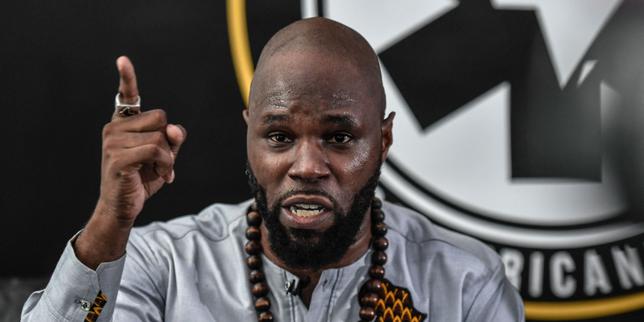
The mainstream media loves a simple script. They see a firebrand like Kemi Seba handcuffed in South Africa and they immediately reach for the "extremist arrested" template. It is lazy. It is predictable. Most importantly, it is wrong. By labeling him merely as a "black supremacist" or a fringe radical, the established press misses the tectonic shift happening beneath the surface of African geopolitics.
The arrest of Stellio Gilles Robert Capo Chichi—known to the world as Kemi Seba—isn't a victory for the rule of law. It is a desperate reflex from a geopolitical architecture that is losing its grip. If you think this is about a visa violation or inciting public disorder, you are looking at the finger pointing at the moon.
The Myth of the Fringe Radical
Critics want you to believe Seba is a lone wolf shouting into the void. This is a dangerous miscalculation. I have tracked political movements across the Sahel and West Africa for over a decade. I have seen how "fringe" ideas become the bedrock of national policy overnight. When Seba burns a CFA franc note, he isn't just performing for the cameras; he is conducting a ritual of economic exorcism that resonates with millions of youth from Dakar to Bamako.
The competitor articles focus on his rhetoric, calling it "hateful." They ignore the mechanics of his influence. Seba operates as a geopolitical influencer who has successfully weaponized the resentment of the "Global South." To dismiss him as a supremacist is to ignore why his message of Souverainisme—sovereignty—is winning. People aren't following him because they hate others; they follow him because they are tired of being told their own currency is managed from a basement in Paris.
South Africa’s Impossible Balancing Act
Why arrest him in Johannesburg? South Africa likes to posture as the moral compass of the continent, the leader of the BRICS+ expansion, and the champion of the multipolar world. Yet, the moment a radical pan-Africanist lands on their soil, the state machinery grinds into gear to silence him.
This exposes the Pretoria hypocrisy. You cannot claim to be the vanguard of a new African century while simultaneously acting as the security guard for the old world order. The South African authorities aren't worried about Seba's "supremacy." They are worried about his ties to Moscow and his ability to mobilize the street. In a country already on a knife-edge of social unrest, a charismatic orator talking about the "re-colonization" of Africa by Western NGOs is a nightmare for the ANC.
The Russia Connection: Beyond the Boogeyman
Let's talk about the elephant in the room that every other news outlet handles with kid gloves: Russia. The standard narrative is that Seba is a "proxy" or a "mercenary" for the Kremlin. This is a patronizing view that denies African agency.
Is he aligned with Russian interests? Obviously. But the nuance missed by the "lazy consensus" is that Seba isn't being used by Russia; he is using Russia. In the current geopolitical market, Moscow offers the only viable "security package" that doesn't come with a lecture on liberal democracy or structural adjustment programs. Seba understands that in a multipolar world, you don't pick a side based on morality; you pick a side based on leverage.
Imagine a scenario where a leader wants to break free from a lopsided trade agreement. In the 1990s, they were crushed. Today, they call Seba, who calls his contacts in the Wagner Group (now Africa Corps), who provide the muscle to tell the old colonial powers to stay home. It is brutal, transactional, and effective.
The Failure of "Black Supremacy" as a Label
Calling Kemi Seba a "black supremacist" is a linguistic trick used to avoid discussing the actual content of his critique. Supremacy implies a desire to dominate others. Seba’s core platform, whether you like his tone or not, is about dissociation.
He isn't asking for Africa to rule Europe. He is demanding that Europe stops ruling Africa. By framing this as "racism," Western analysts can ignore the legitimate grievances regarding the CFA franc, the presence of foreign military bases, and the extraction of lithium and gold by multinational corporations that pay zero tax to the local populations.
If we look at the data on currency stability in the CFA zone versus the economic sovereignty of the ECOWAS nations, the "stability" provided by France looks more like a ceiling than a floor. Seba points this out. The media calls him a radical. I call him a realist with a megaphone.
The Arrest Is a Marketing Gift
If the South African government wanted to stop Kemi Seba, the last thing they should have done was arrest him. They have just handed him the greatest asset a revolutionary can own: martyrdom.
Every hour he spends in custody is another million views on social media. Every headline calling him a "supremacist" validates his claim that the "global system" is out to get him. You don't defeat an ideology by locking up the man; you defeat it by providing a better alternative. And right now, the pro-Western neoliberal model is failing to provide jobs, security, or dignity to the African youth.
I have seen this movie before. You arrest the agitator, and his followers don't disappear—they radicalize. They stop talking and start acting. The arrest in South Africa won't be the end of Seba's influence; it will be the starting gun for the next phase of the "African Spring."
The Brutal Reality of Sovereignism
The uncomfortable truth that nobody wants to admit is that Seba’s brand of pan-Africanism is winning because the "civilized" alternatives have failed. The NGOs have failed. The IMF has failed. The "peacekeeping" missions have failed.
Seba’s approach is messy. It is loud. It is often offensive. But it is perceived as authentic. In a world of PR-managed politicians and corporate-sponsored activists, authenticity is the most valuable currency on the planet.
The arrest is a signal that the old guard is terrified. They aren't afraid of Seba's "hate speech." They are afraid that he is right about the fragility of their power. They are afraid that the youth of the continent have stopped listening to the speeches in New York and started listening to the man in the beret.
Stop looking at the handcuffs. Start looking at the crowd waiting outside the station.
The era of managing Africa from a distance is over. Whether Kemi Seba is the right messenger is irrelevant. The message has already been delivered, and it is currently being signed for by an entire generation that has nothing left to lose.
Release him or keep him; the fire is already lit.