Desperation has a distinct smell.
In the summer of 1834, along the muddy banks of the Ohio River, it smelled like boiled vinegar, cloves, and rotting apples. It smelled like chamber pots emptied in the dead of night and the sharp, metallic tang of calomel—a mercury-based purgative that doctors handed out like peppermint drops. If you lived in Cincinnati or New York or a cramped Philadelphia rowhouse during the Jacksonian era, your stomach was a battlefield. Cholera swept through port cities like a scythe. Dysentery emptied entire boarding houses in forty-eight hours. Even on a good Tuesday, a diet heavy on salted pork, rancid lard, and unwashed river water left millions of Americans doubled over in quiet, relentless agony.
Imagine, for a moment, a hypothetical cooper named Thomas living in a damp basement flat near the Cincinnati docks. Let us put him in July of 1835. His gums are bleeding from the mercury his local physician prescribed for a "bilious fever," his gut twists every time he drinks from the neighborhood pump, and his three-year-old daughter has not kept down a spoonful of broth in two days. When a man in that state hears that a respected professor of medicine has found a miracle cure growing right in the backyard garden, he does not ask for peer-reviewed clinical trials. He reaches for his last silver coin.
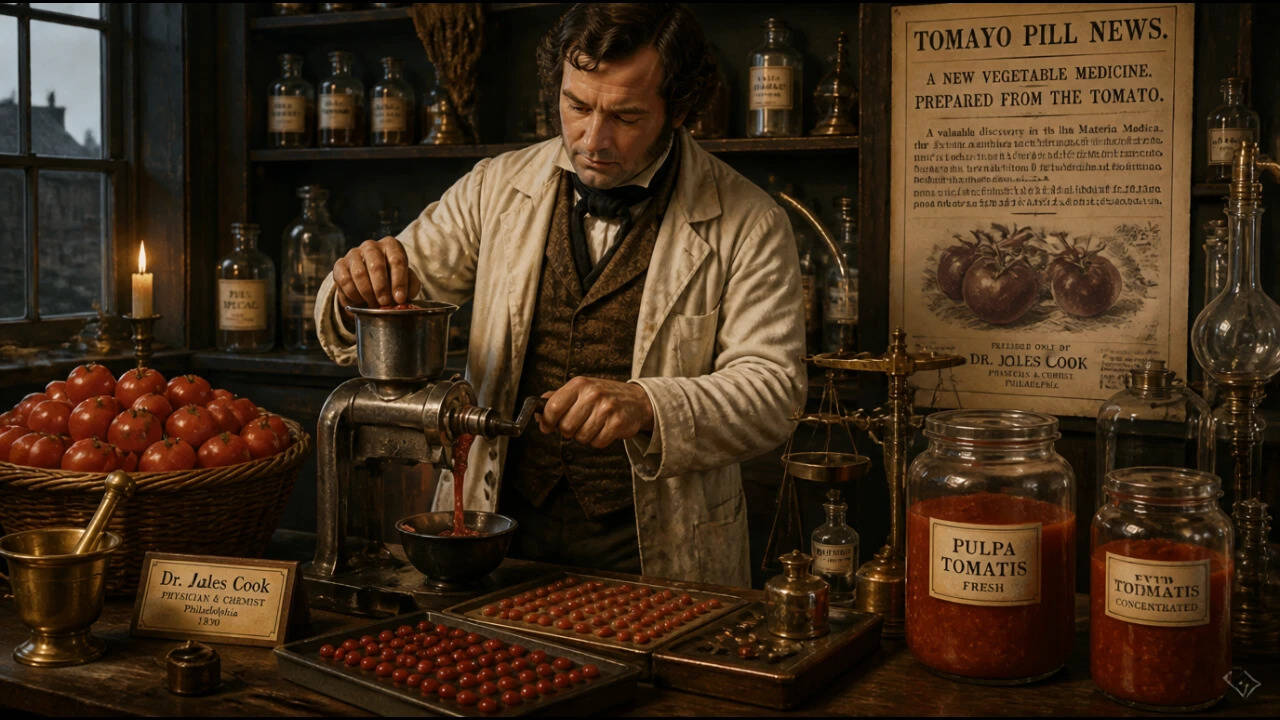
This is the strange, forgotten truth sitting beneath a condiment we now squirt carelessly onto french fries. Before tomato ketchup became the harmless red sugar-paste of the modern American diner, it was marketed, swallowed, and fiercely debated as a potent pharmaceutical drug. For nearly a decade in the 1830s, Americans bought concentrated tomato pills and bottles of medicinal ketchup to cure everything from chronic indigestion to violent diarrhea.
And then, almost as quickly as the fever broke, the entire empire collapsed into fraud, bitterness, and public humiliation.
The Poison Apple That Became a Panacea
To understand how a kitchen condiment hijacked nineteenth-century medicine, you have to understand how terrified Americans once were of the tomato itself.
For centuries across Europe and North America, the bright red fruit—botanically a berry, legally a vegetable—carried a sinister reputation. It belonged to the Solanaceae family, making it a close botanical cousin to deadly nightshade, belladonna, and mandrake. When wealthy aristocrats ate tomatoes off pewter plates in the seventeenth and eighteenth centuries, the high acidity of the fruit leached lead out of the metal, poisoning the diners. Naturally, people blamed the red fruit rather than the tableware.
In early nineteenth-century America, most citizens viewed the "love apple" as an ornamental curiosity at best and a slow-acting toxin at worst. Some suspected it caused cancer. Others warned it inflamed the blood or provoked madness.
Then stepped forward Dr. John Cook Bennett.
Bennett was a man built for the chaotic, unregulated frontier of Jacksonian medicine—charismatic, restless, and endlessly ambitious. By 1834, he had secured a post as president of the medical department at Willoughby University in Ohio, a fledgling institution eager for prestige. That autumn, Bennett began delivering a series of public lectures that turned centuries of culinary superstition upside down.
The tomato, Bennett declared, was not a poison. It was the single greatest medicinal discovery of the modern age.
According to Bennett’s sweeping claims, the acidic pulp of the tomato could cure diarrhea, halt violent attacks of cholera, soothe chronic indigestion, and cleanse a sluggish liver. His logic rested on the dominant—and deeply flawed—medical theory of the era. Nineteenth-century physicians believed most internal illnesses stemmed from an imbalance of "bile" in the liver and stomach. To fix the body, doctors routinely administered massive doses of calomel (mercurous chloride) to force the liver to purge. Calomel worked, in the sense that it triggered violent vomiting and diarrhea, though it also caused patients' teeth to fall out, rotted their jawbones, and frequently killed them.
Bennett offered a seductive alternative. He claimed that tomatoes acted as a "natural calomel"—a gentle, vegetable-based purgative that stimulated bile without poisoning the patient.
Word spread like wildfire through the penny press. Newspapers from Maine to Missouri reprinted Bennett’s lectures verbatim. Farmers who had previously tossed tomatoes to their hogs suddenly planted acres of them. Recipes for "tomato ketchup"—originally a thin, spiced, vinegary sauce modeled after Asian fish brines and English mushroom ketchups, entirely devoid of modern corn syrup—began appearing in medical columns rather than cookbooks.
People drank it by the spoonful before meals. They mixed it into warm water for sick children.
Enter the Pill Barons
Whenever panic meets a plausible cure, capitalism arrives with a patent.
If fresh tomatoes worked wonders in August, what was a suffering citizen supposed to do in January, months before commercial canning or refrigerated railcars existed? The answer was obvious to any enterprising apothecary: concentrate the miracle into a pill.
By 1837, the "tomato pill" craze had erupted into a full-blown commercial war. Drugstores across New York, Boston, Baltimore, and St. Louis filled their front windows with wooden boxes and glass apothecary jars promising the condensed essence of the tomato.
Consider what happens when a medical theory becomes a consumer brand.
Dr. Bennett himself was quick to endorse commercial preparations, lending his academic title to "Dr. Bennett’s Compound Extract of Tomato Pills." Almost immediately, rivals smelled blood in the water. The fiercest challenger was a shrewd New York patent-medicine mogul named Archibald Miles, who launched "Dr. Miles’ Compound Extract of Tomato."
Miles did not merely sell pills; he sold salvation wrapped in newsprint. He flooded newspapers with breathless testimonials from supposedly cured clergymen, sea captains, and frontier judges. His advertisements warned consumers against "worthless counterfeits" while claiming his own extract possessed all the liver-cleansing power of mercury without a single drop of poison.
Think of the tomato pill craze as the nineteenth-century equivalent of the modern wellness supplement boom. Replace the apothecary jar with an amber glass dropper bottle on a social media feed, swap "biliousness" for "gut inflammation" or "adrenal fatigue," and the psychological machinery is identical. People were exhausted by harsh, alienating mainstream medicine—in 1835, literal mercury; today, endless prescriptions and rushed ten-minute clinic visits—and they desperately wanted to believe that nature held a gentle, side-effect-free shortcut to health.
I have stood in modern pharmacies staring at walls of proprietary herbal blends, feeling that exact pull of hope against skepticism. When your body is failing you, nuance feels like a luxury you cannot afford. You want the bottle that promises everything.
The Anatomy of a Collapse
For three years, Archibald Miles and John Cook Bennett made small fortunes while millions of Americans swallowed reddish-brown pills made of dried tomato pulp, licorice root, and mystery binders.
Then the cracks began to show.
First came the public mudslinging. Bennett and Miles turned on each other in the newspapers, accusing one another of peddling fraudulent recipes, forging medical endorsements, and deceiving the public. Readers watching two supposed champions of medical science tear each other apart in paid advertisements began to wonder if either man was telling the truth.
Second, and far more fatal, was the physical reality of the pills themselves.
Customers began cracking open their expensive boxes of "Compound Extract of Tomato" only to find rock-hard pellets that tasted suspiciously like cheap aloes, jalap, and rhubarb—standard, dirt-cheap laxatives that any country druggist kept in bulk behind the counter. When chemical analysts and skeptical physicians examined the competing brands, the illusion evaporated. Many of the pills contained almost no tomato extract at all. Those that did were merely dried vegetable matter padded out with harsh purgatives so the customer would feel an immediate, dramatic effect in the bathroom and assume the "tomato" was working.
By 1840, the medical establishment had seen enough.
Journals like the Boston Medical and Surgical Journal—the direct ancestor of the New England Journal of Medicine—published scathing dismantlings of the craze. Physicians pointed out that while tomatoes were a pleasant, mildly nutritious addition to a summer diet, they possessed zero magical ability to cure cholera, dissolve gallstones, or replace legitimate medical care.
John Cook Bennett’s reputation imploded even faster than his pills. Exposed as an academic opportunist who had exaggerated his credentials and fabricated degrees, he drifted away from mainstream medicine altogether, eventually reinventing himself as a controversial religious figure in Nauvoo, Illinois, before ending his days raising prize poultry in Iowa.
The tomato pill market vanished almost overnight. Boxes that sold for fifty cents in 1838 could not be given away in 1842.
What Remained in the Bottle
The craze was a farce, yet it left behind two permanent transformations in American life.
First, it broke the psychological taboo against the tomato. Once millions of ordinary families had eaten tomatoes in sauces, stews, and medicinal ketchups without dropping dead from nightshade poisoning, they realized the fruit was delicious. The tomato quietly migrated from the apothecary shelf to the kitchen table, paving the way for the canning industry, condensed soups, and eventually Henry J. Heinz’s famous glass bottles in 1876.
Second, the 1830s ketchup mania exposed a permanent vulnerability in how human beings think about health.
Technically, Bennett was not entirely wrong about the biology of the tomato, even if he lied about its powers. Today we know tomatoes are rich in vitamin C—which genuinely prevents scurvy, a real scourge of nineteenth-century winters—and lycopene, a potent antioxidant linked to cardiovascular health. Eating fresh tomatoes really did make people feel better when their winter diets consisted mostly of salt pork, cornmeal, and whiskey.
Bennett’s crime was taking a modest nutritional truth and inflating it into an omnipotent cure.
Every generation falls for its own version of the tomato pill. Whenever someone packages an ordinary food into an expensive capsule, attaches a charismatic doctor’s name to the label, and promises it will effortlessly scrub away complex diseases, they are running Archibald Miles’s exact playbook.
Next time you tap the bottom of a glass ketchup bottle over a plate of fries, look closely at that thick red ribbon sliding onto the porcelain. Nearly two hundred years ago, frightened parents fed that exact mixture by the teaspoon to feverish children in dark rooms, praying a dose of spiced vinegar and crushed love apples would hold death at the door.