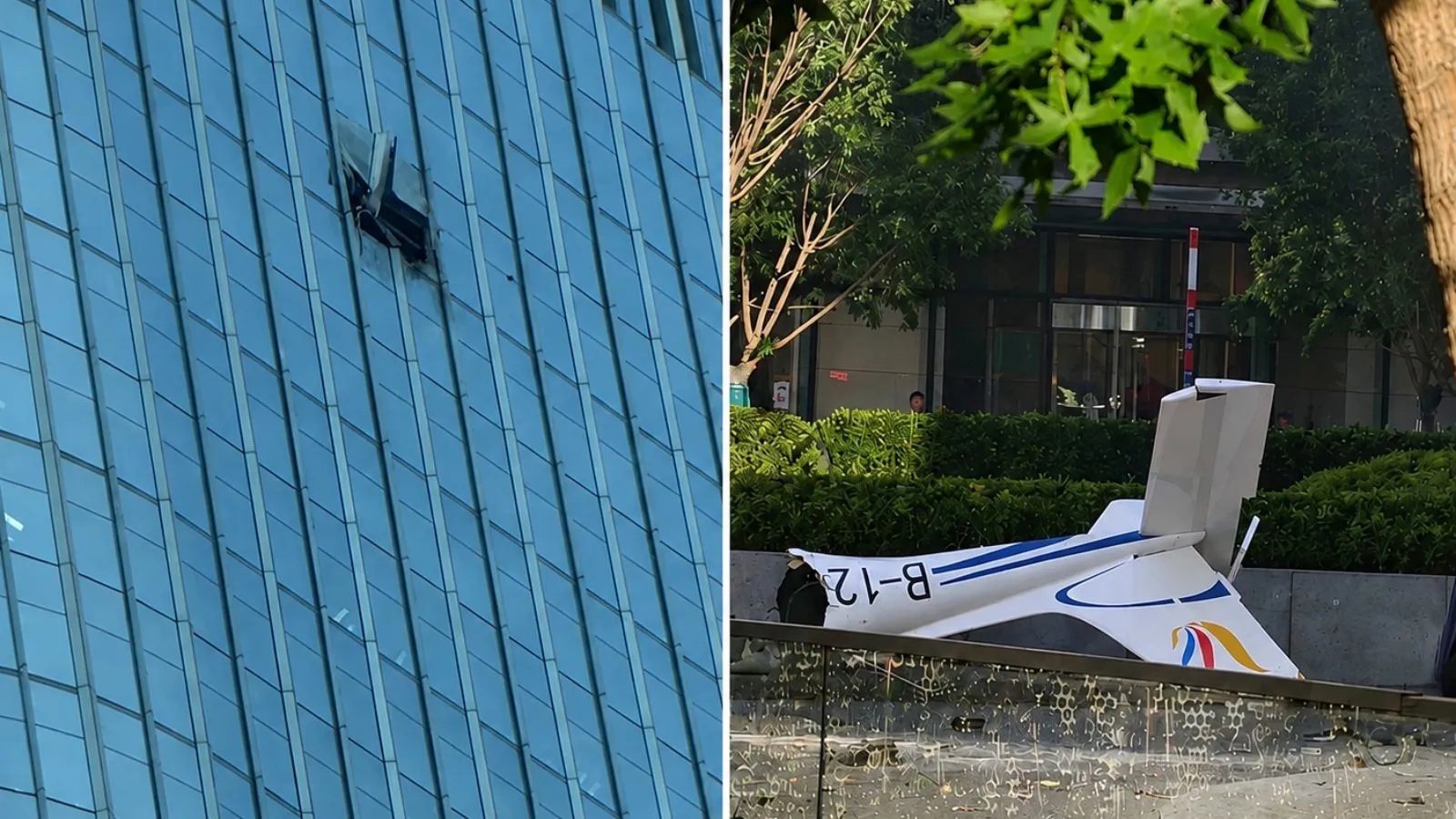
An aircraft striking the tallest skyscraper in a capital city represents a simultaneous failure of psychological screening mechanisms, kinetic monitoring systems, and sovereign airspace containment. On June 26, 2026, a privately operated Aurora SA60L light sport aircraft departed its designated flight training sector in suburban Pinggu and penetrated the ultra-restricted core airspace of Beijing, ultimately impacting the 528-meter CITIC Tower (China Zun). The official municipal probe released on July 2, 2026, by the Chaoyang district government formally classified the incident as an act of "endangering public safety caused by personal reasons," confirming that the 66-year-old pilot, surnamed Liu, left explicit diary entries detailing intent to end his life.
This trajectory exposes a fundamental structural vulnerability in urban aviation security: the extreme asymmetry between the low barrier to entry for general aviation and the massive kinetic risk posed by low-altitude, small-radar-cross-section aircraft in dense metropolitan centers. Deconstructing this event requires an examination of the human operational risk factors and the regulatory loopholes that permitted a rogue flight vector to intersect with one of the most heavily monitored urban coordinates on earth.
The Human Error Matrix: Screening and Psychological Red Flags
The official investigation revealed that the pilot suffered from documented chronic insomnia and clinical anxiety, living as a self-employed divorcé in complete isolation. Despite this severe psychological regression, the operator successfully maintained a sport pilot license obtained in 2021 and advanced to a private pilot license in 2024. This progression highlights a systemic bottleneck in aviation medicine: the reliance on periodic, self-reported, or superficial physical evaluations that fail to intercept active psychological deterioration.
The operational sequence on the day of the crash reveals a specific behavioral anomaly known in aviation safety as the "compliance facade."
- Phase 1: Supervised Verification. The pilot first conducted an accompanied check-flight with an instructor at Shifosi Airport in Pinggu. This phase served to demonstrate mechanical competence and psychological stability under direct observation.
- Phase 2: Solo Transition. Immediately upon receiving clearance for a solo flight at 17:30, the pilot initiated the planned suicide sequence.
- Phase 3: Vector Divergence. Within ten minutes of takeoff, at 17:40, the pilot deliberately breached the lateral boundaries of the assigned training sector, ceased all radio communication with air traffic control, and assumed a direct heading toward the central business district.
This behavioral pattern demonstrates that traditional check-rides and supervised flights cannot reliably predict insider threats when an operator possesses the unilateral authority to transition to solo operations. The structural gap exists because current general aviation protocols assume a baseline alignment of intent between the pilot and the regulatory framework. Once that alignment fractures, a light sport aircraft functions effectively as an unguided kinetic missile.
The Kinematics of Low-Altitude Airspace Penetration
The mechanics of the flightpath present a profound technical contradiction. Beijing maintains some of the most stringent airspace restrictions globally, co-managed by the Civil Aviation Administration of China (CAAC) and the People’s Liberation Army Air Force (PLAAF). Any flight over the capital requires explicit joint military-civilian clearance. How an Aurora SA60L—a single-engine, two-seat aircraft made largely of composite materials—traveled roughly 50 kilometers from the rural Pinggu district into the urban core undetected or unchallenged points to a distinct technical limitation in low-altitude radar monitoring.
Light sport aircraft possess low thermal signatures, minimal electromagnetic emissions, and small physical profiles. When flying at low altitudes, their radar returns are frequently obscured by terrain masking, ground clutter, and urban architectural density. The technical breakdown can be modeled through three distinct operational vectors:
- Radar Cross-Section (RCS) Exploitation: The carbon fiber and fiberglass construction of modern light sport aircraft inherently yields a low RCS compared to commercial aluminum airframes, dropping the detection probability on standard civil primary surveillance radar.
- Transponder Disconnection: By terminating communication and likely deactivating the Mode S or ADS-B transponder, the pilot eliminated secondary surveillance radar tracking, forcing air traffic control to rely on raw primary reflections that are easily confused with weather anomalies or avian activity.
- The Target Dilemma: The flight took place at approximately 18:00, matching peak urban traffic and high ambient noise levels. The transition from an anomalous blip to an active urban threat occurs in a window of fewer than 15 minutes, neutralizing traditional intercept protocols.
The physical impact occurred at 17:55. The aircraft struck the upper glass facade of the 108-story CITIC Tower, wounding 13 individuals on the ground and within the building via secondary debris showers. The structural resilience of the skyscraper prevented catastrophic failure, as the kinetic energy ($E_k = \frac{1}{2}mv^2$) of a 600-kilogram light sport aircraft traveling at cruising speeds is insufficient to compromise heavily reinforced steel-concrete composite columns, a stark contrast to commercial airliners with mass factors 300 times greater.
Systemic Regulatory Fallout and Asymmetric Countermeasures
The immediate institutional response inside China reflects a policy of total risk elimination through structural paralysis. Flight schools nationwide have been ordered to suspend all operations indefinitely to undergo comprehensive safety and political inspections. This reaction addresses the immediate symptoms but exposes the fragility of a general aviation sector caught between economic expansion and absolute security mandates.
Just weeks prior to the incident, Beijing had codified sweeping airspace regulations requiring prior government and air traffic approval for every outdoor flight, including recreational consumer drones. The June 26 crash exposes the limitation of legislative bans: laws regulate compliant actors but possess zero preventative efficacy against a suicidal operator already determined to violate public safety laws.
The resulting framework creates an operational bottleneck. To secure urban centers from low-altitude asymmetric threats, regulatory bodies are forced to choose between two highly disruptive economic paths. The first is the total suppression of the low-altitude economy, effectively destroying the domestic private aviation, flight training, and logistics drone industries. The second is the mandatory implementation of hardware-level geofencing and remote termination systems built directly into the avionics of all light aircraft.
Because the Aurora SA60L and similar light sport categories utilize digital engine control units and modern flight displays, future airworthiness directives will likely mandate hardcoded, un-bypassable "no-fly zone" algorithms. If an aircraft passes an unauthorized geofence coordinate, the onboard avionics would automatically override pilot inputs, entering a stabilized autonomous holding pattern or executing an immediate controlled descent away from high-density urban geography. Implementing this tier of control introduces profound liability questions regarding software failure overrides, yet it remains the only systematic technical mechanism capable of separating a compromised pilot from the physical control surfaces of an airborne vehicle.