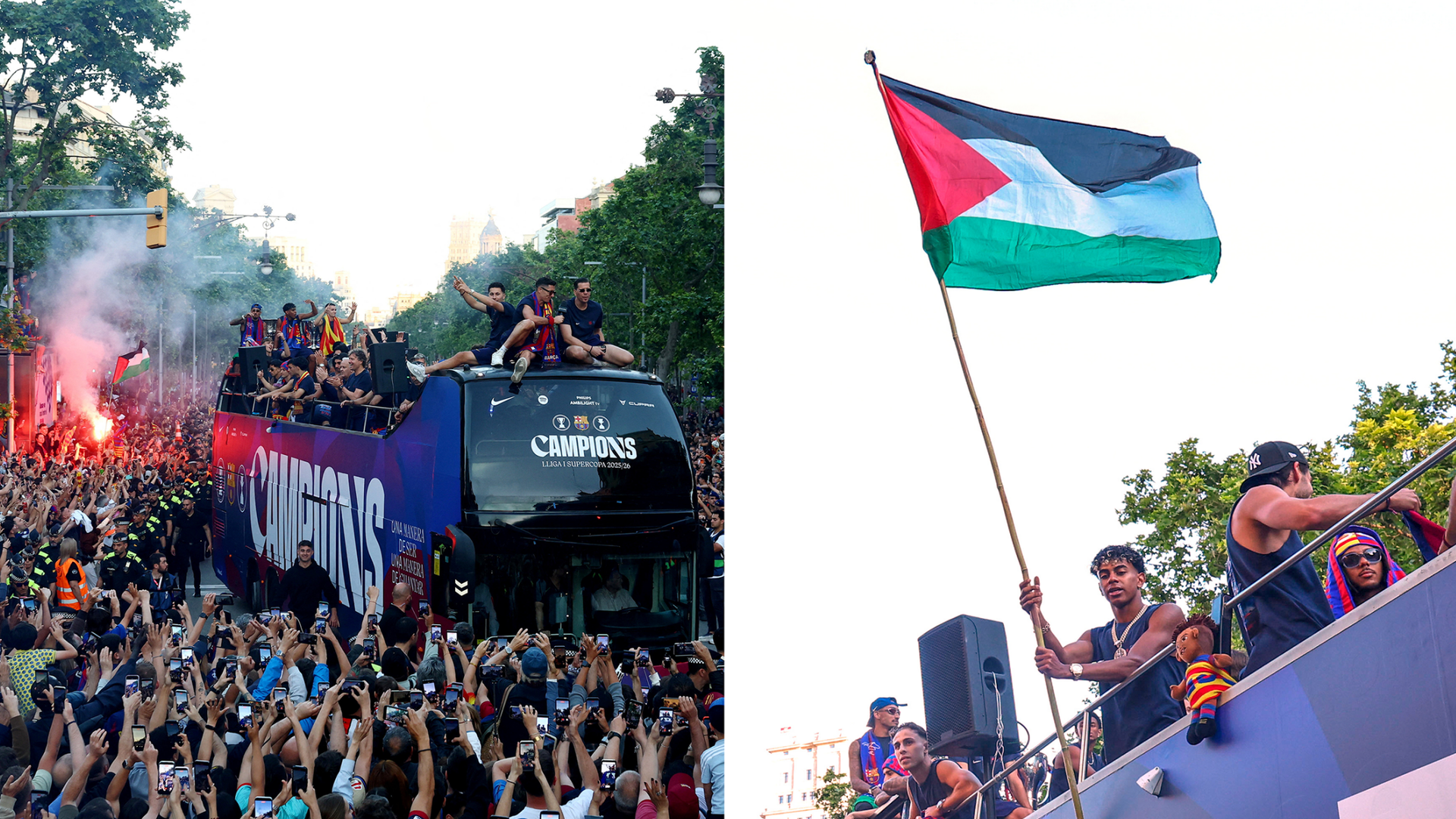
The internet has a memory problem. More specifically, the football media ecosystem has a verification problem that borders on the pathological. You’ve seen the headline. You’ve seen the blurry social media grabs. You’ve heard the roar of the digital crowd claiming that Barcelona’s teenage phenom, Lamine Yamal, used a trophy parade to make a definitive geopolitical statement.
The "lazy consensus" dictates that every young star is now an activist by default. The narrative machine wants you to believe that a sixteen-year-old on the verge of superstition-shattering greatness spent his victory lap focused on international diplomacy. Meanwhile, you can find other stories here: The Murray Myth Why Coaching Jack Draper is a Calculated Risk for British Tennis Not a Guaranteed Win.
Here is the cold, hard truth: the flag wasn't Palestinian. The "controversy" is a ghost. And the media’s rush to publish fiction for clicks is the real scandal.
The Anatomy of a Visual Hallucination
In the digital age, a flag is rarely just a piece of fabric. It is a Rorschach test. When Lamine Yamal celebrated Barcelona’s domestic success, images circulated of him draped in a four-colored banner: red, green, white, and black. To see the bigger picture, check out the detailed article by FOX Sports.
To the untrained or agenda-driven eye, the Palestinian flag is the immediate assumption. It fits the current global climate. It generates engagement. It creates a "moment."
But geography matters. Accuracy matters more.
The flag in question was the Mataró flag. For those who haven't spent time in the trenches of Catalan local identity, Mataró is Yamal’s hometown. It is the heart of his "304" celebration—the postal code of Rocafonda that he flashes with his fingers after every goal.
The Mataró flag features four horizontal stripes: blue, red, yellow, and white, often adorned with the city's coat of arms. In various lighting and low-resolution social media clips, the deep blues and reds of a municipal flag can easily be distorted. More importantly, Yamal has frequently carried the Mocador de Casteller, a traditional red bandana with white polka dots, or the Senyera (the Catalan flag).
The confusion wasn't an accident. It was a projection. People saw what they wanted to see because the reality—a kid celebrating his neighborhood—isn't "viral" enough.
The Activism Trap
We are living through the era of the "Mandatory Statement." Fans and pundits now demand that athletes occupy the role of moral arbiters. When a player doesn't speak, it’s a scandal. When they do speak, it’s a firestorm.
I’ve watched clubs scramble to manage the PR fallout of "non-events" for years. The danger here isn't just misinformation; it's the stripping away of an athlete's right to be a local hero before they are forced to be a global symbol.
Yamal is a child of the Maresme coast. His identity is rooted in the concrete pitches of Rocafonda. When he drapes himself in a flag, he isn't signaling to a desk in New York or a protest in London. He is signaling to the kids back home that he hasn't forgotten the 304.
By misidentifying his symbols, the media effectively erases his actual heritage to serve a more convenient, high-traffic narrative. It is a form of digital colonialism—taking a local boy's tribute to his block and colonizing it for a global culture war.
Why the Media Keeps Getting It Wrong
Why did major outlets and thousands of verified accounts run with the Palestinian flag story?
- The Speed Over Substance Cycle: If you wait ten minutes to verify the colors of a municipal flag, you lose 50,000 retweets. In the modern newsroom, being first is a business requirement; being right is an optional luxury.
- The Algorithm Favors Friction: A story about a teenager honoring his hometown is "nice." A story about a teenager sparking a geopolitical debate is "explosive." Platforms prioritize the latter.
- The Lack of Cultural Context: Most English-speaking or international football "journalists" couldn't find Mataró on a map if their lives depended on it. They don't understand the nuances of Catalan symbolism or the specific regional pride inherent in La Masia graduates.
The Cost of the "Fake Statement"
This isn't a victimless mistake. When we falsely attribute political stances to players—especially those who are minors—we paint a target on them.
Imagine a scenario where a club’s board, fearing sponsor backlash or political pressure, disciplines a player based on a viral lie. It’s happened before. It will happen again. We are putting the weight of the world on the shoulders of a kid who just wants to dribble past a fullback and make his mother proud.
If you want to support Lamine Yamal, support his right to be a sixteen-year-old from Mataró. Stop trying to recruit him into your digital infantry.
The Brutal Reality of Verification
If you want to know what’s actually happening in a victory parade, stop looking at Twitter "Aggregators." These accounts are the bottom-feeders of the industry. They scrape content, add a sensationalist lie, and wait for the revenue to roll in.
Real expertise in sports journalism requires more than a high-speed internet connection. It requires an understanding of:
- Vexillology: The study of flags.
- Regional Politics: The specific tension between local, national, and international identities.
- Contextual History: Knowing that Yamal has worn these specific colors since his youth team days.
The "insider" secret is that half the things you see trending are built on a foundation of pure imagination. The Yamal flag story is just the latest example of how easily the public can be led into a frenzy by a low-resolution JPEG and a confident caption.
The next time you see a headline claiming a player has made a "shocking" or "bold" political move, do the one thing the modern media refuses to do.
Look at the fabric. Check the zip code. Stop falling for the bait.
Lamine Yamal didn't choose a side in a global conflict during a bus ride through Barcelona. He chose Mataró. He chose his neighbors. He chose his truth.
The fact that you were told otherwise says everything about the state of modern "news" and nothing about the boy with the 304 in his heart.
Log off and check the source. Or better yet, learn the difference between a city flag and a nation-state. It’s the least you owe to the sport.