The Feel-Good Lie We Tell Ourselves
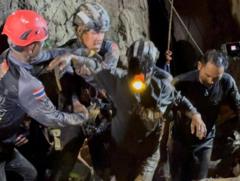
The media is running its favorite playbook right now. A flooded cave in Laos. Five trapped men. The triumphant extraction of the first survivor. Broadcasts are filled with breathless praise for the coordinated response, the institutional oversight, and the standard operating procedures that made the miracle happen.
It is a comforting narrative. It is also entirely wrong.
The mainstream coverage of complex wilderness rescues suffers from a chronic misunderstanding of how survival actually happens in high-consequence environments. We are conditioned to credit the massive command centers, the flashing lights, and the official spokespeople spinning narratives at press conferences. We applaud the bureaucracy.
In reality, institutional frameworks do not save people in extreme environments. They almost always delay the process. The survival of that first man in Laos was not a triumph of official protocol. It was a victory of rogue engineering, localized improvisation, and the sheer defiance of standard safety margins.
When you strip away the public relations gloss, a brutal truth emerges: the very structures we trust to manage crises are fundamentally ill-equipped for the chaotic reality of sub-surface extraction.
The Illusion of Risk Management
Look at any major incident command post and you will find a wall of risk-assessment matrices. Color-coded grids. Probability formulas. Red tape designed to ensure that no official signs off on a maneuver that could result in liability.
In a standard corporate setting, this protects the bottom line. In a flooded cave network, it creates a paralysis that kills.
+-----------------------------------------------------------------+
|               THE CRISIS PARALYSIS CYCLE                        |
|                                                                 |
|   [Extreme Event] -> [Institutional Risk Assessment]             |
|                                |                                |
|                                v                                |
|   [Survival Window Closes] <- [Bureaucratic Delay / Protocol]   |
+-----------------------------------------------------------------+
Let's dissect the mechanics of a cave rescue. You are dealing with zero visibility, fluctuating hydrostatic pressure, hypercapnia risks, and rapidly shifting mud dynamics. No two cave systems are identical. The Tham Luang rescue in Thailand proved this, and Laos reinforces it. Yet, the initial institutional instinct is always to wait for a standardized asset—a specific dive team, a certified piece of machinery, or a formal diplomatic clearance.
While command structures deliberate over liability and protocol, the physiological clock ticks. Hypothermia, rising carbon dioxide levels, and psychological panic do not wait for a committee vote.
The people who actually pull bodies—alive or dead—out of the earth know that real-world rescue requires an immediate, calculated embrace of extreme risk. It requires cutting lines, bypassing chain of command, and using uncertified gear in ways the manufacturers never intended. The first man out in Laos did not survive because the system worked; he survived because a handful of divers on the ground chose to ignore the system's inherent timidity.
Why standard diving protocols are a death sentence underground
Ask any certified open-water scuba instructor about the rules of diving, and they will quote the sacred texts: never dive alone, maintain a clear path to the surface, and always adhere to your decompression tables.
Apply those exact rules to a flooded cave extraction, and everyone dies.
                  OPEN-WATER vs. CAVE RESCUE DYNAMICS

   Open-Water Protocol                 Cave Extraction Reality
   -------------------                 -----------------------
   - Direct vertical ascent            - Horizontal, constricted exit
   - Shared buddy breathing            - Single-file zero-visibility mud
   - Regulated gas reserves            - Depletion by panic hyperventilation
In a subterranean bottleneck, a "buddy" is not an asset; they are a logistical hazard blocking a three-foot-wide passage. You cannot share air in a space where two human bodies cannot fit side-by-side. Furthermore, standard regulator configurations are useless when a panicked victim thrashes in complete darkness, stirring up silt that turns water into liquid clay.
True cave rescue relies on hyper-specialized, highly volatile techniques:
- Solo Diving Infrastructure: Total self-reliance where redundant systems replace human partners.
- Heavy Sedation Protocols: Field-administered anesthetics to completely eliminate the victim's panic response, turning a human being into a piece of cargo that will not drown itself or the diver.
- Custom Gas Blending: Managing localized oxygen toxicity risks on the fly without the luxury of laboratory environments.
These methods are terrifying. They violate almost every standard workplace safety regulation in existence. If a domestic dive commercial operation attempted them, they would lose their licenses and face criminal negligence charges. Yet, they are the only mechanisms that work when the ceiling is solid rock.
The Expertise Paradox: Why Big Organizations Flub Local Crises
I have spent years analyzing operational failures in high-risk industries, from industrial blowouts to deep-sea salvage. There is a recurring pattern: the larger the responding organization, the worse the ground-level execution.
This is the Expertise Paradox. A massive international agency brings capital, heavy logistics, and global prestige. What it lacks is localized, tacit knowledge—the unquantifiable understanding of how a specific environment behaves.
During a sub-surface crisis, a local fisherman who knows how the local mountain runoff flows after a three-hour downpour is infinitely more valuable than a hydrologist flying in from a capital city with a satellite model. The local resident understands the reality of the terrain; the hydrologist understands an abstraction of it.
Yet, institutional arrogance consistently pushes the local expert out of the room. Command structures favor credentials over execution. They spend 48 hours setting up satellite communications tents and briefing media pools while the window for a low-tech, high-speed intervention slams shut.
Dismantling the "Safety First" Myth
We love the phrase "safety first." It is a corporate mantra designed to make people feel secure. But let’s be brutally honest: in a radical survival scenario, putting safety first means doing nothing.
If safety were truly the highest priority during a cave rescue, no diver would ever enter the water. The environment is inherently hostile to human life. The probability of casualty among rescuers is statistically significant. Therefore, the phrase is a semantic lie. The actual priority is mission execution under calculated peril.
              THE TRIANGLE OF HIGH-RISK EXTRACTION

                           [Mission]
                             /   \
                            /     \
                           /       \
                  [Risk] ------------ [Time]
When we pretend that these operations can be made clean, safe, and orderly, we do a massive disservice to the public and to the operators themselves. It creates an expectation that technology and money can eliminate danger.
They cannot. Technology fails when it hits a wall of wet limestone. Money cannot buy visibility through ten tons of suspended silt. The only currency that matters in these moments is human grit and a willingness to operate in the gray zone of extreme legal and physical liability.
The Uncomfortable Truth About the Remaining Four
As celebration circles the rescue of the first man, the media treats it as a proof of concept. The assumption is that the remaining four men will be extracted like clockwork using the exact same template.
This assumption is reckless.
In subterranean operations, the environment degrades with every single transit. Each diver swimming through a tight restriction disturbs the fragile geometry of the cave walls. Silt settlement patterns change. Current dynamics shift as external rain continues to fall, altering the chemical composition and temperature of the water.
More importantly, the psychological state of the remaining trapped individuals deteriorates exponentially. Isolation, darkness, and the physical toll of breathing contaminated air deplete their cognitive reserves. The strategy that saved the first man might kill the third.
To survive, the extraction team must remain aggressively fluid. They must be willing to abandon the very plan that just succeeded if the variables on the ground shift by even a fraction of a degree. They cannot afford to celebrate. They cannot afford to trust the protocol.
Stop looking at the podiums where officials in clean uniforms give press statements. Look at the mud-covered outcasts sitting on gear crates in the rain, ignoring the official chain of command, making peace with the fact that their next dive might be their last. Those are the people saving lives. The rest is just noise.