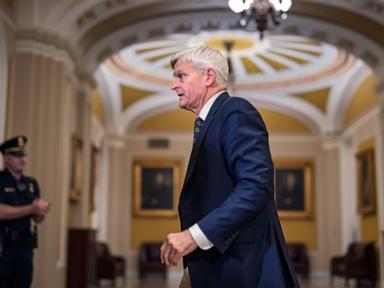
The air inside the Senate Republican lunchroom smelled of expensive steak and cheap adrenaline. It was Wednesday afternoon on Capitol Hill, the kind of heavy, humid June day where Washington politics ceases to be an abstract game of policy and becomes something raw, sweating, and uncomfortable.
At the center of the room sat Donald Trump. He was not just the president; he was a man who had spent the last several months systematic in his destruction of anyone within his own ranks who dared to look at him sideways. To his left and right sat men and women who had spent years perfecting the art of looking at their shoes whenever he entered a room.
Then there was Bill Cassidy.
The senior senator from Louisiana was already a ghost. Weeks earlier, his political career had been executed in a swift, brutal primary defeat. Trump had endorsed his challenger. The voters of Louisiana obeyed. For Cassidy, the future was gone. He had nothing left to lose. When a politician has nothing left to lose, they become the most dangerous thing in Washington: an honest man with a microphone.
The room fell quiet as Trump began to speak. He did not invite conversation; he dictated reality. His voice carried that familiar, raspy cadence that had reshaped American life over the last decade. He was furious about the previous day’s vote. Four Republicans had crossed the aisle to join Democrats in passing a symbolic war powers resolution. The measure sought to block further military action in Iran, a conflict that was supposed to last four weeks but had stretched into its fourth agonizing month.
Trump looked around the room, demanding to know how any Republican could vote to bind the hands of their commander-in-chief during a war.
Cassidy did not look at his shoes. He stood up.
The Volume of the Room
Imagine standing in a room full of your closest peers, people you have worked alongside for over a decade, and realizing you are entirely alone. Cassidy stood tall, his posture carrying the clinical stiffness of his former life as a gastroenterologist. He looked directly at the president.
"You have not told the American people what is going on," Cassidy said. His voice was steady, but the room went ice-cold. "This is supposed to last four weeks. It has lasted four months. Our original objectives have not been achieved."
The response was immediate.
Trump did not argue the logistics of the Iranian conflict. He did not offer statistics or strategic briefings. Instead, the volume in the room spiked. Trump’s voice rose, filling the ornate space, sharp and unyielding. He told Cassidy to sit down. He called him a lunatic.
Silence stretched across the tables. Senators who had private doubts about the war suddenly found their plates intensely fascinating. John Cornyn, who had also suffered a primary defeat at the hands of a Trump-backed challenger, watched the exchange with a dry, hollow expression. Lisa Murkowski had walked into the room late, unaware of the blast radius she was stepping into, only to hear the president actively insulting her colleagues.
Cassidy felt the blood rush to his ears. Rage. It is a human reaction, one that politicians spend millions of dollars in media training trying to suppress. But the training fails when the stakes become personal.
"He raised his voice," Cassidy later admitted to a cluster of reporters in the hallway, his face still flushed from the encounter. "I lost my temper. That is not appropriate. It is the Irish in me, but I again matched his tone and his volume."
For a few fleeting moments, two men from the same political party stood in a private room on Capitol Hill, shouting over each other. One had the entire weight of the executive branch and a fiercely loyal base behind him. The other had only a discarded voting record and a looming retirement date.
Consider what happens next when the shouting stops.
Cassidy sat down. He did not do it because he was broken; he did it to stop the bleeding. He tried to de-escalate. The damage, however, was already done. The veneer of a unified party had cracked open, exposing the deep, throbbing anxiety that lies just beneath the surface of the modern Republican establishment.
The Cost of the Quiet
To understand why a routine lunch turned into a shouting match, you have to understand the invisible weights these people carry. The public sees the votes, the television appearances, and the press releases. They do not see the quiet calculations made in the dark.
For the last two years, Congressional Republicans have operated under a code of survival. Speak softly. Protect the thin majority. Avoid the primary challenge. It is a strategy built on fear, and for the most part, it works. But fear creates a toxic ecosystem. It forces leaders to support policies they despise and cheer for actions they know are reckless.
The war in Iran had become the ultimate test of this survival code. When the first strikes were ordered, leadership promised a swift, surgical intervention. Four weeks. That was the timeline given to the public and to the lawmakers who hold the purse strings.
Now, four months into the conflict, the bodies are coming home, the bills are mounting, and the objectives remain as blurry as they were on day one. Most Senate Republicans whisper about their concerns in the dimly lit corners of the Capitol. They call the strategy unstable. They worry about the upcoming elections.
But when the cameras turn on, the whispers vanish.
Cassidy’s primary defeat in May changed his calculus. When Julia Letlow won Trump’s endorsement and cruised past Cassidy, she did not just take his seat; she took his chains. He was no longer bound by the need to please a voter base that valued loyalty over oversight. He was free to ask the questions that his colleagues were too terrified to utter.
The tragedy of the modern Senate is that a lawmaker must lose their job before they can find their voice.
The Unifying Message
As Trump left the lunchroom, he paused to speak briefly with reporters, describing the meeting as "colorful" and praising the party's leadership under John Thune. He insisted the meeting was a great success, a testament to the party's incredible unity.
Inside the room, his colleagues knew better.
"The president closed by preaching unity," John Cornyn remarked, his voice dripping with the cynical exhaustion of a man who had seen the script play out too many times before. "But he spent the prior hour talking about things which were not exactly unifying."
This is the reality of the Capitol Hill showdown. It was not a debate about national security or constitutional authority. It was an exercise in submission. Trump did not want to convince Cassidy that the war in Iran was going well; he wanted to remind the remaining senators what happens to anyone who publicly doubts the plan.
The message was received.
As reporters swarmed the hallways after the lunch, seeking comment from the senators who had witnessed the blow-up, most chose the path of least resistance. Roger Marshall of Kansas brushed it off as nothing more than a standard disagreement. "You all act like no one ever yelled at each other," he said, turning away. Others simply smiled tightly and walked faster toward the elevators.
They knew the truth. They knew that Cassidy was right about the lack of information, right about the shifting timelines, and right about the human cost of the conflict. But they also knew that Cassidy was going home in January, and they wanted to stay.
The sun began to set over the Capitol dome, casting long, distorted shadows across the plaza. Bill Cassidy walked out of the building alone, his footsteps echoing on the stone. He had no regrets about the shouting match, nor did he regret his historic vote years earlier to convict the man who had just called him a lunatic. He had stood up, he had matched the volume, and he had spoken the truth to the most powerful man in the country.
But as he walked away, the doors of the Capitol slid shut behind him, leaving the rest of his party inside the quiet, crowded room, still staring at their shoes.