Dust settles slowly over the desert checkpoints. For years, the sandbags bore the weight of an era, stacked high by hands that knew the smell of cordite better than the scent of home. Now, those hands are empty.
Consider a man named Azad. He is a hypothetical figure, but he wears the face of a thousand young fighters who stood on the ridges of northern Syria when the world looked away. He spent his youth gripping a rifle, watching the horizon for threats that bore down from the sky and rolled across the plains. Azad did not fight for glory. He fought because the alternative was the erasure of everything his community built from the ashes of conflict. For another view, check out: this related article.
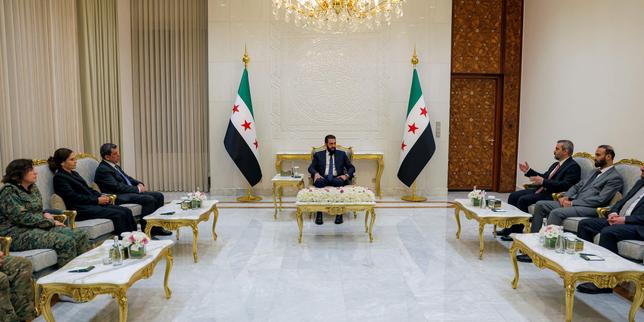
And then comes the decree. The announcement arrives not with the crash of artillery, but with the quiet rustle of a statement passed from hand to hand. The Kurdish-led authorities in Syria have declared the dissolution of their armed forces.
Silence follows. It is a heavy, disquieting silence. Related insight regarding this has been provided by Associated Press.
To understand the magnitude of this moment, you have to look beneath the geopolitical abstractions. For over a decade, these forces functioned as the primary defensive shield against extremist ideologies and external aggression in the region. They guarded the prison camps holding thousands of foreign fighters. They patrolled the borders of a fragile, self-administered autonomous zone.
Now, the architecture of that defense is shifting.
History teaches a harsh lesson about vacuums. Power abhors an empty space. When one armed faction steps down, others prepare to step in. The central government in Damascus watches closely. Neighboring states eye the shifting boundaries with calculated interest. The fighters who once patrolled the streets of Qamishli and Hasakah must now reckon with a stark reality: the guns are laid down, but the underlying tensions remain entirely unresolved.
Listen to the wind moving through the concrete ribs of a half-built house in Rojava. It sounds like a question. What happens to the people who trusted a promise of security when the uniforms are packed away?
This is where the human cost hides. It does not appear in official communiques or diplomatic cables. It lives in the kitchen of a mother whose son is returning home not as a triumphant defender, but as an ordinary civilian navigating an uncertain economy with no skills other than survival. It lives in the quiet anxiety of teachers and nurses who wonder if the institutions they helped construct will survive the political realignment.
Bureaucrats call this integration. Strategists call this a transition. But on the ground, it feels like holding your breath underwater.
The decision to dissolve the armed forces is framed as a step toward national unity, an effort to weave the fragmented pieces of Syria back into a single fabric under Damascus. Yet unity enforced by political necessity rarely feels like peace. It feels like a gamble. A high-stakes wager where the chips are human lives and the house always collects.
Let us be clear about the mechanics of this shift. Integrating regional defense units into a centralized state military is not simply a matter of changing patches on a shoulder. It requires trust where none exists. It demands reconciliation after years of blood, suspicion, and ideological divergence.
Azad sits on his porch at dusk. He places his calloused hands on his knees. The rifle is gone, turned in to a depot weeks ago. In its place is a rusted tractor and a field that needs plowing. He does not know if the peace will hold until sunrise. He only knows that the night belongs to a different kind of uncertainty now.
The river flows past the ancient banks of the Euphrates, indifferent to politics, carrying the debris of old wars toward an unpredictable sea. Farther down the road, the checkpoints are unmanned. The barriers are pushed aside. A new chapter begins in the long, sorrowful history of the Levant, written not with the roar of cannon fire, but with the quiet scratch of a pen signing away an army.


