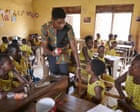
The rain in Lilongwe does not ask for permission. When it hits the corrugated iron roof of the primary school, the sound is absolute, a deafening roar that swallows the teacher’s voice whole.
For the fifty-two children crowded onto a concrete floor built for twenty, the storm means two things. First, the notebooks must be tucked beneath shirts to keep the ink from running. Second, the lesson is over. You cannot teach geography when the sky is shouting.
Let us trace a line from that leaking roof to a glass tower in Manhattan. It is a straight line, though it is drawn in ink that most people never see. It is the line of sovereign debt.
Every year, an invisible ledger balances the survival of nations against the expectations of global creditors. According to a recent, sobering analysis by the United Nations, that ledger is currently tilted toward a quiet catastrophe. Across dozens of developing countries, governments are now spending more money every single month just to pay the interest on foreign loans than they are spending to educate their own children.
Think about that choice. It is not a choice made out of malice or ignorance. It is the cold math of survival in a financial system designed by the wealthy for the wealthy. If a nation defaults on its debt, its economy suffocates. The currency plummets, inflation spikes, and import costs soar. So, the debt is paid first. Always. The school roof can wait. The textbooks can be shared among four children instead of two. The future can be pushed down the road, one quarterly payment at a time.
This is the mechanics of a modern trap.
The Cost of Staying Solvent
To understand how a country ends up sacrificing its classrooms to satisfy external balance sheets, we have to look past the dense economic jargon that usually hides these realities. Economics is often treated as an exact science, full of impenetrable equations and sterile terms like "debt-to-GDP ratios" and "liquidity constraints." But at its core, macroeconomics is simply human behavior writ large, backed by the power of enforcement.
Consider a hypothetical country. We will call it Republica to keep the data clean, though its reality is shared by more than thirty nations across Africa, Asia, and Latin America.
Republica needs to build a road network to get its farmers’ crops to port. It does not have the cash on hand, so it issues bonds or takes out loans from international lenders. The terms seem manageable at the time. But then external shocks arrive. A global pandemic stalls trade. A war thousands of miles away drives up the cost of fuel. The central bank of the world's largest economy raises interest rates to fight its own domestic inflation.
Suddenly, the interest on Republica’s loans, which are denominated in foreign currencies like the U.S. dollar, balloons. The local currency depreciates. It now takes twice as many local taxpayers to buy the same single dollar needed to pay back the lender in New York, London, or Beijing.
The United Nations data reveals that global public debt has reached an unprecedented peak of $92 trillion. Of that staggering sum, developing nations carry a disproportionate, agonizing share of the burden. Not because they owe the absolute majority of the money, but because the cost of borrowing for them is drastically higher. A African nation often pays an interest rate four times higher than the United States and eight times higher than Germany just to borrow the exact same amount of money.
This is the premium of poverty.
When those interest payments come due, they do not arrive as a polite request. They are deducted from the national treasury with the clinical precision of an automated bank withdrawal. What is left over is what the government has to run the country.
When the pie shrinks, the cuts are predictable. You cannot easily cut the military without risking instability. You cannot cut the salaries of the police or the ministries without bringing the capital to a halt. So you cut the social investments that only pay off twenty years from now. You cut the training programs for new teachers. You freeze the budget for rural school construction. You stop buying chalk.
The Classroom as an Economic Variable
The consequences of these math problems are not abstract. They have a scent, a sound, and a face.
In a small town outside Lusaka, a teacher named Joseph stands before a blackboard that has been scrubbed so many times the slate is turning gray. He has thirty text books for eighty students. The math lesson must be copied by hand onto the board, line by line, consuming forty minutes of an hour-long class period.
Joseph is highly qualified. He holds a university degree and understands the pedagogy of early childhood development. But he has not received a cost-of-living adjustment to his salary in three years. His paycheck buys half the groceries it did before the inflation crisis. He spends his evenings driving a motorcycle taxi just to pay his own rent.
"When I look at my students, I see brilliant minds," Joseph says during a quiet moment between periods. "But I also see a clock ticking. If they do not learn to read fluently by age nine, the data says they will likely drop out to work the fields. We are losing them before they even have a chance to fail."
The UN report frames this exact scenario through a terrifying statistical lens: 3.3 billion people—nearly half of humanity—now live in countries that spend more on debt interest payments than on either education or health.
Let that number sit with you.
Three point three billion lives.
We are not talking about a few mismanaged economies or isolated cases of corruption. This is a systemic failure of the global financial architecture. It is an arrangement where the immediate liquidity of international bondholders is legally prioritized over the intellectual development of an entire generation of human beings.
The tragedy is that education is the only reliable engine of long-term debt sustainability. A country cannot build a high-value tech sector, an advanced manufacturing base, or a modern agricultural system without a literate, numerically competent workforce. By starving education to pay current debt, nations are systematically destroying their future capacity to pay off any debt at all.
It is the economic equivalent of eating your seed corn to pay the rent on the barn.
The Long Journey of a Borrowed Dollar
Where does the money actually go?
When a developing nation pays interest on its foreign debt, that capital does not vanish into thin air. It flows back into the global financial ecosystem. It populates the portfolios of pension funds, private equity firms, sovereign wealth funds, and commercial banks in the global north.
There is an argument often made in the sterile rooms of international finance that contracts are sacred. Lenders took a risk, the argument goes, and if countries do not honor their debts, the entire system of international credit collapses. Risk must be priced. Consequences must be borne.
But this argument ignores a fundamental imbalance in how that risk was created. Much of the debt currently strangling the global south was accumulated during a period of historically low interest rates, when western capital flooded into emerging markets looking for higher yields than they could get at home. Lenders aggressively marketed these loans. They knew the risks, and they charged high interest premiums precisely to cover those risks.
Yet, when the crisis hits, the burden of adjustment falls entirely on one side of the equation. The private creditors rarely take a "haircut" willingly. Instead, international financial institutions step in with bailout packages that are conditional on severe austerity measures.
Consider what happens next: the international community provides emergency funds so the developing country can avoid default, which means the country uses those new funds to pay off the private lenders. The private Wall Street firms walk away whole. The developing nation is left with even more debt, this time owed to public institutions, accompanied by strict mandates to slash domestic spending.
And who sits at the bottom of that pyramid of mandates? The child waiting for a desk in Malawi. The girl who must walk three miles to a school without a working toilet in South Asia. The boy whose school was destroyed by a climate-induced hurricane and cannot be rebuilt because the treasury is dry.
The system is functioning exactly as it was designed to function. It protects capital. It penalizes vulnerability.
The True Cost of Silence
The debate over global debt relief is often treated as a matter of charity, a humanitarian gesture from wealthy nations to the poor. This is a fundamental misunderstanding of the stakes.
This is not about pity. It is about a structural injustice that diminishes the collective future of the planet. When millions of children are denied a quality education because their country's wealth is being exported to service historic loans, the loss is universal. We lose the scientists who might discover the next generation of vaccines. We lose the engineers who could design better adaptation strategies for a warming world. We lose the artists, the thinkers, and the leaders who enrich the human story.
The United Nations has called for an urgent overhaul of the global financial architecture, including a systematic mechanism for debt restructuring, lower borrowing costs for developing states, and emergency liquidity during crises. These are practical, necessary steps. They are achievable.
But they require a shift in perspective. We must stop viewing international finance as a game of ledger entries and start viewing it as a system that directly shapes human potential.
The storm in Lilongwe eventually passes. The rain stops hammering the iron roof, leaving behind only the steady drip of water into the mud outside. Inside the classroom, the children shake the dampness from their shoulders and open their notebooks once again.
The ink is slightly smeared. The teacher’s voice is tired. But the lesson resumes.
These children are doing their part. They show up every day, walking through mud, sitting on concrete, sharing pencils, demonstrating an unyielding appetite for a better life. The question is not whether they have the will to learn. The question is whether the global financial system will continue to demand their future as collateral for the past.