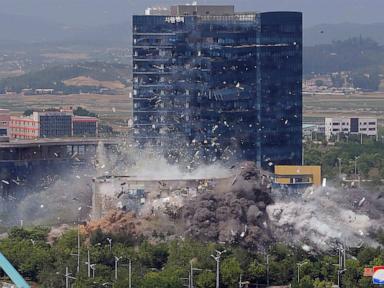
The civil judgment handed down by the Seoul Central District Court ordering the North Korean government to pay 35 billion won, equivalent to roughly 32.5 million United States dollars, for the 2020 demolition of the Inter-Korean Joint Liaison Office fundamentally alters the architecture of cross-border legal accountability. While municipal courts rarely exercise jurisdiction over foreign sovereign states due to the traditional doctrine of state immunity, this case exploits a crucial structural exception under South Korean jurisprudence: tortious acts committed within national territory by a foreign actor that violate established norms of international law and bilateral agreements.
The jurisdictional logic relies on the premise that the Liaison Office, situated within the Kaesong Industrial Complex, occupied territory subject to specific treaty frameworks and state-backed guarantees of physical integrity. When Pyongyang unilaterally detonated the four-story facility in June 2020, citing retaliatory grievances over anti-regime leafleting campaigns originating in the South, it breached not only diplomatic protocol but also property rights vested in Seoul's state-owned assets and construction investments. Analyzing this litigation requires breaking down the core vectors of the case into three distinct functional dimensions: jurisdictional foundations, asset recovery mechanisms, and geopolitical precedent.
The Jurisdictional Framework and Sovereign Immunity Exceptions
The primary analytical hurdle in any transnational suit against a rogue or isolated state involves overcoming sovereign immunity. Under general international law, states are immune from the jurisdiction of foreign courts for sovereign acts, known as acta jure imperii. However, modern jurisprudence increasingly recognizes exceptions for commercial activities or tortious conduct resulting in property damage or personal injury within the forum state.
In this instance, the Seoul court navigated this barrier by establishing that the destruction of state property financed by South Korean taxpayers within a designated cooperation zone falls outside protected sovereign functions of the acting state. The liaison office was not merely a diplomatic outpost; it was a physical manifestation of bilateral economic and political infrastructure governed by specific agreements. The demolition constituted an unprovoked destruction of extraterritorial or jointly managed assets situated on northern soil but carrying direct financial and administrative linkage to the southern government.
By accepting jurisdiction, the judiciary established a legal baseline: state-sponsored kinetic action against physical infrastructure established under bilateral frameworks strips the perpetrator of standard jurisdictional shields when targeted assets belong explicitly to the opposing sovereign entity.
The Mechanics of Judgment Enforcement Against an Isolated State
Securing a favorable judicial ruling represents only the initial phase of a complex recovery vector. Enforcing a multi-million-dollar judgment against the Democratic People's Republic of Korea presents an almost insurmountable operational bottleneck given the complete absence of diplomatic relations, commercial transparency, and accessible sovereign reserves within the domestic financial system.
To evaluate the practical efficacy of the ruling, analysts must examine potential enforcement avenues:
- Frozen Assets: South Korea holds minimal identifiable North Korean state assets within its domestic banking architecture, as historical economic sanctions and asset separation protocols isolate Pyongyang from direct financial exposure in Seoul.
- Seizure of Intellectual Property and Royalties: Past legal strategies have attempted to target copyright royalties or licensing fees generated by North Korean state media broadcasts or cultural exchanges redistributed in the South. These revenue streams, managed by government-affiliated trust accounts, offer the most viable, albeit modest, pool of attachable funds.
- Third-Party Jurisdictional Reach: Unlike foreign judgments enforced through international arbitration treaties, domestic court orders against North Korea lack extraterritorial reciprocity, meaning creditors cannot easily seize North Korean diplomatic real estate or cargo in third-party nations without facing local sovereign immunity hurdles.
Consequently, the utility of the judgment is primarily normative and strategic rather than liquid. It establishes a quantified liability ledger that permanently alters the balance sheet of any future bilateral normalization talks or economic reintegration packages.
Economic Restitution as a Strategic Coercion Tool
The imposition of a quantifiable financial penalty shifts the calculus of inter-Korean diplomacy from ideological rhetoric to balance-sheet accounting. For decades, engagement strategies treated provocations as political friction points to be managed through humanitarian aid or economic concessions. This judicial intervention institutionalizes a framework of financial deterrence.
By attaching a specific price tag to physical infrastructure, Seoul has created a structural precondition for any future financial engagement. If Pyongyang seeks the resumption of economic cooperation, industrial complexes, or infrastructure investments, this 35 billion won judgment—plus accrued interest—functions as an unpayable debt that remains encumbered on any future bilateral ledger.
This creates a permanent structural wedge. It prevents future administrations from unilaterally writing off state property destruction as a cost of doing business with an erratic neighbor, embedding legal accountability directly into the machinery of foreign policy formulation.
Strategic Forecast and Enforcement Trajectory
The long-term trajectory of this legal precedent points toward a protracted standoff between formal judicial decrees and geopolitical reality. Pyongyang will predictably ignore the ruling, refuse participation in enforcement proceedings, and dismiss the court's authority entirely.
However, the strategic value lies in the institutional memory of the state. Future policy planners inherit a binding judicial precedent that constrains executive overreach, ensuring that any normalization of relations must account for adjudicated property losses. The immediate tactical play for Seoul involves identifying and freezing minor commercial royalties and intellectual property transactions, while the broader strategic play remains fixed on preserving this financial claim as a non-negotiable liability in any ultimate endgame of peninsular integration.