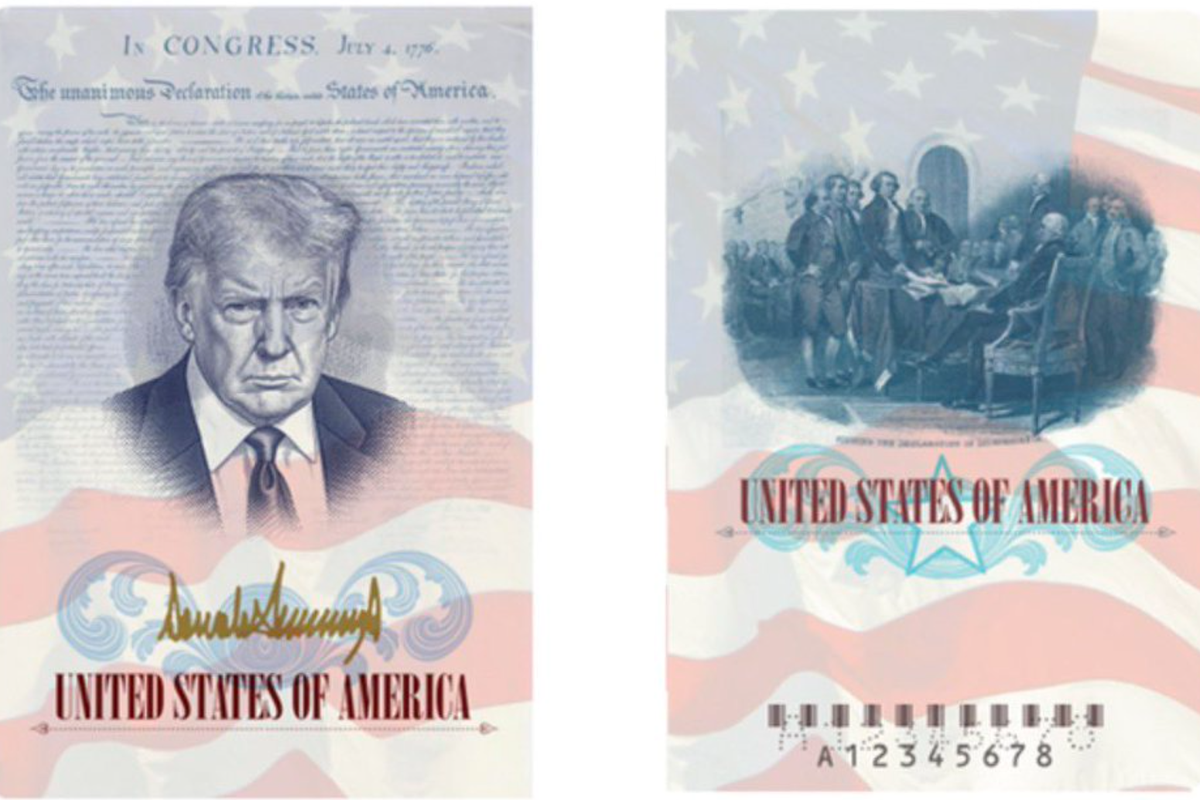
The proposed integration of Donald Trump’s likeness onto United States passports to commemorate the Semiquincentennial (250th anniversary) represents a significant shift in the semiotics of sovereign identification. This move transitions the passport from a neutral proof-of-citizenship document into a high-visibility vehicle for national branding. Analyzing this proposal requires looking past political sentiment and examining the structural mechanics of document security, international reciprocity, and the bureaucratic cost of large-scale aesthetic modification.
The Architecture of Sovereign Branding
Passports serve two primary functions: they are security-cleared biometric assets and ideological artifacts. Most nations utilize the physical real estate of the passport—watermarks, endpapers, and covers—to project historical continuity. The inclusion of a living or recently active political figure introduces a variable of "reciprocity risk" where foreign customs agencies must navigate the shifting symbolic landscape of an ally or adversary.
The current proposal centers on the 2026 milestone, a date that necessitates a fixed production timeline. For the State Department to execute a redesign of this magnitude, three distinct operational phases must align:
- Security Substrate Integration: Modern passports utilize poly-carbonate data pages and complex UV-reactive inks. Introducing a high-fidelity portrait requires recalibrating the OVI (Optically Variable Ink) and holographic overlays to ensure that the image does not interfere with Machine Readable Zone (MRZ) scanners.
- Diplomatic Protocol Alignment: Under ICAO (International Civil Aviation Organization) Document 9303 standards, any change to the visual profile of a passport must be communicated to every global port of entry. Failure to socialize a redesign leads to increased secondary screening rates for citizens as foreign automated border control systems flag the new imagery as a potential counterfeit anomaly.
- Manufacturing Throughput: The US Government Publishing Office (GPO) manages the printing of millions of booklets annually. A commemorative edition creates a "collector’s distortion" in the supply chain, where demand spikes as citizens seek to replace valid documents prematurely to obtain the new design, potentially straining the existing backlog of applications.
Technical Barriers to Image Implementation
The technical difficulty of placing a specific individual’s face on a passport page is not a matter of printing, but one of anti-forgery synchronization. Federal document designers utilize a "layered defense" strategy. When an image is added, it must be woven into the guilloché patterns—those complex, repetitive thin-line designs that are nearly impossible to scan and reproduce.
If the image is placed as a watermark, it affects the opacity of the page, which can confuse the infrared sensors used by many European and Asian border kiosks. If the image is printed in color, it requires a specific set of pigments that do not bleed or fade over the ten-year lifespan of the document. The State Department has historically preferred landscapes and historical monuments precisely because they lack the high-contrast focal points of a human face, which can be easily manipulated by forgers to mask physical alterations to the traveler’s actual photo.
The Economic Implications of Commemorative Redesign
The cost function of a national passport redesign is rarely captured in a single line item. It is distributed across the Department of State’s Bureau of Consular Affairs. The transition from the "e-Passport" to the "Next Generation Passport" (NGP) already cost hundreds of millions in R&D and hardware upgrades at processing centers.
A temporary 250th-anniversary edition introduces a "dead-end" asset. Unlike a permanent redesign, a commemorative version requires its own set of plates, specialized ink batches, and quality control protocols that will be decommissioned once the anniversary window closes. This creates a high marginal cost per unit. If the government does not pass this cost onto the citizen via increased fees, it must be absorbed by the general fund, making the face of a political figure a literal tax-funded branding exercise.
International Perception and Document Power
The "power" of a passport is often measured by its visa-free access score. This access is built on the foundation of trust between nations. When a country introduces overt political imagery into its travel documents, it risks the document being perceived as a propaganda tool rather than a neutral security instrument.
While countries like the United Kingdom have featured various historical figures (such as William Shakespeare or Ada Lovelace) in their passport pages, these are typically figures with broad, centuries-old consensus. Using a contemporary figure introduces a volatility factor. If a future administration decides to rescind the design, the State Department would be forced to manage a dual-inventory system where two distinct, valid versions of the US passport are circulating simultaneously, increasing the complexity of identity verification for domestic TSA agents and foreign border guards alike.
Operational Volatility in the 2026 Timeline
The 250th anniversary occurs on July 4, 2026. Given that passport production must begin months in advance to ensure the documents are in the hands of citizens by the start of the celebratory year, the design freeze must happen by mid-2025.
This timeline creates a bottleneck in the vetting process. Every element of a US passport—from the type of thread used in the binding to the microprinting on page 14—undergoes rigorous stress testing against chemical solvents, heat, and physical wear. Short-circuiting this testing to meet a political or commemorative deadline increases the risk of "delamination," where the security layers of the passport begin to peel, rendering the document invalid for international travel.
The Bifurcation of Public Demand
Data suggests that any significant change to a passport’s visual identity triggers a non-linear response in renewal applications.
- The Surge Effect: A subset of the population will apply for renewals early to secure the commemorative edition, creating an artificial peak in demand that could extend processing times from weeks to months.
- The Avoidance Effect: Conversely, a separate demographic may delay renewal or wait until the commemorative period ends, leading to a secondary surge once the "standard" design returns.
This oscillation disrupts the labor planning for the National Passport Center. Staffing levels are generally set based on predictable 10-year renewal cycles (peaking 10 years after the last major travel boom). A commemorative design acts as a shock to this system, forcing the government to choose between paying massive overtime costs or allowing the "time-to-delivery" metric to degrade.
Strategic Forecast for 2026 Travel Documents
The implementation of Donald Trump’s face on the US passport will likely be restricted to the interior visa pages rather than the data page or the cover to mitigate the highest-level security risks. By placing the image on the 28-page or 52-page insert section, the State Department can utilize standard printing techniques without re-engineering the poly-carbonate core.
The most efficient path for the administration is to offer the commemorative design as an "opt-in" or a limited-run "Collector’s Series." This allows the GPO to maintain a steady baseline of standard NGP production while dedicating specific print lines to the anniversary edition. This "dual-track" manufacturing strategy minimizes the risk of a total system failure while satisfying the mandate for a commemorative branding shift.
Expect the initial rollout to face litigation or administrative challenges centered on the "neutrality of sovereign assets." However, from a purely logistical standpoint, the success of the project will be determined by whether the State Department can update the global ICAO Public Key Directory (PKD) fast enough to prevent a logistical nightmare at international airports during the peak summer travel season of 2026. The final move for any strategist in this space is to prioritize the update of digital certificates over the physical aesthetics; a passport that looks "historic" but fails an e-gate scan is a liability, not an asset.