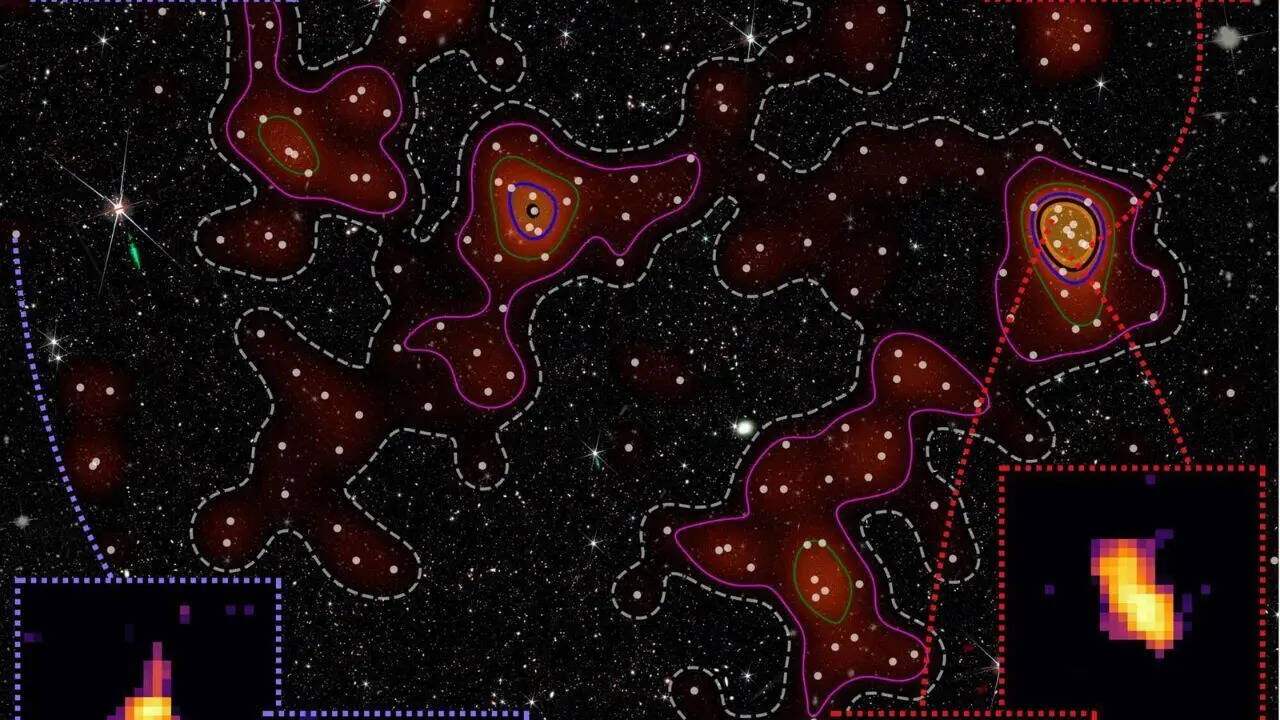
The global scientific community is currently patting itself on the back over the discovery of the "Loktak Protocluster." Headlines are flooded with romanticized accounts of an international research team, led by Dr. Ronaldo Laishram at the National Astronomical Observatory of Japan (NAOJ), locating a massive galaxy structure dating back 12.6 billion years. Mainstream science journalists are swooning over the poetic naming convention, comparing the four interconnected galaxy concentrations to the floating phumdis of Manipur's Loktak Lake.
The mainstream press bought the press release hook, line, and sinker. They want you to believe this is a profound revelation about how the "local environment" nurtured early galaxies into existence.
It is time to puncture this comforting, neatly packaged narrative.
The popular interpretation of the Loktak Protocluster data is fundamentally flawed. In their rush to celebrate cosmic architecture, commentators are completely misreading the mechanics of the early universe. They are confusing the symptoms of massive gravitational collapse with structural nurture. What the Subaru Telescope and the James Webb Space Telescope (JWST) actually revealed is not a nurturing "city of galaxies." It is a violent cosmic trap that forces us to question our most basic assumptions about structural growth in the early universe.
The 1.4x Size Illusion
The cornerstone of the current consensus rests on a specific piece of data published in The Astrophysical Journal Letters. When observed in ultraviolet light—which highlights hot, active star-formation regions—galaxies inside the Loktak Protocluster look identical in size to isolated "field" galaxies. But when viewed in optical light—revealing mature, older stellar populations—the protocluster galaxies are, on average, 1.4 times larger.
The lazy consensus looks at this 40% size increase and declares that dense cosmic neighborhoods accelerate growth. They claim the environment "shaped" the outer structures of these galaxies earlier and more rapidly.
This is backward logic.
A 40% increase in rest-optical size at redshift $z \simeq 4.9$ does not mean these galaxies are thriving under the influence of their neighbors. It means they are being cannibalized and stripped. The early universe, a mere 1.2 billion years after the Big Bang, was an incredibly dense, chaotic pressure cooker. When you jam dozens of young galaxies into a tight overdensity spanning roughly 65 by 36 comoving megaparsecs, you do not get an organized urban planning project. You get a gravitational demolition derby.
The expanded optical profiles are the distinct thermodynamic signatures of tidal interactions. These galaxies are not gracefully building out their outer stellar disks through internal evolutionary processes. They are gravitationally tugging at each other, tearing stars away from their original orbits and bloating their outer halos through minor mergers and near-miss collisions. The core star-forming regions look identical across both environments because the central gas reserves have not yet felt the full chokehold of the cluster's dark matter halo. The observed "growth" is actually structural degradation disguised as expansion.
Stop Treating Protoclusters Like Modern Cities
Astrophysicists love using the analogy of a "city of galaxies" under construction. It is an easy mental shorthand for the public, but it introduces a massive conceptual error. A modern galaxy cluster, like the Coma Cluster, can be reasonably analyzed as a stabilized ecosystem where environmental mechanisms like ram-pressure stripping and strangulation dominate.
Applying that same framework to a protocluster at $z \simeq 4.9$ is anachronistic.
Imagine a scenario where a civil engineer tries to analyze the structural traffic flow of a city before the foundation concrete is even poured. That is what happening here. At 1.2 billion years post-Big Bang, the Loktak structure is not a single cohesive unit; it consists of four distinct overdensity peaks. It is a highly unstable, unrelaxed system that hasn't achieved virial equilibrium.
The standard narrative assumes a linear, orderly progression: matter aggregates, galaxies grow larger due to proximity, and a cluster forms. But hierarchical assembly is a messy, brutal process. The field Lyman-alpha emitters (LAEs) used as a control group in the Subaru Silverrush survey are not "underdeveloped" just because they are smaller in rest-optical wavelengths. They are simply pristine. They have not had their stellar distributions violently stretched out by the crushing tidal fields of three neighboring galaxy concentrations.
By celebrating the bloated sizes of the Loktak protocluster members as a sign of accelerated maturity, the astronomical community is celebrating a car crash because the debris field covers a wider surface area than the original vehicle.
The Selection Bias No One Admits
There is an uncomfortable truth buried in the methodology of tracking these ancient structures: Lyman-alpha emitters are highly biased tracers.
The Subaru Telescope identifies these regions using narrowband filters designed to catch the specific 121.5-nanometer emission line of hydrogen gas excited by intense starburst activity. This means we are only looking at the brightest, loudest, most hyperactive objects in the room.
When the research team concludes that environment dictates growth based on 16 protocluster members versus 23 field galaxies, they are dealing with a severe case of survival bias. What about the faint, obscured, or already quenched galaxies that do not emit strong Lyman-alpha signals? By relying primarily on LAEs to map the overdensity, our view of the Loktak structure is heavily distorted.
We are looking exclusively at the statistical outliers. Drawing sweeping conclusions about the universal laws of galaxy evolution from a handpicked sample of cosmic fireworks is bad science. The reality is that the dense environment of the Loktak protocluster might actually be suppressing the formation of smaller, more typical galaxies through intense background radiation fields—a detail completely ironed out by the triumphant press releases.
The Blind Spot of Cosmic Romanticism
The rush to connect deep-space data with regional geography is an excellent public relations strategy. Naming a 12.6-billion-year-old structure after a freshwater lake in Manipur generates engagement, wins political praise, and makes abstract astrophysics digestible. But it also smuggles an unwarranted sense of harmony into a cold, indifferent vacuum.
The floating phumdis of Loktak Lake exist in a delicate, life-sustaining ecological balance. The Loktak Protocluster is the exact opposite. It is an arena of pure gravitational violence where smaller structures are systematically erased to feed the growth of a singular cosmic monolith. Over the next ten billion years, those four beautiful, interconnected concentrations of galaxies will violently collide, merge, and lose their individual identities entirely, collapsing into a sterile, elliptical galaxy graveyard.
If we want to truly understand the early universe, we must discard the comforting narrative that dense cosmic environments act as benign cradles for galaxy development. Proximity is not a luxury in the cosmos; it is a liability. The Loktak Protocluster is not an inspiring blueprint of early cosmic organization. It is an active disaster zone of tidal disruption, structural bloating, and inevitable gravitational assimilation. Until astronomy stops substituting romanticized metaphors for cold thermodynamic realities, we will remain completely blind to the true, brutal nature of cosmic dawn.