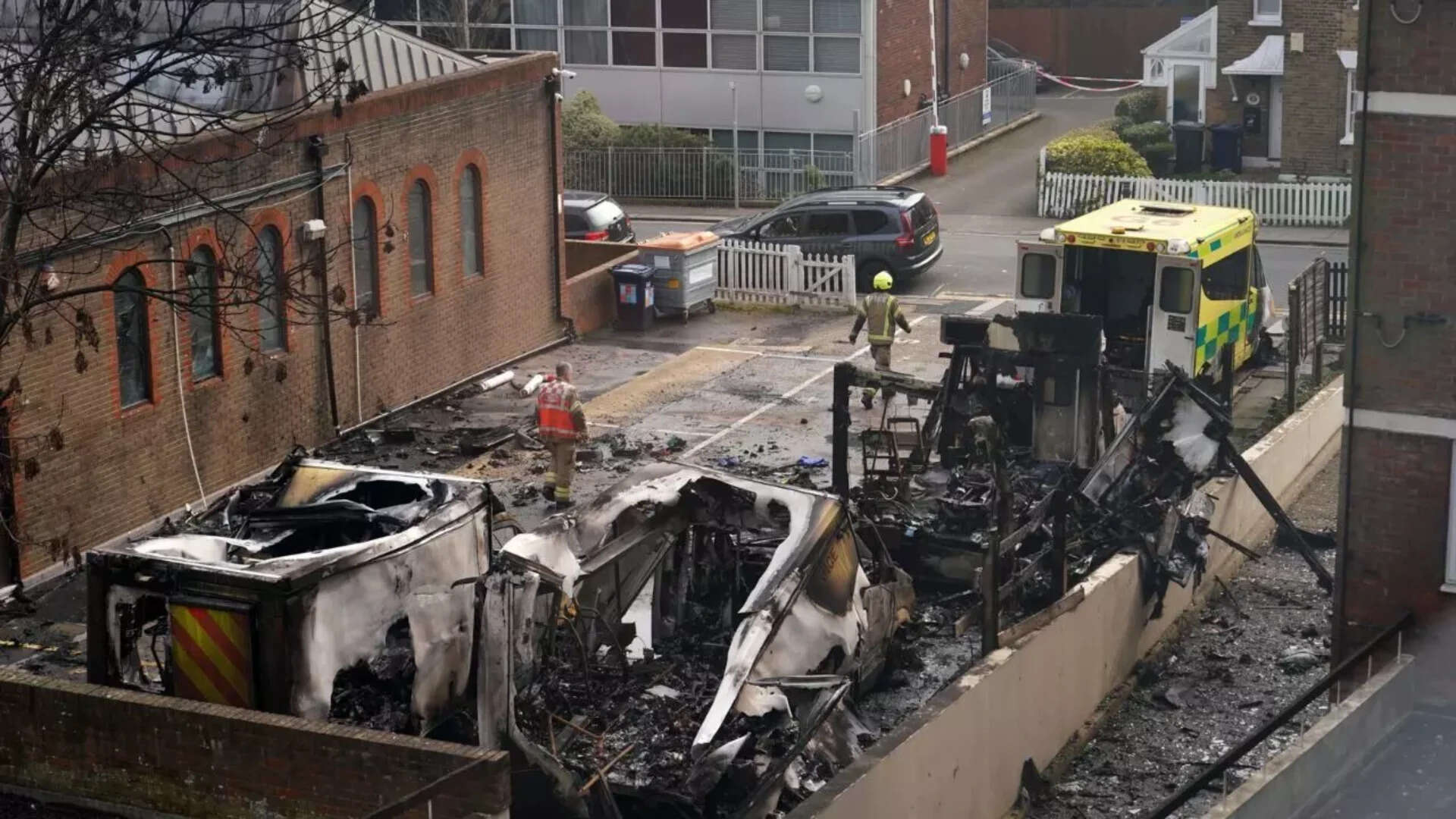
The pre-dawn fire that gutted ambulances parked outside a North London synagogue represents more than a localized hate crime. It is a siren blaring for a security apparatus that has consistently failed to anticipate the escalation of street-level radicalization. While Keir Starmer and the Metropolitan Police were quick to issue condemnations of the antisemitic attack, the official response masks a deeper, more systemic failure. We are witnessing the physical manifestation of a social friction that has been allowed to heat up for years, unchecked by the very authorities now expressing "shock" at the outcome.
This was not a random act of vandalism. Torching medical vehicles—tools of mercy—outside a house of worship is a calculated strike designed to maximize psychological terror. For the Jewish community in London, the charred husks of these ambulances are a grim reminder that the boundary between online vitriol and physical violence has effectively vanished. The "why" behind this isn't found in a vacuum; it is rooted in a policing strategy that has prioritized reactive damage control over the proactive dismantling of extremist cells.
The Intelligence Gap and the Escalation Ladder
The Metropolitan Police often speak of "tensions" as if they are weather patterns beyond human control. In reality, the arson attack on the synagogue is a predictable rung on an escalation ladder. When public discourse remains poisoned and street protests are allowed to veer into intimidation without immediate consequence, the fringe elements feel emboldened to move from shouting to firebombing.
Security analysts have long warned that the "soft targets" of the UK’s religious infrastructure are inadequately protected. While high-profile government buildings have seen a massive uptick in surveillance and physical barriers, community centers and synagogues remain vulnerable. This specific attack targeted vehicles belonging to a voluntary emergency service, Hatzola, which serves the entire community regardless of faith. By destroying these assets, the perpetrators did not just attack a religion; they crippled a piece of the city's critical health infrastructure.
The intelligence failure here is twofold. First, there was a failure to monitor the digital chatter that almost always precedes such a coordinated strike. Second, there was a failure of presence. A synagogue that has been the subject of previous threats should not be a place where attackers can comfortably set multiple vehicles ablaze and vanish into the night.
Political Rhetoric Versus Street Reality
Prime Minister Keir Starmer's condemnation was swift, but for many on the ground, words have begun to lose their currency. There is a growing sense that the political class is playing a game of "condemnation whack-a-mole." They wait for an atrocity, issue a press release, and then return to the status quo until the next fire is lit.
The disconnect is dangerous. While Westminster debates the definitions of extremism, the people tasked with enforcing the law are often hamstrung by shifting directives. Police officers frequently report a lack of clarity on when to intervene during "high-tension" events. This hesitation is interpreted by bad actors as a green light. If the state cannot or will not protect the sanctity of a house of worship and its emergency vehicles, it effectively cedes control of the streets to the most violent voices.
We must also look at the funding of communal security. For years, the Community Security Trust (CST) has shouldered the burden of protecting Jewish life in the UK. While the government provides grants, the heavy lifting of intelligence gathering and physical guarding is often privatized. This creates a tiered system of safety where protection depends on a community's ability to self-fund its own survival.
The Logistics of Terror
Setting fire to an ambulance is not an easy task for a lone, impulsive actor. It requires accelerants, a method of entry, and an escape route that avoids the dense network of London's CCTV. This points toward a level of premeditation that suggests a cell or at least a highly motivated group.
The Weaponization of Fire
Fire is a preferred tool for the modern extremist because it is low-tech but high-impact. It destroys evidence while creating a visual spectacle that dominates the news cycle. The choice of ambulances as the target is particularly heinous.
- Symbolic Value: It attacks the community's ability to care for its own.
- Tactical Impact: It removes emergency response capacity from the local grid.
- Psychological Reach: It signals that even those who save lives are not safe.
The investigation must move beyond the "hate crime" label and look into the logistics. Where was the fuel sourced? How did the attackers bypass local security patrols? If this was a coordinated effort, the fingerprints of the organization behind it will be found in the days leading up to the event, not just in the ashes.
The Failure of the Prevent Strategy
For over a decade, the UK's "Prevent" strategy has been the cornerstone of anti-radicalization efforts. The synagogue attack is a stark piece of evidence that this strategy is faltering. Prevent was designed to catch individuals before they turned to violence, yet the sheer volume of radicalized content circulating online has overwhelmed the system.
The problem is that the system is designed to look for "lone wolves" while ignoring the ecosystems that sustain them. Radicalization does not happen in a vacuum; it is nurtured in specific digital forums and physical meeting spaces that are often known to authorities but left unaddressed due to political sensitivities. When we ignore the ecosystem, we shouldn't be surprised when it produces a predator.
A Pattern of Selective Outrage
There is a growing perception that the state's response to violence depends heavily on the identity of both the victim and the perpetrator. To maintain public trust, the rule of law must be applied with absolute neutrality. When a synagogue is attacked, the response must be as robust as if it were a government office or a major commercial hub.
The "shock" expressed by officials is, in itself, a form of negligence. Anyone paying attention to the rising statistics of antisemitic incidents in London over the last eighteen months would see this arson not as a shock, but as a mathematical certainty. In 2025, reports of harassment and physical assault reached record highs. The fire in the synagogue parking lot is simply the latest, most visible peak of a very large and very dangerous mountain.
Rebuilding the Security Perimeter
Fixing this requires more than just more police on the beat. It requires a fundamental shift in how we view "community safety."
- Unified Surveillance: Integration of private communal security feeds with the Metropolitan Police’s command centers to allow for real-time response.
- Aggressive Prosecution: Moving beyond simple arson charges to include domestic terrorism enhancements that carry significantly longer sentences.
- Digital Decoupling: Forcing social media platforms to take immediate action against local London-based groups that incite physical "direct action" against religious sites.
The current approach is purely reactive. We wait for the smoke to clear before we start looking for the arsonist. A proactive stance would involve identifying the agitators who provide the intellectual and moral justification for these attacks long before they ever strike a match.
The Cost of Silence
The burnt-out ambulances in North London are a monument to our current inability to maintain civil order. Every time an attack like this occurs and the perpetrators aren't swiftly brought to justice, the social contract thins. People begin to look for security elsewhere, often in more radical or insular ways, which only further fragments the city.
The Jewish community in London has been an integral part of the city’s fabric for centuries. If they can be targeted with such brazenness, no group is truly safe. This isn't just about antisemitism; it's about the erosion of the state's monopoly on violence. When the mob or the shadow-cell feels they can act with impunity, the very foundation of the metropolis begins to crumble.
The investigation into the synagogue fire will likely produce a few arrests in the coming months. But unless the underlying issues of radicalization and security negligence are addressed, the arrests will be a band-aid on a gaping wound. We need to stop acting surprised when the sparks we've ignored for years finally start a fire.
The next step for the Home Office should be an immediate, transparent audit of security around all high-risk religious sites, coupled with a mandate for the Metropolitan Police to prioritize the dismantling of the networks that facilitate these attacks rather than just cleaning up the aftermath.
Would you like me to investigate the specific funding gaps in the Metropolitan Police's hate crime units over the last three fiscal years?