The wind at the Port of Rotterdam doesn't care about geopolitics. It carries the sharp, metallic tang of salt and the low-frequency hum of thousands of shipping containers shifting like giant Lego bricks. Somewhere in that labyrinth of steel is a crate of high-precision medical sensors from a lab in Munich. On the other side of the world, in the heat-shimmer of Western Australia, a miner named Elias is waiting for those sensors. Without them, his drill rig stays dark. Without his lithium, the electric cars humming through the streets of Paris don't move.
For years, Elias and the technician in Munich were separated by more than just 14,000 kilometers. They were separated by a thicket of red tape, tariffs, and the agonizingly slow pace of old-world diplomacy. But the air changed this week.
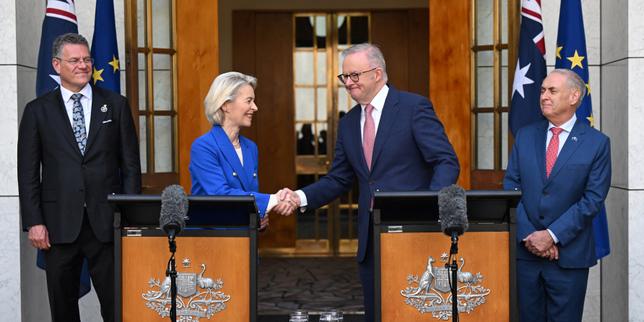
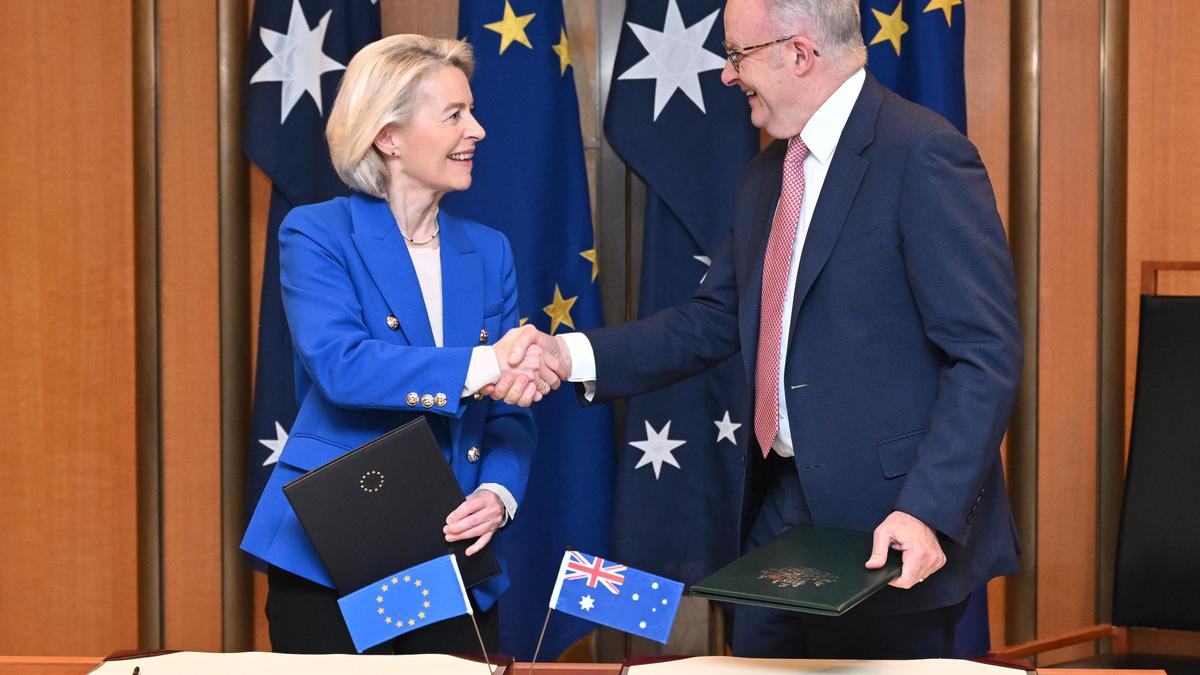
The announcement of a finalized free trade agreement between the European Union and Australia isn't just a win for bureaucrats in charcoal suits. It is a fundamental rewiring of how the democratic world breathes. For the first time, the "tyranny of distance" has been replaced by the necessity of trust.
The Price of a Border
Think of a trade barrier not as a tax, but as a friction burn. Every time a bottle of Barossa Valley Shiraz sits in a customs warehouse for an extra week, the value drops, the spirit of the maker withers, and the consumer pays for the delay. Before this pact, European car manufacturers and Australian farmers were operating in a system designed for a world that no longer exists—a world where neighbors traded with neighbors and the "Far East" or the "Great South" were afterthoughts.
The numbers are staggering, yet they often obscure the reality. When we talk about removing 99 percent of tariffs, we aren't just talking about money. We are talking about the ability of a small cheesemaker in the Pyrenees to find a market in Sydney without needing a legal team to navigate the paperwork. We are talking about Australian critical minerals—the cobalt, the lithium, the manganese—flowing into European battery plants with the same ease as if they were being moved between provinces.
But why now? The answer lies in the sudden, cold realization that the global supply chain is fragile. It is a glass ornaments hanging by a thread. The pandemic showed us that when the thread snaps, we all scramble in the dark. By codifying this text, the EU and Australia have decided to weave a thicker cord.
A Shield Made of Paper and Steel
While the trade deal provides the economic pulse, the new defense partnership provides the heartbeat of security. It is easy to look at a defense pact and see only fighter jets or submarines. Look closer. The partnership is about something much more intimate: the shared protection of the digital and physical commons.
Imagine a specialized cyber-security analyst in Canberra. Let’s call her Sarah. Her job is to watch the invisible pings off the coast of underwater data cables. In the old model, Sarah might see a threat but have to navigate a labyrinth of international protocols before she could share that data with her counterparts in Brussels.
The new defense framework acts as a high-speed data bypass. It acknowledges that a threat to the stability of the Indo-Pacific is, by extension, a threat to the stability of the Baltic. Security is no longer a matter of guarding your own backyard; it’s about ensuring the fence is electrified all the way around the world.
This isn't just about "military cooperation." It is about the "interoperability" of values. Australia has long been the democratic anchor in the southern hemisphere, often feeling isolated as it stared across the Pacific. By locking arms with the European Union, that isolation evaporates. It transforms Australia from a distant satellite into a central node of a global democratic network.
The Invisible Stakes of the Green Transition
The most profound part of this story isn't found in the headlines about tanks or tariffs. It is found in the dirt.
Europe has a hunger that it cannot satisfy alone. Its goal of becoming the first climate-neutral continent by 2050 is a beautiful ambition, but it is physically impossible without the raw materials held beneath the Australian crust. Australia, conversely, has the resources but needs the sophisticated capital and the massive market scale that only the EU can provide.
This trade pact is the marriage certificate for the Green Revolution.
Consider the hypothetical journey of a wind turbine blade. The technology is perfected in Denmark. The capital comes from a pension fund in Amsterdam. But the rare earth elements required for the magnets come from a mine in Queensland. Under the old rules, each step of that journey was taxed, slowed, and complicated. Now, the path is cleared. The turbine spins faster because the paperwork moved quicker.
The Human Cost of Hesitation
There will be critics. There always are when two massive entities merge their interests. Some will worry about local industries being overshadowed; others will fret over the environmental footprint of shipping goods across such vast distances. These are valid fears. No deal of this magnitude is without its bruises.
But the cost of doing nothing was becoming unbearable. We have seen what happens when democracies hesitate. We have seen what happens when we rely on authoritarian regimes for our energy or our essential electronics. It creates a vulnerability that can be exploited at the worst possible moment.
The EU and Australia aren't just trading wine and minerals. They are trading certainty. They are telling the world that despite the geographical gap, their clocks are synchronized.
The technician in Munich can now send those sensors knowing they won't rot in a port. Elias can extract that lithium knowing there is a stable, high-value market waiting for it. The consumer in Rome can buy a jacket made with Australian wool without feeling the sting of a hidden "distance tax."
The ink on the text is dry, but the story is just beginning. It is a story written in the wake of cargo ships and the fiber-optic pulses of shared intelligence. It is the sound of two distant cousins finally deciding to move in together to protect the family business.
The world is getting smaller, not because the distances are shrinking, but because the handshakes are reaching further. Somewhere on a dock in Melbourne, a crane operator is lifting a crate that wouldn't have been there a year ago. He doesn't see a trade pact. He sees work. He sees a future that is slightly more secure than it was yesterday.
The wind still blows at the port, but now, it carries the weight of a promise kept.
Would you like me to analyze how this specific agreement might impact the global market prices of critical minerals over the next five years?