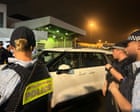
The tarmac at Sydney International Airport does not care about geopolitics. It is just gray asphalt, shimmering under a brutal Australian sun, waiting for the wheels of a charter flight to touch down.
When the doors opened, a small group of women and children stepped out into the crisp morning air. They carried no luggage to speak of. Their clothes were worn, their eyes heavy with the kind of exhaustion that takes years to accumulate and generations to dissolve.
They did not arrive in handcuffs. There were no flashing police lights, no dramatic perp walks for the evening news, no instant arrests. Instead, there were caseworkers, plainclothes security personnel, and the overwhelming, terrifying silence of a country they once called home, but which now felt like a different planet.
This is the reality of Australia’s quiet repatriation of citizens linked to the collapsed Islamic State caliphate. While the headlines scream about national security and legal loopholes, the human truth is far more complex, fragile, and unsettling.
The Dust of the Camp
To understand the quiet arrival in Melbourne and Sydney, you have to go back to Al-Hawl and Roj. These are not just refugee camps; they are vast, open-air holding pens in northeastern Syria, choked with dust, disease, and the wreckage of a failed holy war.
Consider a hypothetical child born in the shadow of the black flag. Let us call him Omar. Omar is seven years old. He has never seen a light switch. He has never tasted clean running water. His entire universe has been a canvas tent, the howling desert wind, and the radicalized whispers of a desperate community.
For years, the Australian government watched from a distance. The political calculation was simple: leaving them there was easier than bringing them back. Public anxiety was high. The memory of terror attacks loomed large. The narrative was written in stone—these people chose to leave, so let them stay in the ruins of their choices.
But human beings are not math equations.
The conditions in the camps deteriorated. Children were dying of preventable illnesses. Western allies, including the United States, began putting pressure on nations to clean up their own messes. The argument shifted from a question of political will to one of fundamental human rights and legal obligation. These women and children were Australian citizens. The passport, a document we take for granted when booking a holiday, represents an unbreakable legal knot. You cannot simply untie it when things get ugly.
The Invisible Shield
When the plane touched down, the immediate reaction from critics was sharp. How could individuals with ties to a brutal terrorist organization walk free into Australian suburbs?
The answer lies in the invisible, immense scaffolding of the Australian security apparatus.
An arrest requires a specific, briefable crime that can hold up in a court of law under strict rules of evidence. Gathering admissible evidence from a war zone thousands of kilometers away is a prosecutor’s nightmare. Spent shell casings, deleted Telegram chats, and hearsay in a Syrian bunker do not easily translate into an Australian criminal conviction.
So, the state uses a different toolkit.
Instead of prison bars, these returnees face a wall of surveillance and psychological intervention. It is a slow, methodical process of reintegration, backed by the Australian Federal Police and intelligence agencies.
- Counter-terrorism teams monitor movements.
- Psychological experts assess the depth of trauma and radicalization.
- Social workers manage the monumental task of reintroducing children to a society they have never known.
It is a gamble masked as bureaucracy. The state is betting that support, surveillance, and structure are more effective tools for long-term safety than a legally shaky prosecution that might collapse under scrutiny.
The Two Wars
There is a profound disconnect between the political theater surrounding this issue and the lived reality of those on the ground.
On one side, you have the political arena, where words like "threat" and "complicit" are tossed around to score points. On the other side, you have a grandmother waiting in a sterile reception room in Melbourne, her hands shaking as she waits to hold a grandchild she has only ever seen in grainy, smuggled photographs.
The women who returned are not a monolith. Some were naive brides who followed husbands into a utopia that turned out to be a slaughterhouse. Others were deeply committed to the ideology, finding out too late that the caliphate devoured its own. Distinguishing between the victim, the perpetrator, and the bystander is a task that would test the wisdom of Solomon.
But the children are blameless.
They did not choose the birthplace. They did not choose the ideology. They are the collateral damage of a war fought by adults who abandoned reality for a blood-soaked fantasy.
The Suburbs Wait
The plane is empty now. The families have been moved to undisclosed locations. They are starting the agonizingly slow process of becoming ordinary.
In the coming weeks, these children will sit in Australian classrooms. They will learn to read English. They will see oceans, parks, and supermarkets filled with unimaginable abundance. They will also carry secrets, nightmares, and the invisible stigma of their lineage.
The neighborhood streets of Melbourne and Sydney remain unchanged. Traffic flows. Coffee is poured. People hurry to work, entirely unaware that down the road, a child who once lived in the heart of a terrorist caliphate is learning how to ride a bicycle.
We want our monsters to look like monsters. We want them in orange jumpsuits, behind thick glass, neutralized and cataloged. It makes us feel safe. It draws a clean line between us and them.
The reality of their return offers no such comfort. It is messy, uncertain, and deeply uncomfortable. It forces a society to ask what it truly values: the desire for retribution, or the difficult, grinding work of redemption and reclamation.
The quiet arrival was not a failure of justice. It was the beginning of a different kind of trial, one played out not in a courtroom, but in the quiet, mundane corners of everyday life, where the stakes are nothing less than a child's soul and a nation's capacity for grace.