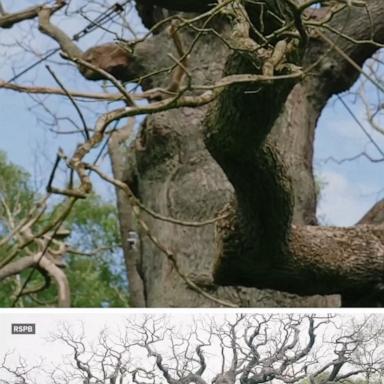
The legendary Major Oak of Sherwood Forest is dead. After standing for more than a millennium as a living monument of British history and folklore, the 1,200-year-old giant failed to produce a single leaf this spring. The Royal Society for the Protection of Birds confirmed the tree succumbed to an intersection of environmental stressors, bringing an end to a life that spanned from the Viking age to the modern era. While many will blame the simple march of time, an investigation into the tree's final decades reveals a far more troubling reality. We killed it with our adoration.
For two centuries, the public flocked to Nottinghamshire to touch, climb, and stand beneath the massive canopy where Robin Hood and his band of outlaws supposedly took refuge. This endless procession of human admiration quietly triggered a slow, invisible suffocation underground. The tragedy of the Major Oak is not that it grew old and faded away naturally. The tragedy is that our well-intentioned preservation efforts, combined with historical industrialization and accelerating modern heatwaves, fundamentally broke the biological systems that kept the ancient organism alive.
The Concrete Effect of Millions of Boots
Trees do not just live in the open air. Their survival depends entirely on what happens in the dark spaces beneath the soil surface. To understand how the Major Oak died, one must look downward at the root system, which tree experts recently described as completely disconnected from its surrounding environment.
Every single person who walked up to the tree over the past two hundred years contributed a tiny amount of downward pressure on the earth. Multiply that pressure by millions of tourists, and the soil undergoes a catastrophic physical transformation known as compaction. The tiny pockets of air between dirt particles disappear. When these air spaces vanish, the soil loses its ability to absorb water and transfer oxygen to the deep roots.
The earth surrounding the trunk effectively turned into concrete.
Even though conservationists erected a wooden fence around the tree in the 1970s to keep visitors at a distance, the damage was already deeply structural. Decades of unmanaged tourist footfall, compounded by the site's history as a military camp during the world wars, left a legacy of starved roots. Recent underground testing by arborists revealed a root system that was severely strangled, unable to access the basic nutrients required to fuel a canopy that once spanned 92 feet across.
Rainwater could no longer penetrate the hardened ground. Instead of soaking down to the deep taproots, water simply washed away across the surface of the packed dirt, leaving the ancient oak perpetually dehydrated even during typical British winters.
The Irony of Artificial Engineering
Human intervention did not stop at the soil level. As the Major Oak grew older, its massive, horizontal limbs became incredibly heavy, threatening to snap under their own weight. To prevent a catastrophic collapse, managers in the early and mid-20th century installed an elaborate network of metal scaffolding, wooden props, and heavy cables to cradle the branches.
It looked like an act of mercy. It functioned as a biological trap.
Ancient oaks possess an extraordinary survival strategy for old age. When a branch becomes too heavy or the root system can no longer sustain it, the tree naturally sheds that limb. This process allows the organism to shrink its overall mass, a phenomenon arborists refer to as growing down. By retreating into its central trunk, an ancient tree reduces the distance water must travel, allowing it to survive on far fewer resources.
The metal props stole this defense mechanism from the Major Oak.
Because the scaffolding artificially held the heavy branches in place, the tree was tricked into maintaining an unsustainable anatomy. The internal plumbing system was forced to pump water and sap across vast distances to the tips of propped-up limbs that should have been dropped decades ago. Recent studies conducted after the site management changed hands showed that this constant, unnatural strain severely depleted the trunk's core water reserves. The tree was spending more energy maintaining its engineered shape than it was taking in through its damaged roots. Conservationists found themselves caught in a terrible catch-22 situation because removing the metal props would have caused the structural collapse of the hollow trunk, yet leaving them in place guaranteed the slow starvation of the entire tree.
Deep Mining and the Altered Water Table
The environmental assault on Sherwood Forest was not limited to the surface. Beneath the forest floor, decades of heavy industry altered the subterranean geography of Nottinghamshire in ways that are only now being fully quantified.
Coal mining was the lifeblood of the regional economy for generations. As deep pits were dug throughout the county, miners encountered vast underground aquifers that threatened to flood the shafts. Massive pumping operations were deployed to drain these voids, systematically drawing millions of gallons of water away from the deep subterranean layers.
This industrial pumping permanently altered the local water table.
For a young tree, a fluctuating water table is manageable. For a thousand-year-old oak with a rigid, non-adaptive root structure, it is a death sentence. The deep taproots of the Major Oak, which had relied on a stable level of moisture for centuries, suddenly found themselves reaching into dry, modified strata. The tree could no longer rely on deep groundwater reserves during periods of surface drought. It became entirely dependent on immediate rainfall, the very rainfall that was already blocked from entering the soil by the compacted tourist paths.
The New Climate Reality
The final blows came from a changing sky. The last decade of the tree's life was marked by a sequence of unprecedented environmental shocks that broke its remaining resilience.
Oaks are resilient to individual dry spells. However, the sheer frequency of recent hot, dry summers left the Major Oak with zero time to recover between seasons. The historic heatwave of July 2022, which saw temperatures in the United Kingdom soar past 40 degrees Celsius for the first time in recorded history, acted as an immediate catalyst for the tree's final decline.
| Year | Environmental Impact on the Major Oak | Canopy Condition |
|---|---|---|
| 2022 | Record-breaking 40°C heatwave and severe summer drought | Canopy shows widespread yellowing; early leaf drop |
| 2023 | Consecutive dry spring preventing early nutrient storage | Leaf production drops by roughly 40 percent |
| 2024 | Winter waterlogging followed by immediate summer baking | Only minor outer branches sprout weak foliage |
| 2025 | Total depletion of internal starch reserves in the trunk | Minimal, stunted leaf burst observed in late May |
| 2026 | Complete system failure; root-to-canopy death confirmed | Zero buds open; tree officially pronounced dead |
During these extreme heat events, trees undergo a process akin to heatstroke. To prevent total fluid loss, they close the tiny pores in their leaves. While this action saves water, it also halts photosynthesis, forcing the tree to live off stored starches. The Major Oak simply ran out of savings. Its trunk was empty.
The Conservation Status of Ancient Giants
The quiet passing of the Major Oak highlights a massive blind spot in national conservation policy. While historical buildings and ancient castles receive strict legal protections and millions in structural upkeep, Britain’s living heritage is frequently left to fend for itself against commercial and environmental pressures.
The Woodland Trust has repeatedly warned that ancient trees are the conservation equivalent of the white rhino, yet they lack the comprehensive legal safeguards granted to ancient architecture. A developer cannot legally demolish a medieval church, but the legal mechanisms to prevent the slow destruction of an ancient ecosystem by surrounding development, infrastructure, or unmanaged tourism remain fragmented and weak.
The Major Oak survived the woodsman's axe for centuries because its wood was too knotted and twisted to be useful for shipbuilding or cathedral roofs. It survived the clearance of Sherwood Forest for agriculture. It could not, however, survive the invisible, modern shifts in climate and regional hydrology.
Life After the Final Leaf
The story of the Major Oak does not conclude with its death. The physical structure will remain standing in Sherwood Forest, shifting from a living botanical wonder into an essential deadwood habitat.
Dead ancient trees are arguably more ecologically active than living ones. The hollow trunk and decaying limbs will provide a home for hundreds of species of rare beetles, fungi, and nesting birds that rely exclusively on ancient wood to survive. The RSPB will maintain the protective fencing, allowing the giant to decompose naturally over the next century, returning its remaining nutrients back into the Sherwood soil.
Meanwhile, clones and saplings grown from the Major Oak’s final acorns have been planted across the globe, ensuring its genetic lineage continues. But the loss of the original organism stands as a stark warning. We must change how we interact with our remaining ancient woodlands, shifting our focus from turning these ancient trees into tourist spectacles to fiercely protecting the invisible underground networks that keep them alive.


