Cold.
That is the first thing you notice about a surgical theater, long before the smell of antiseptic hits the back of your throat or the rhythmic, high-pitched beep of the pulse oximeter settles into your bones. The air is kept refrigerated to slow down bacteria, which means the steel instruments feel like icicles through two layers of latex gloves, and the human chest, once opened, radiates a startling, fragile warmth against the chill.
For decades, a Swiss surgeon stood at that table. His entire professional existence was governed by the laws of millimeters, sutures, and biological inevitability. When a cardiac or thoracic surgeon looks at a heart, they do not see a valentine. They see a muscular pump roughly the size of a closed fist. They see four chambers, four valves, the delicate, treacherous branching of the coronary arteries, and the thin, translucent sac of the pericardium that holds it all together. In the operating room, emotion is a contaminant. Sentimentality makes hands shake. You survive the profession by reducing the most poetic organ in the human body to plumbing and electrical wiring.
Yet, when this same Swiss surgeon walked out of the sterile light of the hospital and stepped back into the world, he began doing something that looked, to the untrained eye, like charming madness. He started picking up stones. Specifically, stones shaped like hearts.
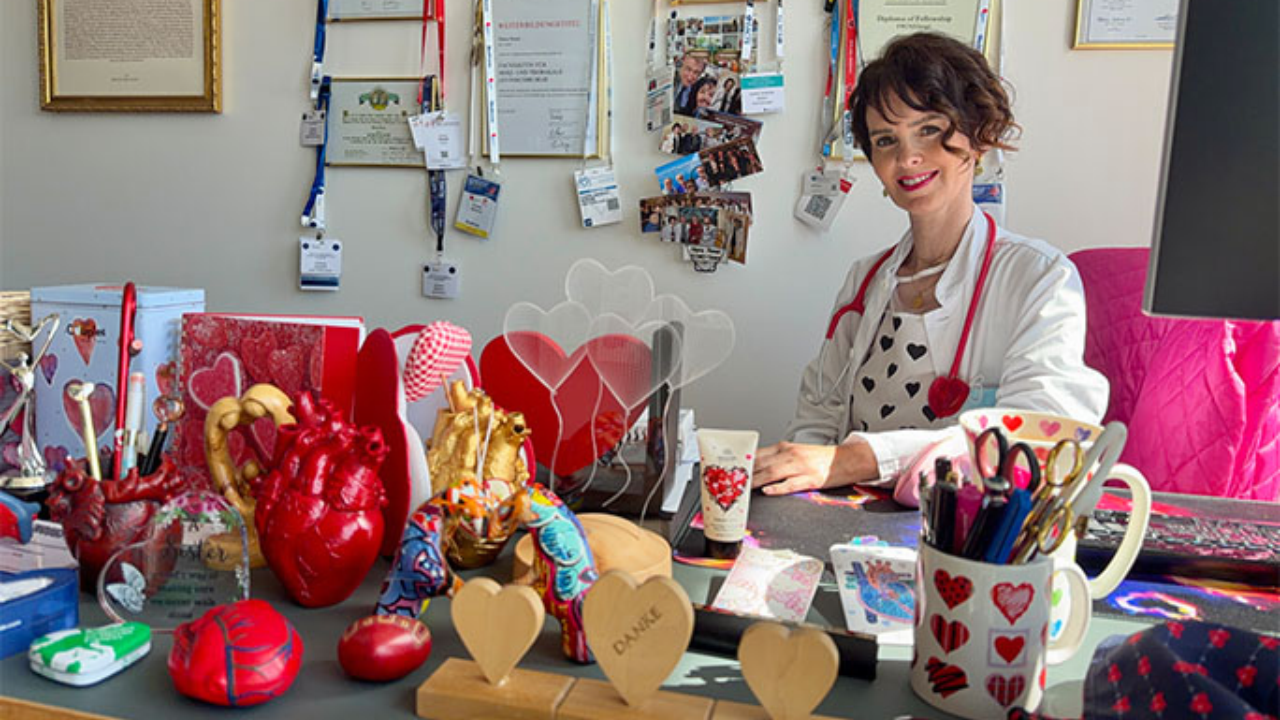
It began with one, then ten, then hundreds, until the quiet rooms of his home in Switzerland began to fill with the symbol he had spent his career treating strictly as meat and muscle. By the time Guinness World Records came calling, his collection had swollen into the thousands. Then, in 2024, he lost the title. Someone else, somewhere else in the world, had amassed more. And so, with the quiet, methodical stubbornness that only a man trained to outlast six-hour surgeries possesses, he went back to work—reclaiming the Guinness World Record with an astonishing 3,200 heart-shaped objects.
On the surface, this reads like a piece of Sunday-paper trivia. A quirky footnote about an eccentric collector with too much shelf space.
Look closer, though. When a person who holds human lives in their bare hands for a living spends decades hoarding 3,200 emblems of love and survival, they are not just decorating their living room. They are building a seawall against the tide of mortality.
The Weight of the Red Muscle
To understand why a surgeon would obsess over a cartoonish, symmetrical shape that bears almost zero anatomical resemblance to the real thing, you first have to understand the psychological toll of the scalpel.
Consider a hypothetical scenario—a composite of a thousand real nights in hospitals from Zurich to Chicago. Imagine a surgeon, let us call him Dr. Lukas, standing over a patient at three in the morning. The patient is fifty-two, a schoolteacher, a father of two. The tissue of his myocardium is bruised and sluggish, starved of oxygen after a massive blockage. Dr. Lukas has to stop that heart, divert the blood through a machine, sew a tiny vein harvested from the man’s leg onto an artery no wider than a strand of uncooked spaghetti, and then—the moment that never stops terrifying even the veterans—warm the blood back up and pray the muscle remembers how to beat on its own.
Sometimes it does. The fibrillating quiver snaps back into a strong, steady lub-dub, and the surgeon goes home to eat cold pasta in silence.
Sometimes it does not.
I remember the first time I walked past a cardiac intensive care unit late at night, peering through the glass at the tangled forest of IV lines and the rhythmic rise and fall of ventilators. I felt an overwhelming, dizzying sense of fragility, as if every person walking down the street outside was carrying a priceless, paper-thin glass lantern inside their ribs, entirely unaware of how easily it could shatter. If a brief glance through a window can leave an ordinary observer rattled for days, imagine living inside that room for thirty years.
Medical culture rarely gives doctors permission to grieve. You close the chest, you talk to the family in a beige room with boxes of cheap tissues on the table, you wash your face, and you check the morning schedule. The grief has nowhere to go. It calcifies. Psychologists who study physician burnout talk about "compartmentalization"—the mental trick of locking trauma inside a vault so you can keep functioning.
Collecting is the reverse of compartmentalization. It is the act of taking something invisible, heavy, and terrifying, and turning it into something solid you can hold in your palm and set on a wooden shelf.
Why We Hoard the Shape of Love
Humans have always used objects to bargain with fate. Long before modern cardiology, medieval pilgrims carried tiny lead badges shaped like hearts to ward off sudden death. In folk traditions across the Alpine regions of Switzerland, painted wooden hearts were hung above doorways not merely as romantic gestures, but as talismans of protection and endurance.
The human brain is an aggressive pattern-recognition machine. Psychologists call it pareidolia—the tendency to perceive specific, meaningful images in random visual stimuli. It is the reason we see faces in electrical outlets and animals in cumulus clouds. When you are primed by trauma, devotion, or longing, your visual cortex becomes hyper-attuned to a single silhouette. You walk down a gravel path along Lake Geneva, and out of ten thousand grey pebbles, your eye locks onto the one eroded by centuries of water into a cleft curve at the top and a gentle point at the bottom.
For our Swiss surgeon, that daily act of noticing became a quiet ritual of restoration. Every heart-shaped stone, piece of driftwood, ceramic trinket, or metal casting was a counter-argument to the fragility he witnessed under the surgical lamps. In the hospital, hearts failed. They tore, they clogged, they weakened. Out in the world, hearts were made of granite, brass, glass, and oak. They could not be broken by a blood clot. They did not need bypasses.
To reach a collection of 3,200 distinct items requires more than casual interest. It requires an almost monastic discipline. Guinness World Records does not simply take your word for it when you claim a title. Their guidelines for collections are notoriously strict: every single item must be unique—no duplicates, no bulk-buying a bag of five hundred identical plastic beads—and every piece must be cataloged, photographed, and verified by independent witnesses.
Think about what 3,200 unique objects actually looks like in physical space. If you lined them up end-to-end, assuming an average width of three inches, they would stretch for eight hundred feet—nearly the length of three football fields. It is an archive of attention. Every single piece represents a moment where a busy, exhausted man stopped walking, bent down, and paid attention to the world.
The Sting of 2024
For years, that record belonged to him. It was a quiet badge of honor, a whimsical counterpoint to the grim seriousness of his medical career. Then came 2024, and the title slipped away.
On paper, losing a Guinness World Record for collecting novelty shapes sounds trivial. Who cares? It is not a Nobel Prize. Nobody dies if someone else owns more heart-shaped ashtrays and river rocks than you do.
Except that is never how human beings actually experience loss, especially loss tied to a personal ritual.
When you pour decades of quiet, restorative energy into a project, that project becomes woven into your identity. Losing the record in 2024 wasn't just about numbers on a spreadsheet in London; it felt like having a private sanctuary trespassed upon. Imagine tending a small, secret garden behind your house for twenty years, only to wake up one morning and find that a stranger down the road has built a bigger, louder version of your exact refuge and claimed the deed to the concept itself.
You feel foolish for caring, which only makes the sting worse. You tell yourself it doesn't matter. You go to work, you scrub in, you tie your knots, you check your charts. Yet, every time you walk past the shelves in your study, the collection looks slightly smaller than it did the week before. The magic dims.
What happens next reveals the exact psychological wiring that separates elite surgeons from the rest of us. When a difficult procedure goes sideways—when a suture pulls through fragile tissue or an unexpected bleed obscures the field—a good surgeon does not panic, and they do not quit. They lower their heart rate, narrow their focus, and work the problem one millimeter at a time.
He did not throw his hands up and box up his shelves. He began the hunt again.
The Anatomy of an Obsession
Rebuilding toward 3,200 items meant auditing the entire collection from scratch, weeding out anything that might fail Guinness’s strict anti-duplicate scrutiny, and systematically scouring flea markets, antique shops, coastlines, and artisan workshops. Friends, former patients, and colleagues—once word got out that the record had been lost—likely became scouts in the campaign, slipping strange little treasures into his coat pockets at medical conferences or mailing small parcels from vacations abroad.
There is a crucial distinction in psychology between healthy passion and destructive compulsion, and it comes down to what the behavior gives back to the person doing it. Compulsion shrinks your world; it isolates you in a room counting things until the outside world disappears. Passion expands your world; it turns every walk in the woods, every trip to a foreign market, and every conversation with a stranger into a treasure hunt.
Look at how collecting operates as a behavioral antidote to modern burnout. We live in an era where almost all of our daily labor is digital, abstract, and instantly erased. You answer forty emails, and by Tuesday morning, forty more have taken their place. You finish a spreadsheet, close the tab, and feel nothing. Even in medicine, modern doctors spend nearly half their shifts staring at electronic health record screens, clicking checkboxes that vanish into cloud servers.
Physical objects push back against that weightlessness. A heart-shaped piece of sea glass has mass. It has a history—a bottle shattered decades ago, tumbled against sand and salt until its sharp edges became smooth enough to hold without bleeding.
That, right there, is the metaphor hidden inside the entire story. And it is worth stating plainly: the surgeon was not collecting perfection. A heart-shaped stone is only shaped like a heart because something violent happened to it. It was cracked off a larger cliff face, battered by glaciers, ground down by rivers, and chipped by frost. Its symmetry is the result of erosion.
Three Thousand Two Hundred Witnesses
When Guinness officially verified the reclaimed record at 3,200 heart-shaped objects, the headlines reduced the feat to a single sentence and a smiling photograph. A man surrounded by red, pink, stone, and wooden hearts. Clean. Digestible. Easy to scroll past while waiting for your coffee.
I find myself wondering about the individual pieces buried in the middle of that count. Not item number one, and not item number 3,200, which always get the spotlight, but item number 1,418. Maybe it is a rusted iron hinge from an old barn in the Swiss Jura mountains. Maybe it is a chipped porcelain dish found in a Zurich secondhand bin, or a smooth river stone pulled from the Rhine on a cold November afternoon after a particularly brutal week in the operating room.
Every single one of those 3,200 objects is a timestamp of survival. It is proof that on a given Tuesday, the collector was alive, walking upright, looking at the ground, and still capable of being delighted by a coincidence of geometry.
We tend to mock collectors as people who are stuck in the past or overly attached to clutter. Minimalism is the fashionable religion of our decade; we are told to throw everything away, keep our surfaces bare, and live light. Sometimes, though, bare surfaces are terrifying. Sometimes a human being needs physical evidence that beauty and order exist in the world, especially when their day job requires them to confront the raw, bloody chaos of how fragile we really are.
Next time you are walking along a gravel driveway, a rocky beach, or a cracked city sidewalk, try looking down for sixty seconds. Not at your phone, and not at your shoes, just at the ground passing beneath you. You will be startled by how quickly your eyes start pulling shapes out of the noise—a leaf bitten by an insect into two rounded lobes, a stain on the concrete, a pebble worn smooth by a million footsteps.
Most of us step right over them without breaking stride. Somewhere in Switzerland, a man who knows better than anyone just how easily a real heart can stop is still bending down to pick them up.