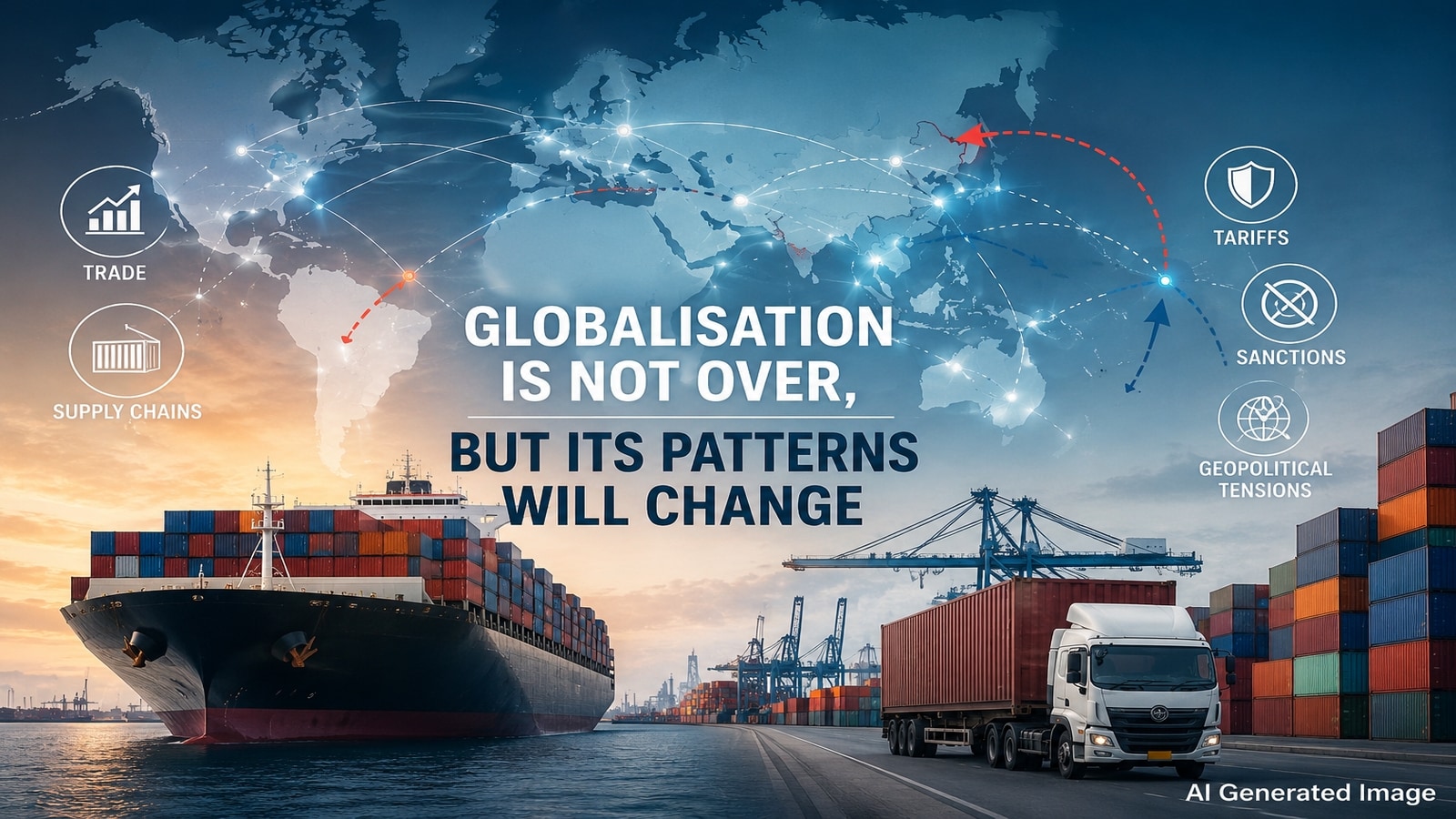
The cargo box looks like nothing. It is a rusted steel monolith, forty feet of industrial apathy sitting quietly on a yellow chassis. Rain pools in its dents. Salt crusts its corners.
To anyone walking past a container terminal at dawn, it is just metal. But inside that box is a refrigerator packed with pharmaceutical insulin meant for a clinic in Chicago, or twelve thousand pairs of sneakers stamped with a brand name teenagers will line up for on a Friday night, or microchips that will dictate whether a hospital ventilator keeps breathing.
For decades, the system that moved that box was invisible. It worked like plumbing. You turned the tap, and water came out; you ordered a part from Shenzhen, and it landed on your loading dock in Ohio thirty days later. Nobody asked about the pipe. Nobody cared about the valve.
Then the pipe cracked.
The Illusion of the Straight Line
I remember standing on a concrete pier in late 2021, watching a container ship sit three miles off the coast. It looked frozen, pinned to the grey horizon like a toy boat in a bathtub. It had been waiting twelve days for a berth. On board were containers of auto parts that assembly plants two thousand miles inland desperately needed to keep their assembly lines moving. Workers were being sent home early because a ship carrying thirty thousand tons of steel and rubber was idling within sight of land, waiting for a crane operator who was home sick with fever.
That was the moment the old map died.
For fifty years, global trade operated on a singular, elegant religion: absolute efficiency. If labor was cheaper in Vietnam, you built your factory there. If shipping lanes were quiet, you ran your vessels at maximum speed to squeeze out fractions of cents per ton. Everything moved in straight lines across the globe, choreographed by algorithms that assumed tomorrow would look exactly like yesterday.
It was a brilliant machine. It was also brittle as dry glass.
When shocks hit—pandemics, blocked canals, shifting politics—the straight line snapped. Companies woke up to a terrifying realization. Being efficient meant you had zero fat to absorb a blow. Lean inventory became empty shelves. Just-in-time delivery became just-too-late disaster.
Sultan Ahmed bin Sulayem, the chief executive of DP World, watched this machinery shudder from the center of the storm. He manages ports from Dubai to London, overseeing the literal arteries of human commerce. In recent assessments, he has pointed out something that many executives whisper in boardrooms but hesitate to say on television: globalization is not dying, but the plumbing is permanently broken. We cannot go back to the way things were, because the world that created those logistics has vanished.
Consider what is happening beneath the surface of international shipping right now. This is not just a matter of freight rates fluctuating or fuel prices ticking upward. It is a fundamental rewiring of how humanity shares its labor and its bounty.
The Weight of the Detour
Imagine a hypothetical shipping coordinator named Elena, sitting in a windowless office in Rotterdam. Five years ago, Elena’s job was boring. She plugged numbers into a spreadsheet, booked space on a vessel steaming straight through the Red Sea and up the Suez Canal, and went home at five.
Today, Elena’s screens are a chaotic web of red alert lights.
Geopolitical friction and security threats have turned the Suez route into a high-stakes gamble. To avoid conflict zones, cargo vessels are now forced to drop their bows southward, around the Cape of Good Hope, adding thousands of miles and weeks of transit time to every single journey.
This is where the abstract concept of supply chain disruption hits the human ledger.
When a ship takes an extra fourteen days to round Africa, every container on board is trapped in limbo. The fuel burned to cover those extra miles is staggering, pumping millions of tons of extra carbon into the atmosphere. More immediately, the ship is out of rotation. By the time it finally unloads in Europe, it should already be halfway back to Asia for its next run.
Multiply Elena’s headache by ten thousand. Every delay cascades. Warehouses fill up with safety stock—inventory companies are now hoarding just in case the next bottleneck arrives. Prices creep upward, not because of simple inflation, but because every single box of goods is now paying a hidden tax of time, fuel, and uncertainty.
We are watching the end of frictionless distance. For a generation, we acted as though oceans were merely blank blue spaces to be crossed as quickly and cheaply as possible. Now, oceans have weight again. Geography has returned with a vengeance.
Rewriting the Rules of the Exchange
So, what does business look like when the old map is useless?
It looks localized, diversified, and paranoid. And paradoxically, it looks more high-tech than ever before.
Chief executives across the globe are no longer asking their logistics teams, "How can we do this for the absolute lowest cost?" Instead, they are asking, "What happens if this route closes tomorrow?"
This has sparked a massive migration of manufacturing. Companies are moving production closer to home—near-shoring—or shifting factories to allied nations where supply lines are less vulnerable to sudden diplomatic freezes. We are trading the hyper-concentrated factory floors of single regions for a multi-polar web of production hubs. If a flood stops a plant in one country, another plant two thousand miles away can spin up its lines by nightfall.
At the ports themselves, the response is frantic modernization. DP World and other major operators are pouring capital into inland freight terminals, digital customs clearing houses, and automated yards where artificial intelligence sorts containers before humans even arrive at work.
To understand this shift, think of a modern shipping terminal not as a parking lot for boxes, but as the brain of an organism. Every container carries an electronic tag. Every crane is monitored by sensors predicting when a motor might fail. Data flows ahead of the physical vessel. When a ship docks in Los Angeles or Jebel Ali, the cranes already know the exact sequence in which boxes must be lifted to clear the yard in hours instead of days.
Yet, technology alone cannot fix a world that is fundamentally more divided.
The Human Core at the Edge of the Machine
We like to talk about global trade as if it were a pure mathematical equation. GDP growth, tonnage, TEUs, demurrage fees. But beneath every statistic is a human hand.
It is the welder in a shipyard in South Korea working through a humid afternoon. It is the truck driver in Nebraska who has lived out of a sleeper cab for three weeks because customs paperwork got tangled in a digital queue. It is the small-business owner in Lisbon who ordered ceramic tiles for a restaurant renovation, only to watch her opening date slip past because her shipment is sitting on a diverted vessel off the coast of Madagascar.
When the old way of doing business dies, these people bear the cost of the transition.
The new era of trade demands something that the previous era ignored: resilience over recklessness. We are stepping away from the fantasy that the entire earth can function as a single, frictionless warehouse operating twenty-four hours a day without a safety net.
Globalization is surviving, but it is growing up. It is shedding its blind optimism and accepting that the world is messy, unpredictable, and prone to sudden fractures.
The rusted steel box still sits on its chassis in the rain. Inside it, the goods wait. But the path they took to get there, and the way the world thinks about their journey, has changed forever. We are no longer sailing blind across a flat map, hoping for the best. We are navigating a storm we finally respect.