Most people walk right over them. A dark, hurried streak cutting across a cracked sidewalk, millions of individual lives busy with an urgency we rarely stop to decode. To an adult, an ant is a nuisance. To an eighth grader sitting in a California classroom, it was a blank page of questions.
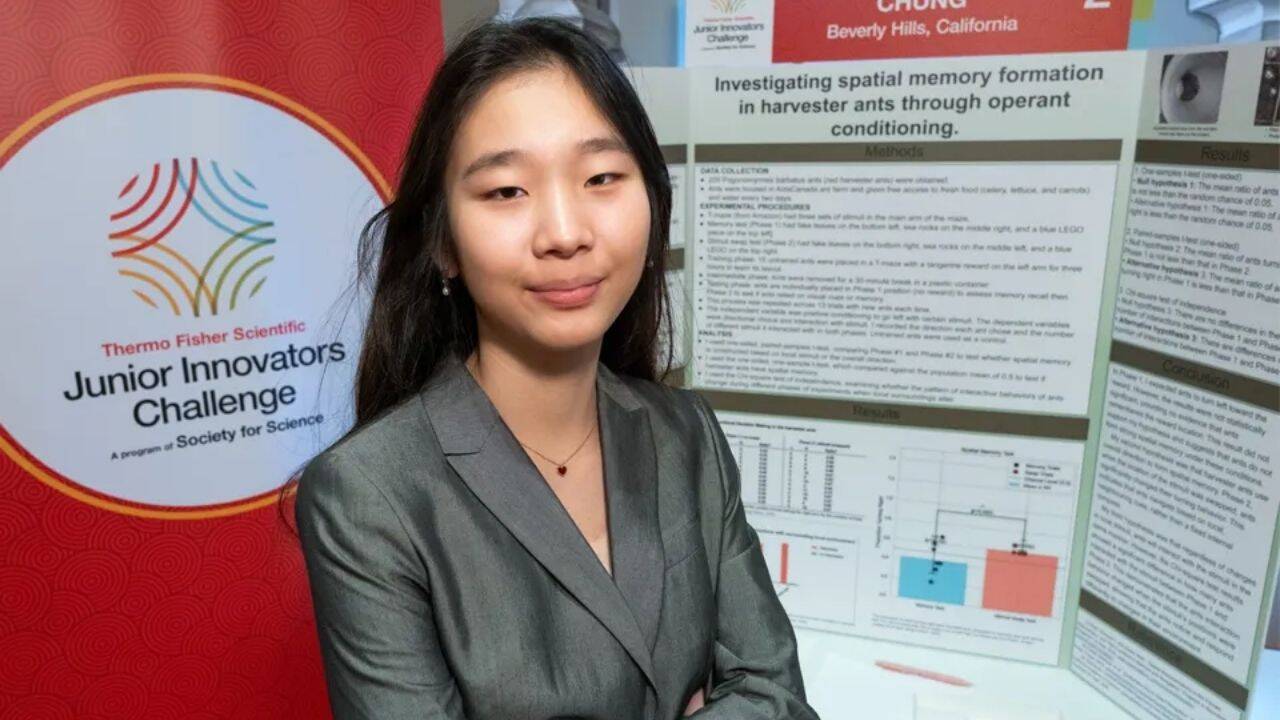
Seungah Chung looked down. While textbooks told tales of chemical pheromones acting as simple breadcrumb trails, her mind wandered into deeper territory. How does an organism with a brain no larger than a pinhead construct a sense of place? How do you find your way across a vast, hostile world when you cannot read a map, ask for directions, or remember a grid coordinate?
The answers did not come from an expensive corporate laboratory. They came from a careful assembly of plastic, patience, and two hundred red harvester ants.
The Architecture of Curiosity
Science often sounds intimidating. We picture sterile white rooms, cryogenic freezers, and billion-dollar particle colliders. But the core of scientific discovery has always been remarkably human. It starts with an itch in the back of the mind. It starts with watching things move when nobody else is looking.
Seungah, a student at Beverly Vista Middle School, decided to build a world for her tiny test subjects. She acquired two hundred red harvester ants, scientifically known as Pogonomyrmex barbatus. She constructed a miniature T-shaped maze. At the end of one specific path, she placed a bright, fragrant fragment of tangerine as a reward.
Imagine walking into a strange building for the first time. You smell citrus. You turn left. But what guides you back when the lights go out?
To find out, Seungah populated the path with a series of artificial markers. She used miniature sea rocks, tiny fake leaves, and colorful plastic building blocks. These were not random decorations. They were deliberate, visual signposts scattered along the corridor. She placed fifteen ants into the maze at a time, letting them explore, letting them learn the geometry of the maze, letting them map the territory through their compound eyes.
Then, she changed the rules.
The Deception of the Blocks
Consider what happens next. The ants had learned the route to the tangerine. They had memorized the turns. If you or I walk down a familiar street, we rely on street signs and storefronts to tell us we are home. If someone moves the storefronts overnight, panic ensues.
Seungah did precisely that to her test subjects. She left the food in its exact original location, but she swapped the positions of the landmarks. She moved the sea rocks to where the fake leaves had been. She shifted the building blocks.
The food did not move. The chemical traces remained largely consistent. But the visual world had shifted around the edges.
The reaction was immediate and telling. The ants became disoriented. Confronted with the altered scenery, many of them turned the wrong way, marching confidently toward an empty corner simply because the visual landmarks had migrated. They were not just following a blind chemical path or a rigid internal pedometer. They were looking at their surroundings. They were using landmarks to anchor themselves in space.
This elegant little experiment, executed with the precision of a seasoned behavioral biologist, earned Seungah a coveted spot as a finalist in the prestigious Thermo Fisher Scientific Junior Innovators Challenge.
Beyond the Ant Farm
It is easy to dismiss this as a clever science fair project. That would be a profound mistake.
Look closer at the implications. We live in an era obsessed with autonomous machines, self-driving vehicles, and artificial intelligence trying to navigate complex, changing environments. Engineers spend millions trying to teach robots how to understand spatial awareness using massive computational power. Yet, a creature with a nervous system weighing a fraction of a milligram solves this exact problem using visual markers and spatial memory.
By proving that harvester ants rely heavily on landmark navigation rather than just rote memorization or simple chemistry, Seungah’s work bridges a quiet gap between insect behavior and advanced robotics. Understanding how tiny brains process visual navigation maps can ultimately inspire leaner, smarter algorithms for machines that must operate where GPS signals fail and computing power is scarce.
The World Outside the Maze
Science is rarely a singular pursuit. The same mind that tracks the behavioral quirks of Pogonomyrmex barbatus also spends time outside the classroom wielding a paintbrush. Seungah volunteers with Ariari21, a community-focused group that brings color and warmth to homeless shelters and senior living centers through vibrant murals.
There is a poetic symmetry there. Whether she is mapping the cognitive boundaries of an ant or splashing color onto a sterile wall to make a human being feel more at home, her instinct is the same. She looks at fragmented spaces and tries to make them legible. She tries to connect the dots.
When asked about her future, she speaks of becoming a microbiologist, inspired by pioneers like Katalin Karikó, imagining invisible battles against pathogens and antibiotic resistance. It is another world of microscopic scales, another domain where tiny things carry enormous consequences.
We spend so much of our lives waiting for monumental disruptions, waiting for grand institutions to hand down answers from on high. We forget that breakthrough insights often begin with a quiet kid staring down at the dirt, wondering how a creature smaller than a comma finds its way back home.
The ants are still marching. The landmarks are still shifting. And the map of the world is waiting for someone patient enough to watch.