In the village of Ormideia, the soil is a deep, ochre red. It is the kind of earth that sticks to your boots and stays under your fingernails, a constant reminder of where you stand. But for the people living there, the question of where they stand is rarely simple. To walk from a neighbor’s kitchen to the local grocery store is to cross an invisible, sovereign frontier. There are no barbed wire fences in the middle of the street, no armed guards checking passports between the bakery and the pharmacy. Yet, the ground beneath their feet belongs to a king who lives two thousand miles away.
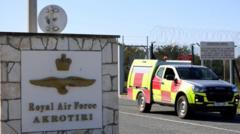
This is the strange, lingering ghost of the British Empire in Cyprus. While the rest of the world moved on from the era of colonial outposts, two jagged bites of the island—Akrotiri and Dhekelia—remained British. They are not merely "bases." They are Sovereign Base Areas (SBAs). They have their own police, their own laws, and their own vision of what the Eastern Mediterranean should look like.
Recently, the President of Cyprus, Nikos Christodoulides, did something quiet but profound. He called for a "frank discussion" about these bases. In the polished language of diplomacy, "frank" is often a polite mask for "painful." It is an admission that the status quo, which has persisted since 1960, is starting to fray at the edges.
The Geography of a Scar
To understand why this matters now, you have to look at a map. Not a modern GPS map, but the one drawn in the frantic, humid days of 1960 when Cyprus was clawing its way toward independence. Britain, sensing the sun setting on its global reach, refused to let go of the island entirely. They carved out 98 square miles—roughly 3% of the land—to serve as permanent "unsinkable aircraft carriers."
Imagine living in a house where two of the bedrooms and half the hallway belong to your former landlord. You can use the hallway, but you can’t repaint it. If the landlord decides to host a loud, dangerous party in those bedrooms, you have no say in the matter, even if the vibrations crack your ceiling.
That is the daily reality for thousands of Cypriots. These bases are not remote desert installations. They are interwoven with civilian life. Farmers plow fields that are technically British territory. Commuters drive through British checkpoints to get to work. When the UK Royal Air Force launches jets from Akrotiri to conduct missions in the Middle East, the windows in nearby Cypriot living rooms rattle. The roar of the engines is a physical weight, a reminder that while Cyprus is a sovereign nation and a member of the European Union, it remains a launchpad for foreign interests.
The Ghost in the Room
For decades, the arrangement was tolerated as a necessary evil. It was the price of independence. But the world has shifted. The geopolitical tectonic plates are grinding against each other with renewed violence, and Cyprus finds itself caught in the middle.
When British jets take off from Akrotiri to strike targets in Yemen or Syria, the island of Cyprus becomes a target by association. The Cypriot government, often kept at arm's length from these military decisions, has to deal with the diplomatic and security fallout. There is a simmering anxiety in the cafes of Nicosia. People wonder: If a retaliatory strike comes, will the world distinguish between the British base and the Cypriot village next door?
President Christodoulides isn't just talking about military strategy. He is talking about dignity. He is addressing the "colonial" tag that these bases still carry. In 2026, the idea of "sovereign" territory held by a former colonial power feels like an architectural ruin that someone is still trying to live in. It is an anachronism.
Consider a hypothetical farmer named Andreas. Andreas owns a grove of lemon trees. Half his trees are in the Republic of Cyprus; the other half are in Dhekelia. To expand his irrigation system, he needs permits from two different governments. One follows the laws of his homeland. The other follows a legal framework derived from a British colonial administration that technically ceased to exist sixty-five years ago. It is a bureaucratic hall of mirrors.
A Debt of History
The tension isn't just about land or noise. It’s about money and broken promises. Under the original 1960 treaty, the UK was supposed to provide financial assistance to Cyprus in exchange for the use of the bases. That payments stopped in the mid-1960s, following the outbreak of intercommunal violence. Since then, the debt has grown into a staggering sum—billions of euros, by some estimates.
The British argument has long been that the bases provide security and stability. They point to the jobs provided to local civilians and the protection the British military presence offers. But that argument is losing its luster. In an age of high-precision missiles and cyber warfare, the "stability" of a 98-square-mile land base is debatable. For many Cypriots, the bases feel less like a shield and more like a lightning rod.
The conversation Christodoulides is calling for isn't just about asking the British to pack their bags and leave tomorrow. He knows the geopolitical reality. He knows the UK won't easily surrender its most strategic foothold in the Levant. Instead, this is about redefining a relationship that has been frozen in time since the Cold War.
The Invisible Stakes
Why now? Why is this "frank discussion" surfacing at this specific moment?
Brexit changed everything. When the UK left the European Union, the bases became a strange, non-EU enclave inside an EU member state. It created a legal nightmare for trade, movement, and the rights of the Cypriots living within the SBA boundaries. Suddenly, the invisible lines became very real again.
There is also the matter of the Chagos Islands. The recent international legal rulings and the subsequent UK decision to negotiate the return of the Chagos archipelago to Mauritius have set a powerful precedent. If Britain can't justify holding onto a remote chain of islands in the Indian Ocean, how can it justify sovereign control over inhabited land in the heart of the Mediterranean?
The "colonial" label isn't just a rhetorical jab. It’s a legal category. If the SBAs are seen as colonial remnants, Britain’s position becomes increasingly untenable under international law. The pressure is mounting, not just from Nicosia, but from a global community that is increasingly weary of "sovereign" exceptions to national borders.
The Sound of the Sea
If you sit on the beach at Lady’s Mile, just outside Limassol, you can see the Mediterranean stretching out in an endless, shimmering blue. It is one of the most beautiful spots on the island. But look behind you, and you see the massive antennae and the gray hangars of the Akrotiri base.
The sea doesn't recognize the borders. The fish swim across the sovereign lines without a permit. The salt spray coats the British radar equipment and the Cypriot beach umbrellas with the same indifference.
There is a sense that the people of Cyprus are tired of living in a puzzle they didn't design. They want to be a bridge between Europe and the Middle East, not a station for someone else's war. They want the ochre soil of Ormideia to belong to the people who till it, fully and without asterisk.
The "frank discussion" has begun. It isn't a shouting match; it’s a steady, persistent pulse. It’s the sound of a small nation finally asking its old guest when they plan to stop acting like the landlord.
History is a heavy coat. For decades, Cyprus has worn it because they were told it was the only way to stay warm. But the sun is high now, the air is hot, and the coat is starting to feel like a shroud. The island is ready to step out of the shadow of 1960 and into a future where the map finally matches the ground.
The red earth remains. The people remain. The invisible lines, however, are beginning to blur.
Would you like me to research the specific legal precedents set by the Chagos Islands case to see how they might apply to the British bases in Cyprus?