The desk in Brussels is large, mahogany, and heavy enough to anchor a ship in a storm. Across it sat reports printed on crisp white paper, bound in blue folders, marked with the quiet urgency of midnight cables.
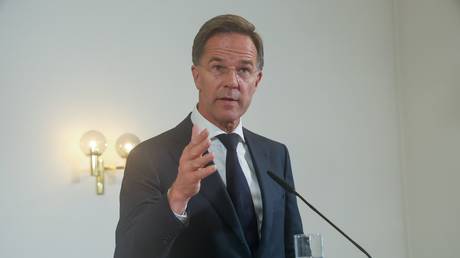
Mark Rutte adjusted his glasses. He did not look like a man about to rewrite the rules of continental survival. Yet, with a quiet cadence that carried the weight of thirty nations behind him, the NATO chief uttered a phrase that slipped past the velvet curtains of diplomacy and landed raw on the world stage: almost sure is enough. Recently making news in related news: Why Everything You Get Wrong About Brazil is a Symptom of Lazy Foreign Bureaucratic Journalism.
Not absolute certainty. Not a signed confession notarized in triplicate. Not a smoking gun held under the bright lights of an international tribunal. Just a probability high enough to tip the scales.
Consider what happens next. Further insights on this are detailed by NPR.
In a command bunker three hundred feet beneath the earth, a young lieutenant watches a cursor blink on a glass screen. The radar trace is ghost-gray, faint, shifting. It could be a flock of migrating geese caught in a thermal updraft over the Baltic. It could be a civilian cargo vessel drifting off course with its transponder dark. Or it could be a hypersonic missile carrying a payload designed to erase a city before the coffee on the breakroom hotplate goes cold.
You do not have forty-eight hours to debate the philosophy of epistemology. You do not have the luxury of waiting for the ambassador to finish his breakfast tea. You have seconds. And in those seconds, the doctrine of absolute proof becomes a luxury for historians, not practitioners of survival.
For decades, the architecture of international security was built on the theology of undeniable evidence. Every border incident, every contested airspace violation, every jagged piece of shrapnel recovered from a crater had to pass through a forensic microscope. The ghosts of the Cold War whispered a constant warning: do not trip over your own feet in the dark. Misinterpretation is the mother of all unintended apocalypses.
We grew comfortable with that lag. We liked the buffer zone between suspicion and retaliation. It gave politicians time to issue measured statements of concern. It gave news anchors room for panels of retired generals to furrow their brows and stroke their chins.
But the nature of the machinery has changed.
The machinery no longer moves at the speed of human deliberation. It moves at the speed of microprocessors and ballistic arcs. When a strike arrives from the gray horizon, the question is no longer Who exactly pulled the trigger? The question
The Margin of Error That Keeps the World Awake
news
gis
The coffee has gone cold on the desk in Brussels. It is three in the morning, the hour when the hum of fluorescent lights sounds less like electricity and more like a low, persistent warning.
Across the table, a stack of encrypted assessments sits heavy. Pixels from a radar feed, thermal signatures captured in the dead of winter, and intercepted radio chatter that crackles with static and urgency. Nobody in this room wants to press the button. Nobody wants to utter the words that tilt the continent from tense peace into something unnameable.
Yet, certainty is a luxury reserved for textbooks. In the machinery of modern deterrence, perfection is a ghost.
When the leadership of the North Atlantic Treaty Organization looks at the wreckage of a stray missile or an uninvited drone trespassing across a sovereign border, they do not find a neat, signed confession. They find fragments. They find ambiguity wrapped in shadows. And then, the statement drops into the global slipstream: almost sure is enough.
Consider what happens next in the quiet corridors of power.
For decades, the architecture of global security was built on a foundation of absolute proof. Treaties demanded verification down to the last bolt and nut. Intelligence agencies operated on thresholds of high confidence before an ambassador could even frown in public. But when a boundary is crossed in the dark, waiting for absolute, undeniable, legally bulletproof verification is a luxury bought with time. And time is the one thing you run out of first.
To understand why a margin of doubt is suddenly acceptable, we have to look past the brass buttons and the podiums. We have to look at the human cost of waiting.
Imagine a village somewhere in Eastern Europe, tucked behind rolling hills where the soil smells of damp earth and coming rain. (This is a hypothetical lens to anchor a very real reality.) Let us call him Jan. Jan wakes up not to an alarm clock, but to a concussive thump that rattles the windowpanes and shakes the dust from the ceiling rafters. For a terrifying, breathless second, he thinks his roof has caved in. It hasn’t. It is an air defense interceptor burning a trail through the stratosphere two miles away, neutralizing a threat that originated hundreds of miles to the east.
Jan does not care about ballistic trajectories. He does not care whether the guidance system failed due to electronic jamming or an intentional command sent from a bunker a thousand miles away. He cares that the sky is falling.
When leaders say they are almost sure who pulled the invisible trigger, they are speaking to Jan. They are acknowledging a grim calculus. If you wait for absolute certainty—for the smoking gun to cool down, for the memorandum to leak, for the adversary to smile and nod—you have already surrendered the deterrent value of your alliance.
Deterrence is not a math equation. It is a psychological shield. It lives entirely in the mind of the person sitting across the table, wondering if you have the nerve to call their bluff.
Critics argue that acting on probabilistic intelligence is dangerous. They warn of slippery slopes, of hair-trigger responses, of misread signals that could escalate into an uncontrollable cascade. They are not wrong. The history of the twentieth century is littered with the smoldering wreckage of false alarms and miscalculated intentions. The Able Archer exercise of 1983 taught the world a terrifying lesson about how easily paranoia can mimic reality.
Danger is the permanent roommate of defense.
Yet, the alternative to accepting the shadow of doubt is worse. The alternative is paralysis. If an alliance designed to protect a billion people adopts a standard of absolute proof, it becomes a paper tiger. Adversaries learn the contours of that hesitation. They learn to operate in the gray zones—the twilight space between declared war and uneasy peace. They send drones that might be navigation errors. They cut undersea cables that might be anchor dragging. They launch cyberattacks that might be rogue actors.
Each individual incident, viewed in isolation, looks like an accident. A fluke. A statistical anomaly.
Stacked together, they form a deliberate pattern of erosion.
This is where the statement from the alliance leadership hits hardest. By declaring that almost sure crosses the threshold of accountability, they are changing the rules of the gray zone. They are signaling that the era of plausible deniability is drawing to a close. They are drawing a thick, red line in shifting sand and daring anyone to test the viscosity.
Walk through any capital in the alliance today, and you can feel the tension in the air. It is not the panicked hysteria of impending doom; it is the heavy, grinding fatigue of prolonged vigilance. Diplomats speak in muted tones. Analysts stare at screens until their eyes sting, hunting for patterns in the noise.
They know the stakes. Every decision is weighted against the memory of past catastrophes. Every word is weighed for its potential to calm a market or inflame a crisis.
And yet, behind the polished mahogany and the diplomatic niceties, there is a fundamental human instinct at play. It is the instinct of self-preservation, sharpened by the bitter realization that aggression only respects strength, and hesitation is read as an invitation.
When the history of this fractured era is written, the debate over degrees of certainty will occupy entire chapters. Historians will parse transcripts, debate radar cross-sections, and dissect the exact phrasing of press conferences held in dimly lit auditoriums. They will ask whether the thresholds were set too low or too high.
They will analyze the mechanics of deterrence as if it were a science.
But down on the ground, in the villages, in the command posts, and in the quiet spaces where ordinary people try to live ordinary lives while history crashes against their doors, the reality remains stark and unpolished.
The coffee is cold. The monitor flickers with another incoming trace. And the people entrusted with keeping the lights on for the rest of the world must look into the gathering dark, accept the terrifying imperfection of human knowledge, and decide that almost sure is enough to hold the line.


