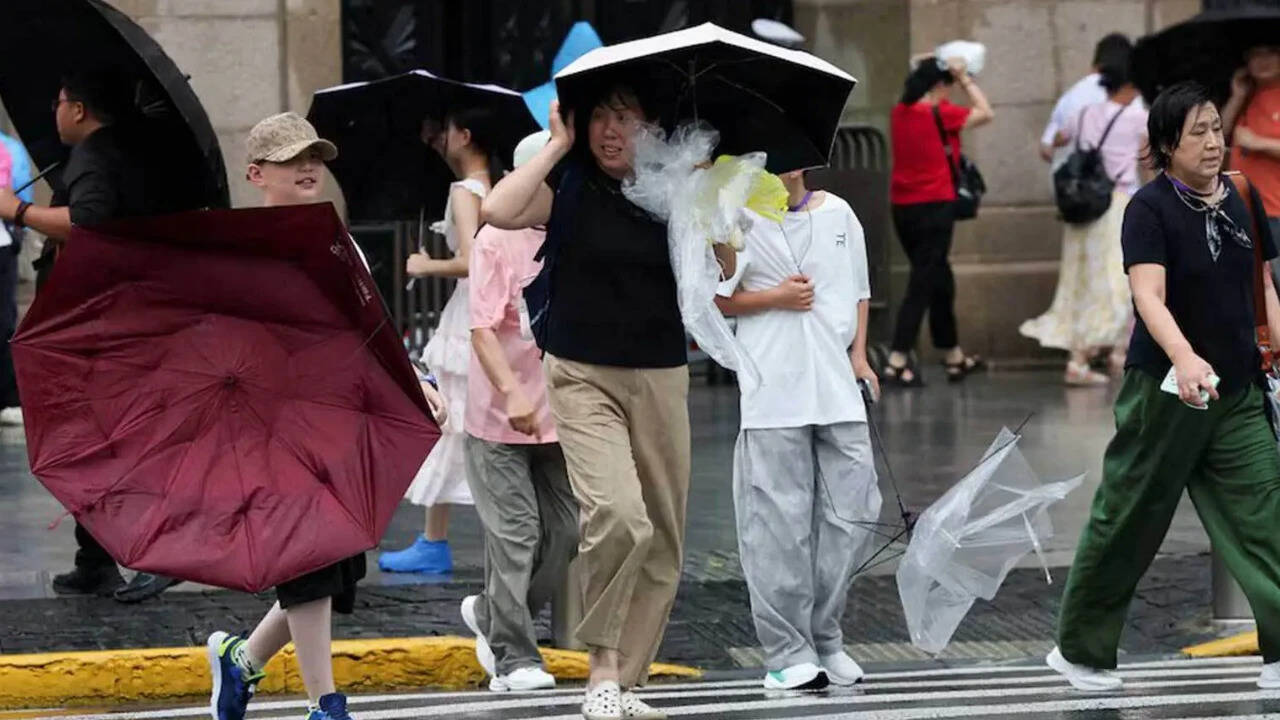
When headlines flash with numbers like one million displaced, the global media machine instantly shifts into autopilot. We get the standard, breathless narration about monster storms, terrified citizens, and state machinery swinging into action to beat back nature.
Let's stop right there.
The breathless reporting on Typhoon Dolphin hitting eastern China misses the structural reality entirely. Shuffling a million people out of harm's way is treated as the ultimate triumph of disaster management. It is not. It is an admission of failure. When a modern economic powerhouse has to relocate the population of a mid-sized European country every time a Category 1 equivalent storm blows ashore, we are looking at an architectural and urban planning bottleneck disguised as a humanitarian victory.
The Illusion of State Control
The lazy consensus in disaster coverage assumes that massive evacuation metrics equal superior governance. If you move a million bodies, you must be doing something right.
The math says otherwise.
Mass evacuation is high-friction, economically destructive, and socially disruptive. Every time hundreds of thousands of people are trucked out of coastal hubs like Wenzhou or cleared out of Shanghai’s periphery, supply chains freeze, manufacturing halts, and billions in productivity vanish into thin air. It is the emergency brake of a society that failed to build a chassis capable of handling high-speed weather.
We praise the speed of the red alert, but we ignore why the coast remains so catastrophically vulnerable to a 150 km/h wind band. A storm packing 42 meters-per-second winds at landfall is severe, yes, but in the grand timeline of meteorological history, it is not an unprecedented planetary anomaly. It is a predictable recurring variable.
The Concrete Fallacy
Cities like Shanghai and the broader Zhejiang littoral have spent decades pouring concrete into vertical expansion while lagging behind on subterranean hydrological engineering. When a weather station records its highest 24-hour rainfall in over a century, the knee-jerk reaction is to blame the clouds.
That is intellectually lazy.
The variable is not just the volume of water falling from the sky; it is the absolute imperviousness of our surfaces. Modern East Asian megacities are paved nightmares of asphalt and glass that reject water rather than absorb it. When concrete replaces wetlands, floodwaters do not care about your emergency response tiers. They follow gravity.
Instead of rethinking urban porosity, authorities rely on brute-force human displacement. Imagine a scenario where municipal budgets spent on orchestrating mass logistical movements of millions were redirected entirely into decentralized sponge-city architectures, subterranean retention vaults, and redundant micro-drainage grids.
We don't do that because clearing a city looks great on evening television. Engineering a watershed doesn't generate prime press clippings.
The Cost of Disruption
Let us look at the actual collateral of these mega-moves. Over a thousand flights canceled, regional supply lines choked, tourist hubs shuttered, and families uprooted into makeshift shelters. The downstream economic shock of panic-driven paralysis ripples through global markets faster than the typhoon travels inland.
When risk mitigation becomes synonymous with mass flight, you create a population conditioned to live in a state of permanent precarity. People stop investing in local resilience because they assume the state will simply bus them away when the barometer drops. It erodes local adaptability.
We need to stop celebrating the logistics of evacuation as if they represent peak civilization. Moving a million people means your buildings are too weak, your drainage is too primitive, and your planning is too short-sighted.
Until we judge city planners by how many people can safely stay put during a storm rather than how many they can herd onto buses, we will remain trapped in this cycle of glorified panic.
Stop asking how fast the state can clear the coast. Start asking why the coast needed clearing in the first place.