Thirty-four.
In the cold arithmetic of international wire reports, thirty-four is a headline metric—a neat, tragic integer slotted between weather updates and stock market fluctuations. When a wooden pirogue capsizes in the dark waters off the coast of Senegal, the initial dispatches always arrive stripped of salt, stripped of panic, and stripped of names. They tell you the vessel was overcrowded. They tell you the Senegalese navy recovered bodies near Dakar or Mbour. They give you the tally, and then the news cycle moves on to the next catastrophe.
But if you have ever stood on the beaches of Hann or Saint-Louis at dawn, watching the Atlantic swell roll in heavy and gray, you know that thirty-four is never just a number. It is thirty-four mothers who spent their life savings on a gamble against the ocean. It is thirty-four empty chairs at evening meals where the thieboudienne tastes like ash.
To understand what happened in the water during that fatal crossing, you have to step away from the sterile language of maritime statistics and look at the invisible ledger that pushes young men and women onto painted wooden boats never meant to leave the coastal shelf.
The Anatomy of a Wooden Coffin
Imagine a man named Moussa. Let us construct him carefully—a composite sketch drawn from hundreds of real testimonies along the West African coast—so that the mechanics of this tragedy become visible.
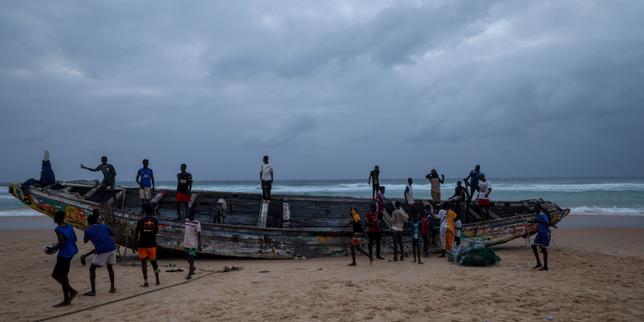
Moussa is twenty-six. He grew up three streets back from the Atlantic in a fishing district outside Dakar. For generations, his family pulled sardinella and grouper from these waters using hand-carved pirogues—long, narrow, brightly painted wooden canoes built for agility in the surf, not endurance on the open ocean. A traditional pirogue is a masterpiece of coastal carpentry, designed to ride the crest of nearshore waves and be hauled onto the sand by twenty pairs of hands at dusk.
It was never designed to carry more than a hundred people across nearly a thousand miles of open Atlantic toward the Canary Islands.
Yet, when the foreign industrial trawlers began scraping the West African seabed clean a decade ago, the fish vanished. Moussa’s father saw his daily catch shrink by seventy percent. Nets came up heavy with plastic and juvenile fish too small to sell. Meanwhile, inflation gnawed through the purchasing power of the CFA franc, turning basic staples into luxuries. When a young man looks at a horizon where the fish are gone, the land is parched, and the local economy offers no ladder to climb, the horizon stops being a boundary. It becomes an exit.
Smugglers—often former fishermen themselves who know every current and sandbar—step into that vacuum with a terrifyingly simple proposition. For the equivalent of five hundred to eight hundred dollars, pooled together by an entire extended family selling jewelry, livestock, or plots of land, they offer a seat on a large motorized pirogue bound for Spain.
Think of the Atlantic route between Senegal and the Canary Islands not as a highway, but as a conveyor belt moving in the wrong direction. The Canary Current pushes south and west, fighting against any vessel heading north. Navigating it in an open wooden hull is the maritime equivalent of trying to cross a frozen mountain range in running shoes. You are exposed to thirty-foot swells, relentless sunburn by day, hypothermia by night, and the constant, corrosive spray of saltwater that turns wooden planks slick and rots human skin within forty-eight hours.
When the Engine Dies in the Dark
Nobody boards one of these boats expecting comfort. They board expecting a coin toss.
In the real-world wrecks that have claimed dozens of lives off the Senegalese coast—including the disaster that left at least thirty-four dead—the collapse rarely happens all at once. It begins with a mechanical failure or a shift in the wind just hours after leaving the shelter of the coast.
Picture the vessel three hours out from shore, long after the lights of Dakar have dissolved into a faint orange smudge behind the horizon. Over a hundred people are wedged thigh-to-thigh on narrow wooden cross-beams. There are no life jackets—or perhaps five cheap foam vests shared among the few who paid extra. At the bottom of the hull, bilge water mixed with spilled gasoline and human waste sloshes around their ankles.
In this hypothetical reconstruction of the final minutes, the outboard motor sputters. A clogged fuel line, a sheared pin, or bad gasoline diluted by a middleman looking to shave costs.
Suddenly, the forward momentum stops.
A pirogue relies on forward speed to cut through incoming swells. Without power, the long, narrow hull turns broadside to the waves. Physics takes over immediately. A heavy Atlantic roller hits the beam of the boat, tilting it thirty degrees. Panic—contagious, instantaneous, and fatal—sweeps through the passengers. People on the low side scramble upward toward the high side to avoid the incoming wall of water.
Their combined weight shifts the center of gravity in half a second.
The boat does not sink gracefully. It rolls. Over a hundred bodies hit the black water simultaneously. Most cannot swim—a grim irony among coastal communities where the sea is a workplace, not a playground. Those who can swim are dragged down by the frantic grip of neighbors who cannot. In the pitch dark, with diesel fuel burning their eyes and nostrils, the boundary between up and down disappears.
By the time local fishermen or naval patrol boats reach the coordinates—often alerted by a single survivor clinging to an empty plastic jerrycan—the ocean has already finished its accounting. Thirty-four bodies recovered. Dozens more simply erased, swallowed by currents that carry them westward into the empty expanse of the central Atlantic, never to wash ashore anywhere.
The Invisible Ledger of the Canary Route
Why does this keep happening when everyone along the coast knows the odds?
From the outside, boarding an overloaded wooden canoe to cross one of the deadliest stretches of water on Earth looks like madness. I used to struggle to comprehend it myself, staring at maps of the Atlantic and measuring the sheer distance between Saint-Louis and El Hierro—over eight hundred nautical miles of nothing. It seemed incomprehensible that anyone would voluntarily step into that void.
Then you spend time talking to the families who stayed behind, and the logic snaps into sharp, uncomfortable focus.
To the people making the crossing, staying put is not safety; it is a slow, guaranteed erasure. In their eyes, the ocean represents a sudden risk, whereas poverty represents a permanent sentence. When European border enforcement tightened patrols in the Mediterranean over the last several years, migration networks did not disappear—they simply shifted southward, pushing desperate travelers onto the far more treacherous West African Atlantic route.
Every crackdown along safer, shorter corridors acts like squeezing a balloon: the pressure does not vanish; it bulges out somewhere more dangerous.
According to monitoring groups and maritime rescue data, thousands of people have died or disappeared along the Canary Islands route in recent years, making it the deadliest migration corridor in the world per capita. Yet the official death toll—like the thirty-four confirmed dead in this latest Senegalese shipwreck—is almost always a severe undercount. Boats vanish without sending a distress signal. Families wait months before admitting their son or daughter is not coming back, paralyzed by the hope that they are merely sitting in a detention center without a phone.
Beyond the Shoreline
After the bodies are laid out under white sheets on the sand, the ritual never changes.
Government officials issue statements condemning the human traffickers. Security forces announce new patrols along the beaches. International observers express deep concern. And within seventy-two hours, three miles down the coast, another carpenter is hammering planks together under the cover of darkness, preparing the next hull for the next midnight departure.
Because you cannot police away an empty stomach. You cannot patrol away the desperation of a twenty-year-old who watches foreign factory ships haul millions of dollars of fish out of his territorial waters while he cannot afford a bag of rice.
True intervention requires changing the math on land before anyone ever steps onto the sand. It means enforcing sustainable fishing agreements that protect local coastal livelihoods from industrial depletion. It means creating legal, regulated pathways for labor mobility so young West Africans do not have to buy a ticket from a smuggler just to seek work. And it means investing in local agricultural resilience and small-scale industry where the returns reach the neighborhoods of Dakar, Mbour, and Ziguinchor—not just the balance sheets of multinational contractors.
Until that calculus shifts, the Atlantic will keep collecting its toll, thirty-four names at a time.
Down on the beach at low tide, long after the naval trucks have driven away and the cameras have packed up their tripods, the surf still washes fragments of bright blue and yellow painted wood onto the wet sand—splinters of a boat built to catch fish, broken by the weight of people trying to catch a future.