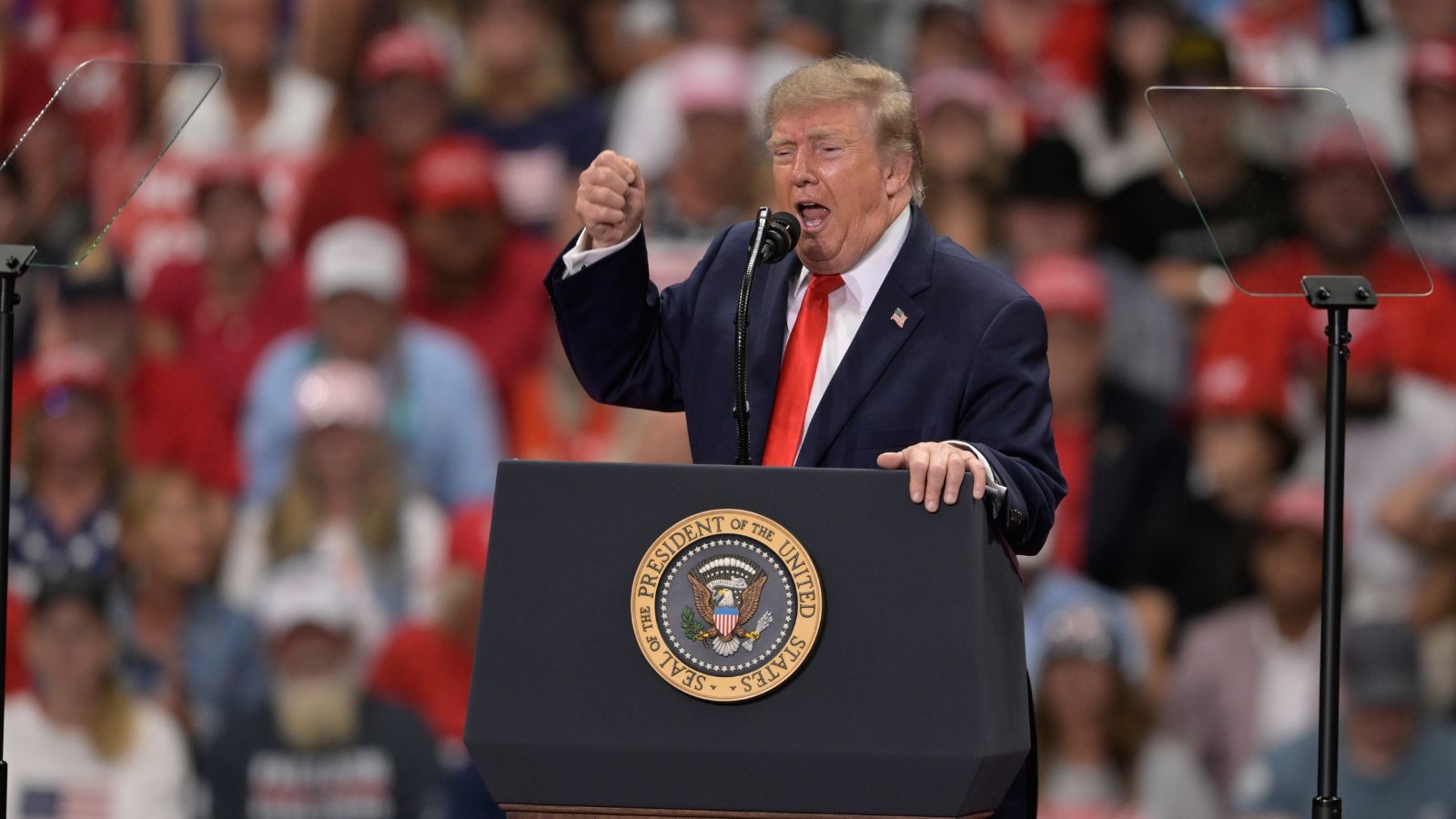
Midterm election coverage routinely mistakes political theater for structural reality, treating off-the-cuff executive remarks as predictive indicators rather than lagging symptoms of voter mobilization. When a president states on the eve of a Tuesday vote that "we’re going to see how it all works out," the statement is not a forecast; it is a rhetorical hedge designed to insulate executive authority from the historical inevitability of midterm attrition. Understanding the actual mechanics of a United States midterm cycle requires stripping away real-time cable news commentary and examining the underlying institutional variables: historical seat-loss baselines, turnout differential models, macroeconomic perception lags, and the structural limits of executive coattails.
The Historical Baseline and Thermostatic Public Opinion
The foundational law of modern American midterm elections is the "midterm penalty," a consistent phenomenon where the party controlling the White House loses seats in the House of Representatives. Since the end of the Second World War, the president’s party has lost House seats in all but two midterm cycles—1998 and 2002—both of which were driven by anomalous, external systemic shocks rather than standard partisan governance. If you found value in this article, you should read: this related article.
Political scientists explain this through thermostatic public opinion, a model formalized by Christopher Wlezien. In this framework, the electorate functions like a thermostat:
- When policy moves sharply in one ideological direction under a sitting administration, public preference adjusts in the opposite direction.
- Voters do not necessarily demand a complete ideological reversal; they demand a corrective check on unilateral executive momentum.
- The midterm ballot becomes the primary mechanism to recalibrate the institutional temperature by handing legislative veto power to the opposition party.
When an executive leader adopts a posture of detached fatalism immediately prior to polls opening, it reflects an implicit recognition of this thermostatic pressure. Campaign operatives internalize polling data weeks before Election Day, identifying districts where generic ballot deficits exceed the structural margin of safety. Publicly, however, the executive cannot concede defeat without depressing base turnout further, nor can they promise a wave victory without inviting humiliation if the historical baseline holds. The resulting ambiguity serves as a strategic buffer. For another angle on this development, check out the latest update from NBC News.
The Turnout Differential Engine
General election models fail in midterm cycles because the electorate shrinks by roughly 30 to 40 percent compared to presidential years. This contraction is not uniform across demographic or ideological cohorts; it is heavily skewed toward high-propensity voters.
To predict or analyze midterm outcomes accurately, analysts must track the Turnout Differential Engine, which operates on three primary variables:
- Asymmetric Enthusiasm: Loss aversion is a stronger behavioral motivator than satisfaction. Voters aligned with the out-of-power party experience acute policy grievance, driving higher registration and early-voting participation. Conversely, voters aligned with the incumbent administration often experience demobilization once their preferred executive is in office, assuming the primary objective was achieved two years prior.
- Demographic Composition Shifts: Presidential electorates include low-propensity, younger, and less politically engaged voters who respond to nationalized, personality-driven campaigns. Midterm electorates revert to older, wealthier, and more locally rooted homeowners. Because these cohorts exhibit distinct partisan leans depending on the specific decade's realignment, the baseline electorate shifts structurally before a single campaign advertisement airs.
- Down-Ballot Decoupling: Without a presidential candidate at the top of the ticket to unify disparate regional coalitions, local candidate quality and localized economic grievances regain salience. Incumbent House members in marginal districts cannot rely on executive coattails; instead, they face the "reverse coattail" effect, where national dissatisfaction with the White House drags down localized approval ratings regardless of the representative's individual legislative record.
Macroeconomic Perception Lags vs. Statistical Reality
A persistent analytical error in election live-blogs is the assumption that voters evaluate the economy using the same metrics as central bankers. While institutional economists track Gross Domestic Product growth, labor force participation rates, and core inflation indices, the midterm voter operates on a lagged, localized price-level heuristic.
Even when macroeconomic indicators stabilize or trend positive in the third quarter of an election year, voter sentiment remains anchored to cumulative price increases over the preceding twenty-four months. In behavioral economics, this is tied to reference-point dependence: consumers measure their current purchasing power against a memorized baseline from the start of the administration's term, not against the previous quarter's rate of change.
Consequently, executive messaging that highlights statistical recovery often backfires during the final stretch of a midterm campaign. Telling a voter that inflation rates have decelerated while grocery and housing costs remain structurally higher than their historical reference point creates a credibility gap. When executive rhetoric shifts from touting economic metrics to vague statements about waiting to see how Tuesday unfolds, it signals that the administration’s economic narrative has failed to penetrate the electorate's lived cost-of-living reality.
The Structural Limits of Executive Rallies
During the final seventy-two hours of a midterm cycle, presidential travel schedules intensify, generating breathless minute-by-minute media coverage. From an operational standpoint, however, late-stage executive rallies yield diminishing marginal returns and carry significant downside risk.
The strategic utility of an executive appearance depends entirely on the partisan elasticity of the specific district or state:
- In Deep-Red or Deep-Blue Districts (Partisan Lean greater than +10): Executive rallies function purely as base-mobilization mechanisms. They drive media coverage, boost small-dollar fundraising, and maximize raw vote totals needed for statewide Senate or gubernatorial races. The risk of alienating swing voters is irrelevant because swing voters do not determine the outcome in non-competitive jurisdictions.
- In Marginal Swing Districts (Partisan Lean between -3 and +3): The same executive presence frequently triggers counter-mobilization. Independent and soft-partisan voters, who generally favor divided government as a hedge against extremism, react negatively to the nationalization of a local race. The opposition party uses the president's physical presence to tie a moderate local incumbent or challenger directly to the most unpopular elements of the national administration.
Live-update journalism tends to treat rally crowd sizes and applause lines as proxies for electoral momentum. In reality, rally attendance measures intensity among the most committed 5 percent of the partisan base, offering zero visibility into the behavior of the decisive 6 to 8 percent of ticket-splitting or late-deciding suburban voters.
The Post-Tuesday Institutional Pivot
The true significance of a midterm election is rarely found in the immediate emotional reaction of party leaders on Tuesday night, but in the structural reorganization of legislative power that follows in January. A shift of even a handful of seats in the House of Representatives alters the operational reality of the executive branch in three distinct ways:
First, subpoena power transfers immediately. When the opposition party captures a chamber majority, committee chairmanships flip. The legislative branch transitions from a vehicle for advancing the administration’s statutory agenda into an investigative apparatus designed to audit executive agencies, delay judicial or cabinet confirmations, and dominate daily news cycles through oversight hearings.
Second, fiscal leverage shifts from unilateral to transactional. With divided control, routine governance functions—such as raising the debt ceiling, passing annual appropriations bills, and authorizing defense spending—become hostage to bipartisan negotiation. The executive branch loses the ability to pass partisan reconciliation packages, forcing the White House to govern primarily through executive orders and regulatory rulemaking, both of which remain vulnerable to judicial review and immediate reversal by a subsequent administration.
Third, the lame-duck acceleration begins. Historically, losing control of Congress in a midterm cycle forces an incumbent president to pivot outward toward foreign policy, trade negotiations, and executive actions where constitutional authority is broader and less constrained by domestic legislative gridlock.
Strategic Execution for Political and Market Analysts
Analysts, institutional investors, and policy strategists evaluating midterm outcomes must discard real-time campaign rhetoric and anchor their decision-making to verifiable structural indicators.
- Discount Executive Ambiguity: Treat late-cycle presidential remarks as noise. Focus exclusively on early-voting return data broken down by party registration and historical turnout propensity in bellwether counties.
- Track the Generic Ballot Spread: Ignore individual district polls with small sample sizes during the final week. Watch the aggregate generic congressional ballot; historically, an out-party lead exceeding 4 percentage points correlates strongly with a wave dynamic that sweeps marginal seats regardless of localized candidate quality.
- Price in Legislative Gridlock Early: For market participants, a divided government outcome is statistically the most probable result of any midterm cycle. Position portfolios and regulatory compliance strategies for two years of statutory paralysis, heightened oversight risk for heavily regulated sectors, and an executive branch reliant on administrative rules rather than major tax or spending legislation.
The outcome on Tuesday is never an open-ended mystery waiting to be solved at the ballot box; it is the predictable mathematical resolution of turnout differentials, thermostatic voter behavior, and macroeconomic reality established months before the final speech is delivered.