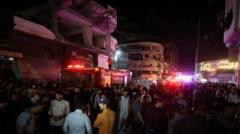
The execution of a kinetic strike within a hyper-dense urban topology creates a predictable, compounding cascade of trauma that outstrips municipal emergency response capacities within minutes. When an aerial or artillery payload detonates in an environment like Gaza City, the immediate lethality is not merely a function of blast radius, but an intersection of structural vulnerability, population density, and systemic triage failure. Media coverage routinely frames these events through a narrative of isolated tragedy—reporting "three killed and dozens injured"—while failing to analyze the structural mechanics that dictate these specific casualty ratios.
To understand the true impact of urban kinetic operations, analysts must move past superficial casualty counts and evaluate the three distinct phases of a strike event: the immediate kinetic transfer, the structural collapse vector, and the secondary medical resource depletion.
The Tripartite Blast Vector Matrix
The total casualty yield of an urban strike is determined by three overlapping vectors that operate in the seconds and minutes following detonation.
[Detonation]
     │
     ├──► 1. Primary Kinetic Vector (Overpressure & Fragmentation)
     │
     ├──► 2. Secondary Structural Vector (Masonry Failure & Entrapment)
     │
     └──► 3. Tertiary Logistics Vector (Triage Asymmetry & Extraction Delay)
1. The Primary Kinetic Vector
The initial detonation produces an instantaneous overpressure wave coupled with high-velocity fragmentation. In open terrain, the energy of a blast dissipates according to the inverse-square law. In a dense urban configuration, however, street canyons reflect and amplify the shockwave. This channeling effect, known as blast modification, extends the lethal radius of the overpressure wave along linear axes, turns loose street debris into secondary shrapnel, and shatters glass blocks away from the epicenter. The immediate mortality rate (the three initial fatalities typically reported by witnesses) occurs almost exclusively within this primary zone due to catastrophic internal trauma or direct fragmentation hits.
2. The Secondary Structural Vector
The vast majority of the "dozens injured" in urban strikes are victims of structural displacement rather than the blast itself. Urban enclaves characterized by non-reinforced concrete frame construction, common in under-resourced conflict zones, possess low lateral blast resistance.
When a payload strikes a multi-story building:
- The load-bearing columns experience shear failure.
- The upper floors undergo progressive collapse, pancake-style, trapping occupants beneath layers of dense masonry.
- Non-structural elements, such as cinderblock infill walls, detach and project inward, causing severe blunt-force trauma, crush syndrome, and traumatic asphyxiation to individuals who were completely shielded from the primary blast wave.
3. The Tertiary Logistics Vector
The final determinant of the ultimate mortality-to-injury ratio is the speed of extraction and triage. In Gaza City, the physical destruction of roadway infrastructure prevents mechanized rescue equipment from reaching the site. Rescuers are forced to rely on manual labor to clear heavy concrete debris. This introduces a critical time delay during which treatable injuries—such as arterial bleeding or compressible crush injuries—transition into fatalities. The "dozens injured" status reported by medics is highly volatile; without immediate surgical intervention, a predictable percentage of these field injuries degrades into delayed mortalities within 48 hours.
The Asymmetry of Urban Triage Cascades
When a localized strike generates dozens of casualties simultaneously, it induces an immediate triage shock on the receiving medical infrastructure. This phenomenon can be mathematically modeled as a queueing theory bottleneck, where the arrival rate of critical patients vastly exceeds the service rate of the available trauma bays.
Standard emergency medical systems operate on a direct-to-definitive-care model. In a mass casualty event within a besieged or blockaded urban environment, this model breaks down entirely. Emergency medical technicians face a stark resource allocation problem governed by three severe constraints.
The first constraint is the degradation of rapid transit. Ambulances cannot navigate cratered roads, turning the golden hour of trauma care into a protracted transport phase. The second limitation is the immediate depletion of consumable medical assets. Blood products, sterile gauze, advanced airway management kits, and anesthetic agents are consumed exponentially during the first wave of patient arrivals.
This creates a bottleneck where surgeons must prioritize individuals based on survivability metrics rather than need. Patients requiring prolonged, complex multi-specialty interventions are frequently deprioritized to save a higher volume of patients with less resource-intensive injuries. This operational reality explains why initial witness reports often conflict with final medical registries; many individuals classified as "injured" in the first two hours are structurally excluded from receiving life-saving care due to the systemic overload.
Structural Variables Dictating Casualty Distribution
The variance in casualty outcomes across different urban strikes is not random. It is governed by a specific set of physical and demographic variables that can be quantified to predict the severity of a strike's aftermath.
- Population Density Per Square Kilometer: In areas where density exceeds 15,000 individuals per square kilometer, any kinetic impact footprint will inevitably intersect with multiple multi-family residential structures.
- Time-of-Day Occupancy Factors: Daytime strikes primarily impact commercial zones or streets, yielding higher fragmentation injuries among pedestrians. Nighttime strikes concentrate casualties within residential structures, leading to higher rates of entrapment and crush injuries.
- Structural Material Integrity: The prevalence of unreinforced masonry or substandard concrete mixes accelerates progressive collapse sequences, drastically increasing the time required for search and rescue operations.
Operational Realities of Field Verification
Analyzing these events requires a rigorous assessment of data provenance. Reports emerging from active combat zones rely heavily on two primary sources: on-scene witnesses and hospital medics. Both sources operate under extreme cognitive and environmental stress, introducing systematic biases into early data streams.
Witness accounts are highly localized and subject to perspective distortion. A witness viewing an extraction point will see the immediate, visceral consequences of the primary and secondary blast vectors but lacks the systemic view required to assess total casualty figures. Conversely, medical personnel at receiving facilities see the aggregate influx but lack context regarding the total number of individuals still trapped beneath rubble.
Therefore, early figures must be treated not as static facts, but as the baseline of a dynamic curve that invariably trends upward in terms of total fatalities as structural extraction progresses and critical injuries fail to receive definitive surgical care.
Strategic Asset Allocation Framework for Urban Trauma Response
To mitigate the compounding mortality rates inherent in urban kinetic strikes, emergency response frameworks must pivot from centralized hospital care to a decentralized, hardened stabilization model. Waiting for casualties to arrive at major medical centers ensures a high rate of preventable death due to transit bottlenecks.
The primary strategic requirement is the forward deployment of modular, rapidly deployable stabilization points located outside the predicted blast fragmentation zones but within pedestrian transit distance of high-density residential sectors. These micro-triage nodes must be equipped exclusively for damage control surgery and immediate hemorrhage control, effectively halting the physiological decline of critical patients before they are subjected to the prolonged transit times caused by destroyed transport infrastructure.
Resources must be shifted away from maintaining standard clinical protocols and aggressively funneled into stockpiling high-mobility, low-tech extraction equipment—such as hydraulic jacks, pneumatic lifting bags, and portable concrete saws—distributed at the neighborhood level. Reducing the time-to-extraction parameter is the single highest-leverage variable in shifting the casualty balance, converting potential structural fatalities into survivable field injuries.