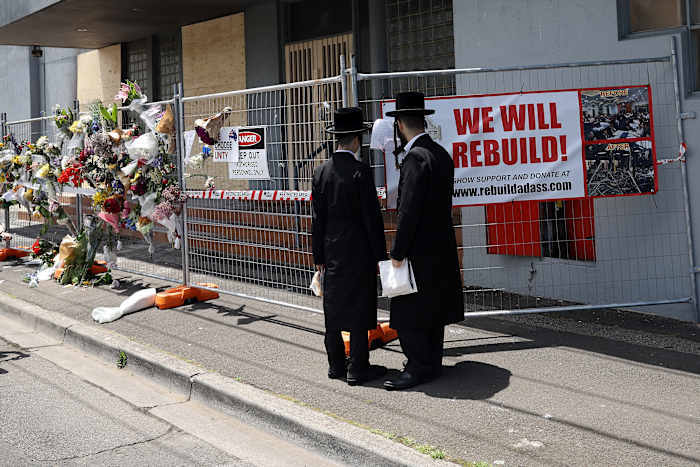
Foreign interference is no longer just about cyberattacks or stolen state secrets. It happens on your local street corner, targeting community spaces.
The latest breakthrough in a massive counter-terrorism investigation proves it. Australian authorities just charged a third man over the devastating 2024 firebombing of the Adass Israel Synagogue in Melbourne. The 20-year-old suspect from Airport West was already sitting in a prison cell on unrelated charges when the Victorian Joint Counter Terrorism Team handed down the new indictment. He now faces serious counts including criminal damage by fire and conduct endangering life.
This isn't a standard case of local vandalism or property damage. This was an organized hit. Security agencies state the attack was directly orchestrated by the Islamic Revolutionary Guard Corps (IRGC), an arm of the Iranian government.
The December 2024 attack gutted two out of three buildings at the Ripponlea property. Worshippers inside preparing for dawn prayers had to run for their lives, and one person walked away with burn injuries. Because of the intense structural damage, the congregation will not be able to open its doors until at least 2029.
The Proxy Strategy Mapping Out Suburbia
Tehran didn't fly its own agents into Victoria to pour liquid accelerant onto a synagogue floor. It hired local hands. Investigators reveal a troubling operational model where foreign governments outsource street-level violence to localized criminals.
The three young men currently facing trial—including previously arrested co-accused Giovanni Laulu and Younes Ali Younes—allegedly served as the physical tools for a much larger apparatus. Australian Federal Police Assistant Commissioner Peter Crozier noted that these individuals might not have even known who was pulling the strings from the top.
"They may not actually be aware of the people who are directing or the principals of these investigations," Crozier stated to reporters.
Using local criminals gives foreign handlers plausible deniability. It muddying the waters for law enforcement. Mike Burgess, the head of the Australian Security Intelligence Organisation (ASIO), pointed out that Iran relied on a dense network of proxies specifically to mask its hand in the plot.
This wasn't an isolated event either. The same Iranian-directed network is accused of firebombing Lewis' Continental Kitchen, a kosher eatery in Sydney, just two over two months before the Melbourne blaze. The weaponization of ordinary, ideologically uncommitted criminals for geopolitical point-scoring has completely shifted the domestic security dynamic.
Diplomatic Fallouts and Obstructing Justice
The political fallout from the investigation has completely transformed Australia's relationship with Iran. Canberra took the historic step of expelling Iran's ambassador alongside three other diplomats. This marked the first time since World War II that Australia took such drastic diplomatic action against a foreign ambassador. While Tehran officially denies the allegations, the evidentiary trail compiled by federal agents and spy networks was strong enough to trigger immediate diplomatic eviction.
The investigation is far from over. Counter-terrorism units are actively chasing leads with global policing partners to pin down the offshore handlers. But things are hitting friction closer to home. Federal police openly state that certain local associates are actively lying to investigators to slow down the process.
Law enforcement has made it clear they won't tolerate the pushback. Crozier explicitly warned those keeping secrets that obstruction charges are on the table if they continue shielding the operation.
What Security Teams Must Track Next
The shift from purely digital sabotage to physical proxy operations means community safety strategies need immediate updating. Relying strictly on local police to treat hate crimes as isolated events leaves a massive vulnerability open to foreign state actors.
If you manage security or run operations for high-risk community sites, prioritize these protective shifts:
- Upgrade to active monitoring systems: Simple closed-circuit cameras only record historical data after a building burns down. Shift resources into perimeter alert systems that identify masked individuals or vehicle loitering in real-time before an entry occurs.
- Deepen multi-jurisdictional intelligence channels: Local neighborhood watches aren't equipped to track global proxy networks. Build direct relationships with federal counter-terrorism or domestic intelligence branches to stay ahead of regional threat assessments.
- Prepare long-term structural contingencies: The Adass Israel community lost their physical facility for a projected five years. Communities must establish redundant operating locations and secure data backups to ensure organizational continuity if a physical site is permanently compromised.


