The sound of a bicycle chain clicking rhythmically is one of the most innocent noises in the world. It is the sound of childhood, of small-town freedom, and of a Saturday afternoon unfolding without an agenda. In Federal Way, Washington, that sound was the only thing filling the air before the screaming began.
We often think of our neighborhoods as sacred zones. We draw invisible lines between the asphalt meant for two-ton machines and the concrete meant for soft, human feet. We trust that those lines hold. But on a recent afternoon, the boundary between a safe neighborhood and a site of calculated terror vanished.
The Weight of Two Tons
A car is not just a tool for commuting. When used with intent, it becomes a weapon of absolute disproportion.
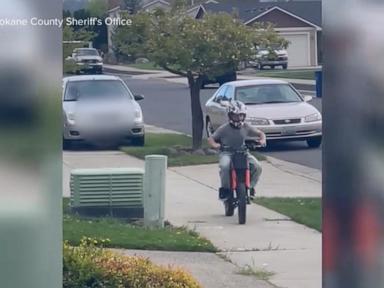
Imagine a twelve-year-old boy. He is small, light, and entirely exposed. He is pedaling his bike on the sidewalk, which is the one place society promises him he will be safe from traffic. Behind him, a 48-year-old man sits behind the wheel of a heavy sedan. The power dynamic is so skewed it defies logic. The boy has his muscles and a thin aluminum frame; the man has three hundred horsepower and a steel cage.
Witnesses watched as the driver didn't just swerve or lose control. He steered. He targeted. He drove his vehicle up over the curb and onto the sidewalk, chasing the child.
This wasn't a "traffic incident." It was a hunt.
The Anatomy of an Outburst
What happens in the mind of a grown man that leads him to use a sedan to terrorize a child?
The driver, later identified by police, didn't stop at the curb. He pursued the boy down the narrow strip of concrete, forcing the child to pedal for his life. The sheer physics of the situation are terrifying. A human being can sprint at maybe fifteen miles per hour for a short burst. A car can hit that speed in a heartbeat without the driver even breaking a sweat.
The terror isn't just in the potential impact. It is in the persistent, mechanical shadow. It is the roar of the engine getting closer to your back while you realize that there is nowhere to turn where the metal won't follow.
When the police arrived, the scene was chaotic. The driver didn't go quietly. He reportedly fought with the officers, adding a layer of volatile aggression to an already senseless act. This wasn't a lapse in judgment; it was a total collapse of the social contract.
The Invisible Scars
We talk about "arrests" and "charges" as if they are the end of the story. They aren't.
The boy wasn't physically crushed by the car, but the damage of such an event is rarely something a bandage can fix. To be twelve years old and realize that a stranger in a car wants to hurt you—and has the power to do it—changes how the world looks. The sidewalk is no longer a safe path. Every engine revving behind you becomes a threat. Every car idling at a stop sign looks like a predator waiting to pounce.
Psychologists call this a violation of "assumptive world" beliefs. Children assume the world is generally predictable and that adults, while perhaps annoying or strict, are fundamentally protective or at least indifferent. That belief is a shield. Once a car chases you onto your own sidewalk, that shield shatters.
The Neighborhood Under Siege
Neighbors who saw the event weren't just witnesses to a crime; they were witnesses to the death of their peace of mind.
Federal Way, like any other suburb, relies on the predictable behavior of its residents. You assume your neighbor isn't going to drive through your flower beds to hit a kid. When that assumption is proven wrong, the entire geography of the neighborhood shifts. The hedges look thinner. The distance between the front door and the street feels dangerously short.
The driver was eventually booked into the King County Jail on charges including second-degree assault. The legal system will do what it does—it will weigh the evidence, read the police reports, and eventually hand down a sentence. But the legal system cannot restore the feeling of safety to that street. It cannot erase the image of a car mounting a curb in pursuit of a bicycle.
Why We Look Away
It is easier to treat this as a "crazy news story" from Washington than to acknowledge the simmering rage that seems to be boiling over on our roads.
Road rage is a term we use to sanitize what is often just pure, unadulterated violence. By calling it "road rage," we shift the blame slightly onto the environment—the traffic, the heat, the stress of the commute. We treat the car as an extension of the person's mood rather than a weapon they chose to deploy.
If a man had chased a child down the street with a knife, we would call it attempted murder without hesitation. When he uses a car, we sometimes hesitate, looking for excuses in the "frustrations of driving." We need to stop looking for excuses.
The car didn't jump the curb. The man drove it there.
The Fragility of the Sidewalk
The sidewalk is our last line of defense. It is the only place in the modern landscape where the pedestrian is supposed to be king. It is where we teach our children to walk, where we push strollers, and where we walk our dogs. It is the buffer between the speed of modern life and the pace of a human heart.
When we allow that space to be violated, we lose more than just a strip of concrete. We lose the ability to let our children be children.
The boy in Federal Way survived. He escaped the metal, the glass, and the tires. He is home now. But the next time he hears the hum of an engine behind him, he won't be thinking about where he's going. He'll be looking for a place to jump.
Somewhere, a bike lies on its side in the grass, its wheels still spinning slowly in the sun, a silent witness to the moment the world stopped being safe.