The Unseen Bottleneck in Server Racks
For years, market observers obsessed over silicon wafers, advanced lithography machines, and high-bandwidth memory chips. They missed what sat directly underneath them.
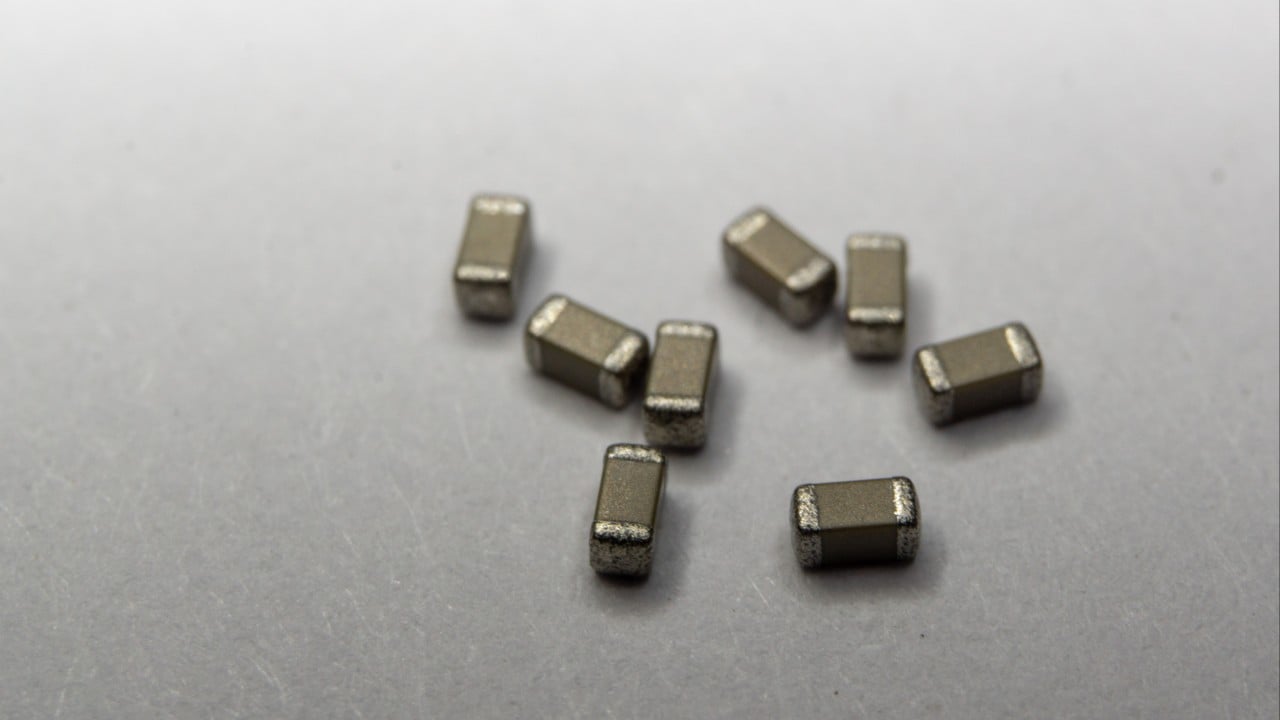
Multilayer ceramic capacitors, universally known as MLCCs, function as the silent workhorses of modern electronics. These components consist of hundreds of alternating layers of ceramic dielectric and metal electrodes, compressed into blocks smaller than a grain of sand. They smooth voltage spikes, filter noise, and store electrical charge right next to power-hungry processors.
When a standard enterprise server boots up, it demands a steady flow of electrical current. An artificial intelligence server demands vastly more.
A single graphics processing unit deployed in a modern training cluster requires thousands of individual capacitors to manage its power delivery network. Standard servers utilize roughly two thousand of these components. High-end artificial intelligence configurations require up to twenty-eight thousand.
The market spent years treating these components as low-margin commodities. That era has ended.
The Physics of Power Density
To understand why artificial intelligence hardware creates an unprecedented strain on supply chains, look closely at motherboard architecture. Processors draw immense currents while shifting power states in nanoseconds. Any voltage ripple can destabilize a billion-dollar training run.
Engineers manage this by packing smaller, denser components closer to the processor die. This is where miniaturization meets physical limits.
Makers must layer ceramic sheets thinner than a micrometer while preventing dielectric breakdown under high thermal stress. Only a handful of global manufacturers possess the material science expertise to volume-produce high-capacitance components in ultra-small formats like the 0402 or 0201 case sizes.
When cloud providers transitioned data center power delivery architectures from twelve volts to forty-eight volts and beyond, the electrical stress on these microscopic components multiplied. A standard consumer-grade capacitor melts or shorts out under these conditions.
Makers must utilize advanced barium-titanate formulations doped with rare elements to maintain stable capacitance across extreme temperature ranges. This technical barrier explains why supply elasticity for high-end server-grade parts remains near zero.
Beyond the Commodity Trap
Mainstream financial coverage often groups all passive components into a single cyclical bucket. That categorization is lazy and inaccurate.
While low-end consumer electronics capacitors face standard boom-and-bust inventory corrections, server-grade and automotive-grade components operate in an entirely separate economic reality. Producers in Japan, South Korea, and domestic Chinese facilities are reallocating manufacturing lines away from generic consumer parts to capture surging enterprise margins.
Lead times for specialized high-capacitance components have stretched past twenty weeks. Major manufacturers have responded with aggressive capital expenditure initiatives, pumping billions into factory expansions. Yet, building cleanroom capacity capable of precision ceramic tape-casting takes years, not months.
Consider a hypothetical mid-tier electronics assembler attempting to secure parts for an upcoming enterprise delivery. If their supply contracts lack priority allocation, they face immediate spot-market price spikes of up to forty percent.
The dependency runs deeper than simple unit counts. Because these components regulate the power distribution networks of neural training clusters, a single defective part can trigger a cascading system failure across an entire rack.
Quality control trumps cost optimization every single time in this environment. Procurement managers no longer shop around for the lowest bidder. They pay whatever is required to secure guaranteed volume from proven fabrication lines.
The Structural Shift
The narrative that hardware booms benefit only microprocessor designers ignores the foundational physics of electronic systems. Every time a hyperscale data center scales up its computing clusters, it pulls millions of passive components along with it.
The ongoing structural shift in electronics manufacturing permanently elevates the strategic value of these tiny blocks of ceramic and metal. As long as computational density continues its upward trajectory, the real constraint on technological progress might not be the silicon at the top of the stack, but the ceramic hiding beneath it.