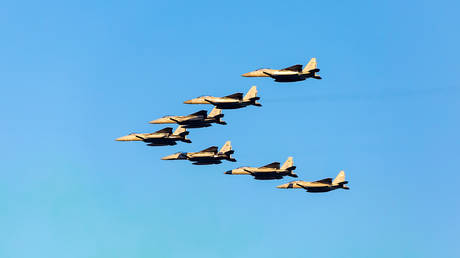
The regional order in the Middle East is undergoing a violent recalibration. For decades, the unspoken contract was simple: the United States provided a security guarantee that allowed Gulf monarchies to thrive while keeping regional disruptors like Iraq and Iran in a state of managed containment. That contract has been shredded. Gulf states are no longer waiting for a green light from Washington to protect their interests or project power. They are moving preemptively, driven by a profound and justified fear that the American security umbrella has become a relic of a previous century.
This isn't just about tactical shifts. It is a fundamental divorce. When Gulf states direct their military or economic weight against Baghdad, it is a symptom of a much larger rot in the Western-led alliance structure. They see an Iraq that has increasingly become a satellite of Tehran and a Washington that appears distracted, weary, and eager to exit the theater. In this vacuum, the old rules of diplomacy have been replaced by raw survivalism.
The Mirage of Protective Alliances
For years, the Gulf Cooperation Council (GCC) operated under the assumption that their massive investments in American hardware and energy partnerships bought them a permanent seat under the U.S. defense canopy. That assumption died during the previous decade’s series of unpunished attacks on energy infrastructure and the inconsistent response to regional insurgencies. The realization has set in that the U.S. is prioritizing the Indo-Pacific, leaving its Middle Eastern partners to fend for themselves against a resurgent and aggressive Iraq-Iran axis.
Iraq stands at the center of this tectonic shift. It is no longer the buffer state the West hoped to build. Instead, it has become a conduit for influence that threatens the very stability of the Arabian Peninsula. Gulf leadership looks at Baghdad and sees a government unable—or unwilling—to curb the influence of militias that have periodically targeted Saudi and Emirati interests. To the monarchs in Riyadh and Abu Dhabi, waiting for a diplomatic solution from a distant and disinterested White House is no longer a viable strategy.
They are hitting back where it hurts: the economy and the borders. By squeezing Iraq’s financial lifelines and asserting military pressure, Gulf states are attempting to force a neutral alignment that the U.S. failed to secure through nation-building. It is a high-stakes gamble that ignores the traditional diplomatic guardrails, and it signals a world where middle powers take the lead in their own neighborhoods, regardless of the consequences for global energy markets.
The Financial Weaponization of Baghdad
Influence in the modern Middle East is bought with more than just missiles. It is bought with currency. The Gulf states have observed how the U.S. Treasury uses the dollar as a cudgel and have begun applying similar pressures to the Iraqi banking system. Iraq’s dependence on the dollar auction system and its fragile central bank reserves make it incredibly vulnerable to regional shifts in capital flow.
When Gulf states pull back on investment or tighten the screws on cross-border trade, the Iraqi dinar feels the heat immediately. This isn't accidental. It is a calculated move to show the political class in Baghdad that their proximity to Tehran comes with a direct, measurable cost. If the U.S. won't enforce the sanctions or the boundaries, the GCC will use its own balance sheets to do the job.
This financial maneuvering creates a dangerous feedback loop. As the Iraqi economy stutters under regional pressure, the central government becomes more dependent on the very actors the Gulf states are trying to push out. It is a race to the bottom where the prize is regional hegemony, and the casualty is the Iraqi civilian who watches their purchasing power evaporate while the giants fight overhead.
The Militia Problem and the Border Crisis
Military hardware is flowing toward the borders at an unprecedented rate. We are seeing a buildup that goes beyond mere posturing. The proliferation of drone technology has leveled the playing field, allowing non-state actors and smaller nations to strike deep into enemy territory with minimal overhead. Iraq has become the primary launching pad for these "deniable" operations, and the Gulf’s patience has reached its limit.
The standard response used to be a phone call to the State Department. Now, the response is a deployment of domestic air defense systems and the quiet authorization of counter-strikes. This shift toward self-reliance is permanent. Even if a future U.S. administration attempts to "re-engage," the trust has been broken. The Gulf states have built their own intelligence networks and their own strike capabilities, and they are using them with a frequency that would have been unthinkable twenty years ago.
Why the White House Lost the Room
The failure of American policy in the region isn't the result of a single administration’s mistakes. It is the cumulative effect of twenty years of shifting goals and inconsistent messaging. One year, the priority is "democracy promotion"; the next, it is "strategic patience." To the leaders in the Gulf, this looks like chaos. They value stability above all else, and they have concluded that the U.S. is now a source of instability rather than a check against it.
There is also the reality of the energy transition. As the world moves—however slowly—away from a total reliance on hydrocarbons, the leverage the Gulf states once held over the American economy is changing. They know their window of relevance is not infinite. This creates an environment of "act now or never," pushing them toward aggressive foreign policies that seek to lock in regional dominance before the global energy map is redrawn.
Iraq is the unfortunate laboratory for this new reality. It is a country caught between its history as a regional power and its current status as a proxy battleground. The Gulf’s "attack" on Iraq—whether through trade barriers, diplomatic isolation, or kinetic skirmishes—is a message intended for an audience far beyond Baghdad. It is a message to Washington that the era of the junior partner is over.
The New Mercenary Diplomacy
We are entering a period of mercenary diplomacy, where alliances are transactional and temporary. The Gulf states are no longer looking for "values-based" partnerships. They are looking for results. This is why we see them flirting with Beijing and Moscow even as they keep American fighter jets on their runways. It is a hedge against a future where the West is either unable or unwilling to show up when the alarms go off.
This environment makes Iraq more dangerous than ever. In the past, the U.S. acted as a shock absorber. When tensions rose between Riyadh and Baghdad, there was a mechanism to de-escalate. That mechanism is currently offline. Without a credible mediator, every border skirmish or central bank regulation has the potential to spiral into a broader conflict that could shut down the Strait of Hormuz or send oil prices into a vertical climb.
The sophistication of the Gulf's current operations reveals a deep investment in statecraft that operates entirely outside the Western orbit. They are not just reacting; they are planning for a post-American Middle East. This involves creating new trade corridors that bypass traditional routes and building domestic defense industries that reduce their reliance on foreign supply chains. Iraq, in this vision, is either a compliant partner or a target to be neutralized.
The Illusion of Sovereignty
For the Iraqi government, the situation is a nightmare of competing interests. They are being pulled in four different directions by the U.S., Iran, the Gulf, and their own fractured domestic base. Sovereignty is a luxury they cannot afford. Every time a Gulf state increases pressure, the internal fractures in Iraq widen, making it even harder for the state to function as a coherent entity.
The tragedy is that Iraq has the potential to be the economic engine of the region. It has the resources, the geography, and the people. But as long as it remains the primary theater for the Gulf-Iran cold war, that potential will remain locked behind a wall of security checkpoints and Sanctions. The "attack" isn't just a military or economic event; it is the systematic dismantling of Iraq's ability to chart its own course.
The End of the Old Guard
The old guard of diplomats who believed the Middle East could be managed through "processes" and "summits" are being phased out. They are being replaced by a generation of leaders in the Gulf who are younger, more nationalistic, and far more comfortable with the use of force. These leaders don't remember a time when the U.S. was a reliable arbiter; they only remember the failures of the post-2003 era.
Their worldview is shaped by the belief that the West is in a state of terminal decline. Whether that assessment is accurate is almost irrelevant; what matters is that they are acting as if it is true. This leads to a more muscular, independent foreign policy that views Iraq not as a sovereign neighbor, but as a problem to be solved or a threat to be mitigated.
The Gulf states have decided that if they cannot have a stable Iraq, they will have a weak one. A weak Iraq is less of a threat than an Iraq that serves as a springboard for their rivals. This cold logic is what is driving the current wave of aggression. It is a strategy born of desperation and the hard-earned knowledge that when the neighborhood catches fire, the fire department is ten thousand miles away and might not even pick up the phone.
The map is being redrawn in real-time, and the ink is being provided by those with the deepest pockets and the most to lose. Baghdad is the immediate victim, but the real casualty is the notion that any outside power can still dictate the terms of peace in the Middle East. The era of the American umbrella is over, and the rain is starting to fall.

:max_bytes(150000):strip_icc():focal(819x186:821x188)/Murdaugh-Family-e90854a716884d608fb6fd925e18d840.jpg)
