The diesel engine vibrates through the soles of Linh’s bare feet. It is 3:00 AM, the hour when the South China Sea is supposed to be quiet. For three generations, his family ran their wooden fishing boat out of Da Nang, tracking the seasonal migrations of tuna and mackerel. The water used to feel infinite. Tonight, it feels like a tightening noose.
Five miles to the east, a wall of white light cuts through the darkness. It belongs to a Chinese coast guard vessel, a steel behemoth displacing thousands of tons, looming over the black water like a floating fortress. It is not fishing. It is patrolling a perimeter that shifted again last month.
Linh kills his running lights. He waits in the dark, watching the radar screen flicker. He is not a diplomat, an admiral, or a geopolitical strategist. But he knows exactly what the headlines mean when they talk about a "new reality" in these waters. It means his nets are coming up empty because the territory is being swallowed, wave by wave.
The global conversation about the South China Sea usually sounds like a legal textbook. Pundits argue over the United Nations Convention on the Law of the Sea, exclusive economic zones, and the precise definitions of low-tide elevations. They track the "Nine-Dash Line" on pristine digital maps in air-conditioned briefing rooms.
But maps lie. They make the ocean look like a flat, blue tabletop where lines can be drawn with a ruler.
The reality is chaotic, wet, and dangerous. What is happening right now is a frantic, resource-driven scramble fueled by an uncomfortable truth: the old rules of international law are dissolving, replaced by a raw doctrine of possession. If you can build on it, park a ship on it, or defend it with a missile battery, it is yours.
The rest is just paperwork.
The Illusion of the Open Ocean
Consider how we got here. For decades, the South China Sea operated under a delicate, albeit tense, status quo. It is one of the most vital maritime arteries on the planet, carrying more than $3 trillion in global trade every year. It holds an estimated 11 billion barrels of oil and 190 trillion cubic feet of natural gas, alongside some of the richest fishing grounds on Earth.
For a long time, claimant nations—Vietnam, the Philippines, Malaysia, Brunei, Taiwan, and China—engaged in a slow-motion game of diplomatic chess. They lodged protests. They cited historical precedents. They pointed to international treaties.
Then, the strategy changed. A new philosophy took hold, practiced most aggressively by Beijing but felt by everyone: stop arguing and start building.
Imagine waking up to find your neighbor has built a concrete wall across half of your backyard. When you protest, they point out that the wall is already there, it has security cameras on it, and they have more security guards than you do. Are you going to tear it down?
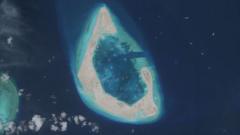
Between 2013 and 2017, China created more than 3,200 acres of new land in the Spratly Islands. They didn't just claim reefs like Mischief Reef or Subi Reef; they dredged millions of tons of sand from the ocean floor, poured it over living coral, and paved it with concrete.
Today, those former reefs feature three-kilometer-long runways, radar arrays, missile shelters, and hangars capable of housing fighter jets. They are unsinkable aircraft carriers parked right in the center of international waters.
The legal world recoiled. In 2016, an international tribunal in The Hague ruled overwhelmingly against China’s historic claims, stating there was no legal basis for the Nine-Dash Line. It was a landmark victory for the Philippines, the country that brought the case.
It changed absolutely nothing on the water.
Beijing dismissed the ruling as a piece of wastepaper. The construction continued. The patrols intensified. The message was unmistakable: possession is ten-tenths of the law.
The Gray Zone and the Steel Fleet
But a nation cannot occupy an entire sea with concrete islands alone. To control millions of square kilometers of open water, you need an omnipresent force. Yet, using grey-hulled navy warships to enforce territorial claims is risky. It invites military escalation. It triggers mutual defense treaties, potentially dragging the United States into a kinetic conflict.
The solution was the creation of a ghost fleet.
To understand how this works, we have to look at the concept of "gray zone warfare." It is a deliberate strategy of aggression that stops just short of provoking a traditional military response.
Step onto the deck of a Philippine supply boat attempting to reach Second Thomas Shoal. The shoal is a submerged reef where a handful of Philippine marines live aboard the BRP Sierra Madre, a rusty, World War II-era tank landing ship that Manila intentionally grounded in 1999 to serve as a makeshift outpost. They are isolated, dependent on regular deliveries of food and fresh water.
The supply boat does not encounter the Chinese Navy. Instead, it is blocked by a swarm of large, metal-hulled commercial fishing trawlers.
These are not ordinary fishermen looking for a catch. This is the People’s Armed Forces Maritime Militia. They are state-subsidized, professionally trained, and equipped with satellite communications. They operate in tandem with the Chinese Coast Guard.
When the Philippine supply boat tries to pass, the tactics are brutal but non-lethal. The maritime militia ships block their path, executing dangerous maneuvers that risk collision. If that fails, the massive coast guard vessels blast the smaller wooden supply boats with high-pressure water cannons.
The water pressure is intense enough to shatter windshields, rip off boat railings, and injure crew members.
It is a agonizingly effective tactic. If the Philippines fires back, they are accused of starting a war. If they do nothing, their soldiers starve, the outpost falls, and another piece of the sea changes hands.
The psychological toll on the crews is immense. Sailors describe the sheer helplessness of facing a wall of steel hulls, knowing that a single miscalculation could plunge their families into a geopolitical firestorm.
The Technology of Disappearance
This scramble is not just fought with steel and water; it is fought with data. Or rather, the manipulation of it.
Every modern vessel above a certain size is required to carry an Automatic Identification System, or AIS. It broadcasts the ship’s identity, position, speed, and heading to ensure safety at sea and prevent collisions. It is the digital footprint that keeps the oceans transparent.
In the South China Sea, those footprints are vanishing.
Over the past few years, a phenomenon known as "dark shipping" has become the norm. Vessels belonging to the maritime militia and coast guard frequently turn off their AIS transponders when entering disputed zones. They become digital ghosts, invisible to standard civilian monitoring systems.
Even more unsettling is the rise of AIS spoofing. Analysts tracking ships via satellite data have documented instances where a vessel's coordinates place it hundreds of miles away on dry land, or show it circling in impossible, geometric patterns, while physical observers confirm the ship is actually anchored next to a contested reef.
The ocean becomes a house of mirrors. For smaller nations trying to monitor their sovereign waters, this digital camouflage makes defense nearly impossible. They cannot counter a threat they cannot reliably track. They are forced to rely on expensive commercial satellite imagery, which only provides a snapshot in time, while the reality on the water changes minute by minute.
The Shrinking Commons
The consequences of this grab-what-you-can reality extend far beyond military strategy. They hit the dinner tables of Southeast Asia first.
The South China Sea accounts for roughly 12 percent of the global fish catch. Millions of people in Vietnam, the Philippines, Indonesia, and China rely on these waters for their livelihood and their primary source of protein.
But the geopolitical scramble has created an environmental tragedy.
To build those artificial islands, millions of tons of coral reef were pulverized, destroying critical spawning grounds for regional fish stocks. Furthermore, the constant presence of hundreds of maritime militia vessels, anchored for months at a time over disputed shoals, has led to massive overfishing and habitat destruction.
Fishermen are being pushed out of their traditional grounds by intimidation. When Linh is forced to steer his boat away from his usual reefs, he has two choices: venture further out into dangerous, deep waters his boat wasn't built for, or crowd into the narrow coastal strips that are already overfished.
"The sea used to feed us," Linh says, his voice quiet over the low hum of his engine. "Now, we are treated like thieves in our own backyard."
This is the hidden cost of the conflict. It is the slow destruction of a shared ecological resource by nations too focused on sovereignty to care about sustainability. The fish do not recognize the Nine-Dash Line, but they are dying because of it.
The Cost of Compliance
What happens when the world accepts this new reality?
Smaller nations face an existential choice. They can resist, risking economic retaliation or outright military skirmishes with a superpower. Or they can adapt, striking quiet deals to share resources, effectively validating the premise that might makes right.
Malaysia and Brunei have often chosen a quieter path, managing disputes through backchannels to protect their lucrative offshore oil and gas operations. The Philippines, under different administrations, has swung wildly between fiery resistance and accommodating appeasement.
But every compromise chips away at the framework of international rules that has prevented global conflict since the end of World War II. If the rules do not apply in the South China Sea, why should they apply anywhere else?
The United States and its allies attempt to push back by conducting Freedom of Navigation Operations. They sail multi-billion-dollar guided-missile destroyers through the disputed waters, asserting that these are international seas.
These operations are tense. US warships are routinely shadowed by Chinese vessels, with both sides trading warnings over radio frequencies.
"You are entering our territorial waters. Leave immediately," the Chinese operator warns.
"I am a United States United States Navy warship operating in international waters in accordance with international law," the American bridge officer responds.
It is a scripted dance performed by two nuclear-armed powers. But as the crowded waters grow more militarized, the margin for error shrinks to nothing. A single steering failure, a misunderstood command, or an overzealous captain could turn a routine patrol into an international crisis.
The sky in the east begins to turn a bruised purple. The white lights of the Chinese coast guard vessel remain fixed on the horizon, an artificial star that never sets.
Linh turns his boat back toward Da Nang. His hold is half-empty. He will make enough to cover the cost of the diesel, but not much more.
On the radar screen, the green sweep continues its endless circle, illuminating a blank expanse of water. The lines that statesmen argue over are invisible on the screen, just as they are invisible on the waves. But they are there, hardening like concrete under the tropical sun, reshaping the world one reef at a time.


