The upholstery on the private rail car smells faintly of old tobacco and damp wool, a scent that has lingered in the corridors of Eastern European diplomacy for the better part of a century. Outside the double-paned glass, the Birch forests of the Russian interior blur into a charcoal smudge against the falling snow. Inside, the air is dead quiet.
Steve Witkoff does not look at the snow. He looks at a digital tablet, scrolling through the same satellite imagery of shattered electrical substations for the fourth time this hour. Across the narrow mahogany table sits Jared Kushner, his expression fixed in that specific, unnatural stillness that comes from hours of listening to translators drone through existential threats. They have just left Moscow. They have just spent hours behind closed doors with Vladimir Putin. And now, the train is rattling its way south and west, carrying them toward the blacked-out platform of a Kyiv railway station that could vanish in a hypersonic flash if the air raid sirens decide to waken.
Wars do not end with a sudden flash of mutual understanding. They end in trains. They end in stale coffee, fluorescent-lit bunkers, and the exhaustion of men who have run out of calculus.
To understand what happened in those rooms behind the Kremlin walls, you have to strip away the wire service updates that reduce human catastrophe to bullet points. The official dispatches tell you only what the state wants you to know: that high-level envoys have arrived in the Ukrainian capital following intense consultations in the Russian seat of power. They speak of diplomatic channels, strategic alignments, and peace frameworks. But diplomacy at this altitude is not an exchange of polished documents. It is a game of staring across a precipice while the ground crumbles beneath your heels.
Consider what happens in the mind of an envoy walking down a Kremlin corridor. The ceilings are high, the gold leaf is heavy, and the silence is absolute. You are stepping on carpets that have absorbed the footsteps of tsars, commissars, and oligarchs. When Putin leans forward across a heavy oak desk, his voice drops to that measured, flat register that doesn't threaten—it simply states physics. He outlines the red lines not as political preferences, but as immutable laws of nature, as immovable as the Ural mountains. He tells you what cannot be given up, what cannot be forgiven, and what will burn before it is surrendered.
And then you nod. You take notes. You translate the coldness back into the language of American pragmatism, searching for the hidden pressure point. Real estate deals teach you how to find the single brick that holds up the arch. Geopolitics teaches you that the entire building is already on fire, and you are just arguing over who gets to keep the ashes.
Hours later, the train crosses an invisible line. The snow looks the same. The grey sky looks the same. But the weight in the air changes.
In Kyiv, the architecture is different. It is neoclassical mixed with Soviet utilitarianism, now punctuated by sandbags, anti-tank hedgehogs, and the jagged, tooth-like ruins of apartment blocks that caught a stray drone three weeks ago. When Witkoff and Kushner step off the train, they are met not by a velvet-lined reception, but by the sharp, crisp wind blowing off the Dnipro River and the immediate, low-frequency thrum of generators keeping a fractured city alive.
Here, the human element is visceral. I remember standing in a kitchen in Podil last winter, watching an elderly woman named Halyna boil water on a camping stove while her granddaughter tried to do math homework by the flickering glow of a single battery-powered LED strip. There were no grand geopolitical theories in that room. There was only the sound of the wind, the biting chill of a radiator that had been cold for days, and the quiet, crushing dignity of a people refusing to be erased by geography.
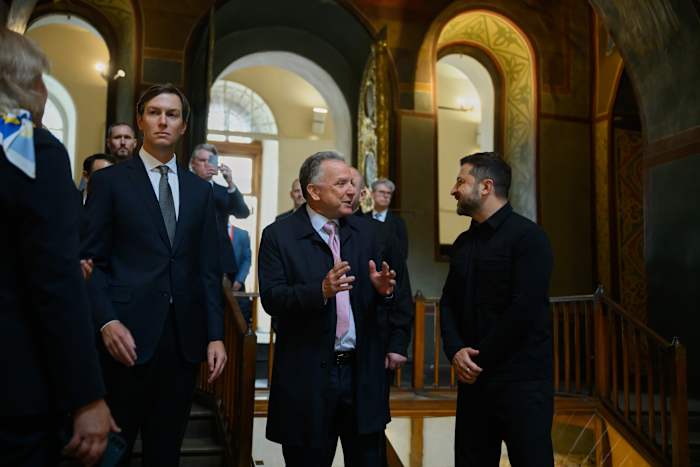
When the envoys sit down with Ukrainian leadership in Kyiv, they are sitting with people who carry that kitchen in their minds.
President Volodymyr Zelenskyy does not wear a suit anymore. The green fleece has become the uniform of a nation suspended between survival and annihilation. When he speaks to American intermediaries, his arguments are not framed in abstract diplomatic terminology; they are measured in the lives of eighteen-year-old conscripts holding frozen trenches near Bakhmut, in the tonnage of grain rotting in silos because the Black Sea is a maritime minefield, in the number of children who sleep in subterranean metro stations every time the air raid sirens wail.
There is a profound, jarring dissonance in moving between these two capitals in a single twenty-four-hour cycle. In Moscow, the war is an administrative project, a grand historical correction executed from velvet rooms. In Kyiv, the war is an ongoing funeral, an unyielding struggle for the right to exist without asking permission from an empire next door.
Yet, the men in the middle—the intermediaries shuttling between the opposing gravity wells—must pretend that a bridge can still be built across an ocean of blood.
What did Witkoff and Kushner actually trade in those rooms? Not treaties. Not yet. At this stage, diplomacy is an exercise in reality testing. It is about figuring out where the hard edges of each side's delusion meet the brick wall of facts on the ground.
Putin believes time is on his side. He calculates that Western fatigue will eventually outlast Ukrainian resilience, that the American political cycle will fracture the coalition, and that winter will do the work that artillery failed to accomplish. It is a coherent calculation, rooted in the cynical history of great power politics.
Zelenskyy and his commanders know this calculation well. Their counter-calculation is equally stark: if they stop fighting, they cease to exist. There is no middle ground between subjugation and sovereignty when one side defines your very language and culture as an historical error.
So what do envoys offer when compromise is a dirty word? They offer exits. They sketch out the contours of a settlement that allows both sides to save just enough face to stop the slaughter without admitting defeat. They talk about security guarantees that look like NATO without being NATO, economic corridors that look like peace without being justice, and territorial accommodations that will leave everyone furious and bleeding, which is usually the definition of a stable international border.
As the sun sets over the Dnipro, painting the horizon in bruised shades of purple and amber, the sirens begin to wail across Kyiv. It is a long, rising, mechanical howl that pierces through double-paned glass and settles directly in the marrow of your bones.
In a subterranean command post beneath the city, the maps glow under green and red indicator lights. Officers move small magnetic markers across topographical grids. Thousands of miles away, strategists in Washington look at polling data and fiscal budgets, wondering how much longer the ledger can balance. In Moscow, lights burn late in the Kremlin as analysts draft the next intelligence summary.
And on a train parked in the rail yards, or speeding back toward the Polish border, two American envoys close their briefing books. They stare out into the blackness of a continent split down the middle, knowing that the distance between a conversation in Moscow and a conversation in Kyiv is measured not in miles, but in the unmeasurable weight of human grief.